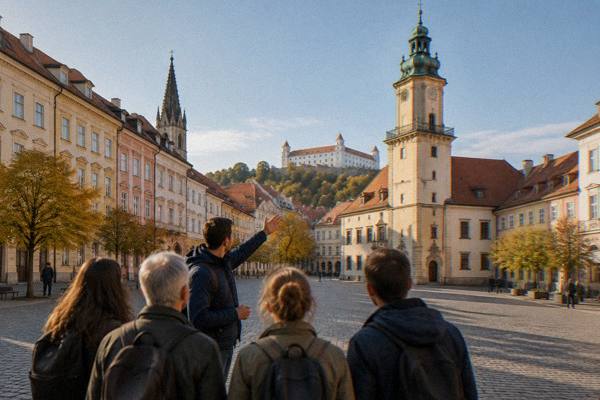
Prague To Bratislava By Train And Bus
Prague and Bratislava sit at opposite ends of one small country pair, and rail and coach services link them through the Slovak and Czech networks. This page covers how the journey works, which Bratislava station you arrive at, and what the city itself costs once you step off the train.
Short answer
Direct trains and long-distance coaches both run between Prague and Bratislava. Trains arrive at Bratislava hlavná stanica, where engineering works until 12 December 2026 reroute some suburban lines; coaches arrive at the city's bus station. Book times and fares direct with the rail and coach operators before travel.
Prague to Bratislava is one of Central Europe's straightforward capital-to-capital runs: Slovakia's capital, an inland city of about 468,000 residents on the Danube, is reached from the Czech capital by both rail and long-distance coach, with tickets sold by the train and bus operators themselves. This page is the Bratislava Travel Guide's desk summary of how the connection works in practice, which stations you arrive at, what changes during the autumn 2026 engineering works around the main station, and what the city costs once you are there, from the 1.20 EUR bus single to the 14 EUR castle museum ticket. Times and fares for the Prague leg itself are set by the carriers and change with the timetable, so the booking always happens at the operator.
What Are Your Options For Prague To Bratislava By Train And Bus?
Both a rail service and a coach service connect Prague with Bratislava, and neither requires routing through a third capital. Trains run into Bratislava hlavná stanica, the city's main station, and long-distance coaches arrive at the Bratislava bus station, from where the city's tram and trolleybus network takes over. Fares and exact journey times belong to the carriers and the timetable of the day, so the operators' own sales channels print the live figures.
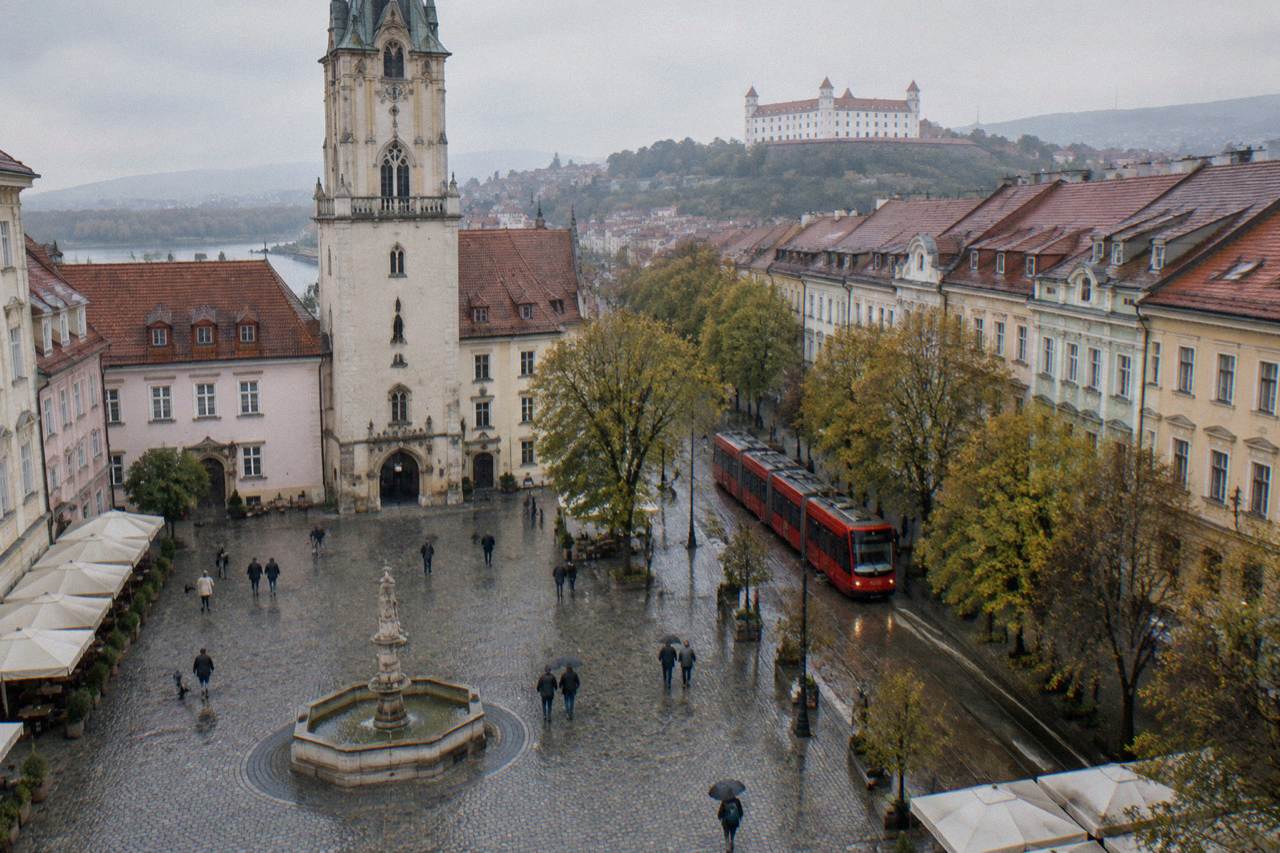
Regional and long-distance services between the two capitals exist and are bookable, and the practical decision is usually about where in Bratislava you want to surface, not whether a seat exists. The train delivers you to the main station, which sits at the edge of the Old Town walk. The coach delivers you to the bus station, which is itself on a tram line. Both arrival points are inside the IDS BK public transport zones 100 and 101, where a 60-minute paper single costs 1.80 EUR, so the last mile of either option costs about the same as a coffee.
One thing worth checking before locking a date: engineering works around Bratislava's main station run from 1 September to 12 December 2026, and while the station itself stays open, some suburban lines are affected. Nothing on the Prague route is cancelled, but a traveller connecting onward the same day should read the Bratislava train station guide before planning a tight transfer. The wider question of how all approaches to the city compare, including the Vienna and Budapest routes, is covered in the how to get to Bratislava guide.
For comparison, the Vienna connection is the one with fully published figures: the REX8 runs hourly from Vienna Hbf to Bratislava hlavná stanica in 56 minutes for about 12.70 EUR, a useful benchmark when weighing whether to break a Prague journey in Vienna. That routing, and whether a through ticket beats a split one, is unpacked in the Vienna to Bratislava guide.
Where Does The Train From Prague Arrive In Bratislava?
Trains from Prague arrive at Bratislava hlavná stanica, the city's main railway station, which stays open throughout the autumn 2026 engineering works even though the S50 line is cut back to Bratislava-Nove Mesto and the R55 to Trnava is cancelled until 12 December 2026. The station sits within walking reach of the Old Town and on trunk public transport lines, including bus 61 to the airport.
The engineering works are the single most useful thing an autumn 2026 arrival can know. Between 1 September and 12 December 2026, the S50 suburban trains start and end at Bratislava-Nove Mesto on an hourly pattern, and the R55 service between Bratislava and Trnava is cancelled outright, with the main station remaining open throughout. Anyone whose Prague itinerary continues westward to Vienna or eastward on regional lines should check the operator's travel updates for the specific travel day.
From the station forecourt the city is simple. The Old Town is a walk downhill, the castle is a climb beyond it, and the airport is about 25 to 30 minutes away on bus 61, with the N61 night bus covering the same route overnight. A single ticket for zones 100 and 101 covers all of it: 1.20 EUR for 30 minutes on paper, 1.09 EUR on the app. The full local network, including the new trolleybus line 32 that replaced bus 64 from 3 October 2026, is detailed in the Bratislava public transport guide.
Prefer to arrive by air instead? Book a flight to Bratislava here.
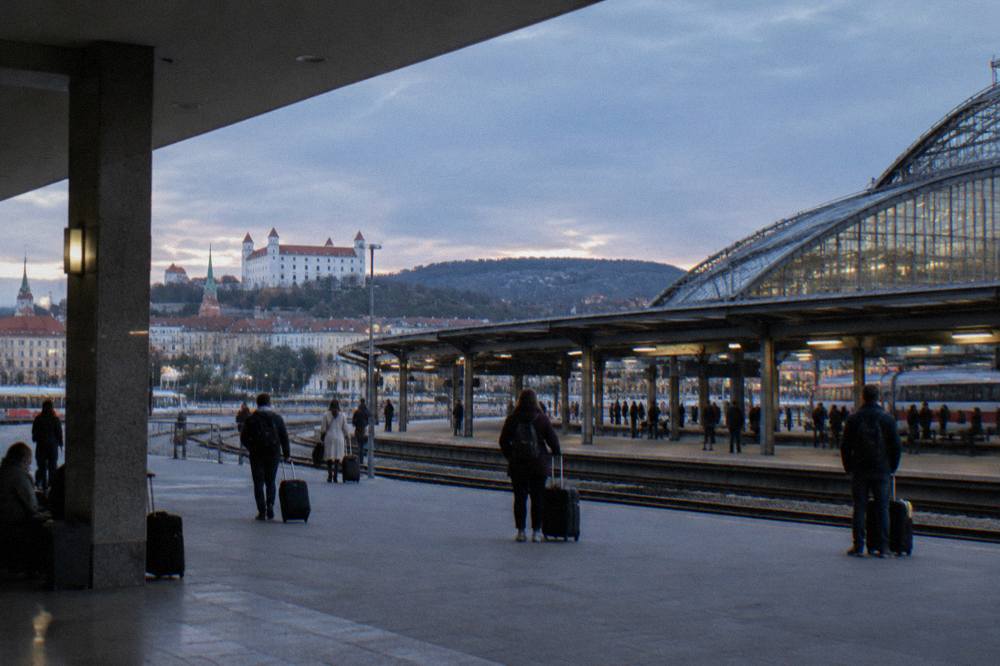
A note on the arrival walk: the station area is itself a district with its own character, covered in the site's station-area guide, and the walk to the Old Town passes it in about twenty minutes on flat ground. Travellers with luggage, or anyone arriving after dark, will do better buying a 60-minute single (1.80 EUR paper, 1.60 EUR app) and riding a tram or trolleybus into the centre rather than walking.
What Does Local Transport Cost Once You Arrive In Bratislava?
A 30-minute single on Bratislava's IDS BK network costs 1.20 EUR on paper or 1.09 EUR on the app in zones 100 and 101, a 60-minute single costs 1.80 EUR, and a 24-hour paper day ticket costs 5.40 EUR, with app day tickets cheaper at 4.85 EUR.
The fare table is short enough to memorise, which is the point. Everything a visitor needs inside the city sits in two tariff zones:
| IDS BK ticket (zones 100+101) | Full price | Reduced |
|---|---|---|
| Paper single, 30 min | 1.20 EUR | 0.60 EUR |
| Paper single, 60 min | 1.80 EUR | 0.90 EUR |
| Paper single, 3 zones, 90 min | 2.40 EUR | - |
| App/eTicket single, 60 min | 1.60 EUR | 0.80 EUR |
| Paper day ticket, 24 h | 5.40 EUR | 2.70 EUR |
| Paper day ticket, 72 h | 10.70 EUR | 5.35 EUR |
| App day ticket, 24 h | 4.85 EUR | - |
| App day ticket, 72 h | 9.68 EUR | - |
| App day ticket, 168 h | 16.20 EUR | 8.10 EUR |
Two practical notes sit beside the table. Second, the Bratislava CARD bundles unlimited transport across all IDS BK zones with free entry to 23 sights: 30 EUR for 24 hours, 36 EUR for 48 hours and 39 EUR for 72 hours, with one child under 18 travelling free with the holder and a free daily 14:00 walking tour of the historic centre included. For a first-time arrival planning a heavy museum day, the card and a 72-hour paper ticket are close on price, and the card's sight list decides it.
What Should You Do On Your First Day In Bratislava?
The practical first day is the Old Town on foot in the morning, Bratislava Castle after it, and one viewpoint at dusk: the castle grounds are free and open daily 08:00 to 22:00, the Museum of History inside costs 14 EUR and is closed Tuesdays, and the UFO observation deck on the SNP bridge is open daily 10:00 to 23:00 at 11.50 to 12.50 EUR. Everything named sits inside a walkable radius.
Bratislava's centre rewards arrival day precisely because it is compact and pedestrian. The Old Town's two squares, Hlavné námestie and Hviezdoslavovo námestie, anchor the walkable core, and the castle above it is a climb rather than a commute. The desk's suggested shape for a one-day visit is laid out step by step in the Bratislava in one day guide, and anyone stretching to a second and third day will find the sequencing in the two-day and three-day itineraries on the same site.
The sight list below is priced from the operators' own pages:
| Sight | Admission | Hours | Closed |
|---|---|---|---|
| Bratislava Castle grounds | Free | Daily 08:00 to 22:00 | Never |
| Castle Museum of History | 14 EUR | 10:00 to 18:00, last entry 17:00 | Tuesdays |
| Devin Castle (summer, Apr to Oct) | 8 EUR | 10:00 to 17:00 or later by month | Mondays |
| Devin Castle (winter, Nov to Mar) | 6 EUR | 10:00 to 16:00, last entry 15:15 | Mondays |
| St Martin's Cathedral tourist zone | 5 EUR | Mon to Sat 09:00 to 18:00, break 11:30 to 13:00 | Sunday mornings |
| Old Town Hall and Apponyi Palace | 8 EUR | 10:00 to 18:00 | Mondays |
| Old Town Hall tower | 4 EUR | As museum | Mondays |
| Michael's Tower | 6 EUR | 10:00 to 18:00 | Tuesdays |
| Primate's Palace | 5 EUR | 10:00 to 17:00 (posted weekly) | Mondays |
| UFO observation deck | 11.50 to 12.50 EUR | Daily 10:00 to 23:00 | Never |
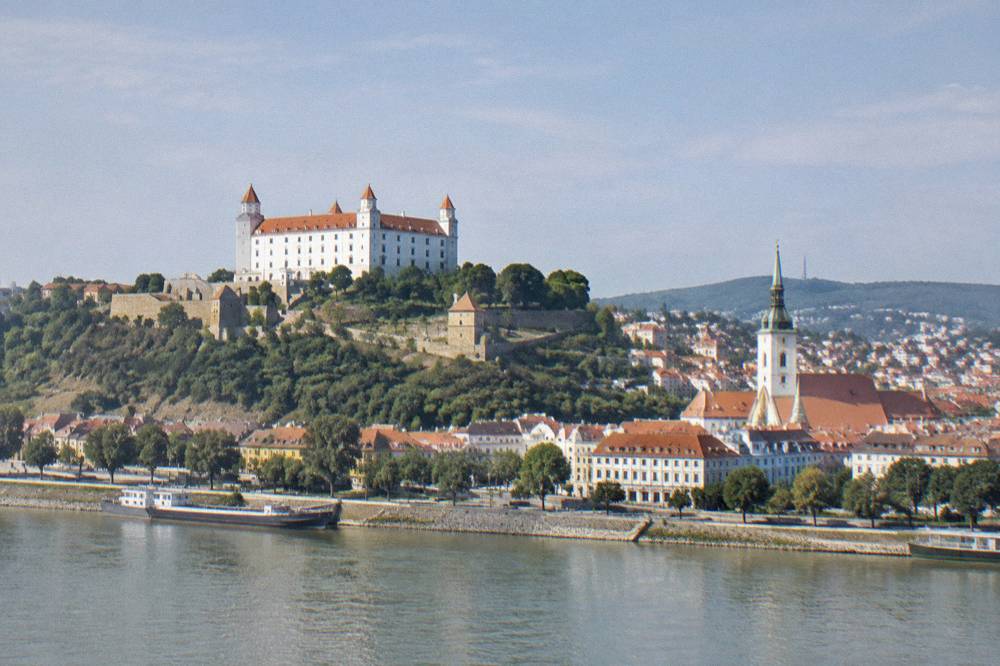
The Tuesday trap catches arrivals: the castle museum and Michael's Tower both close on Tuesdays, while the Old Town Hall is the one that closes on Mondays. Plan the castle for any day but Tuesday, or content yourself with the free grounds, which stay open to 22:00 year-round and carry the view over the Danube and the Petržalka housing estates opposite. Devin Castle, the riverside ruin at the city's western edge, is the day-trip exception: it stays open all winter, Tuesday to Sunday, and a round-trip river cruise is one of the relaxed ways to reach it, as the Devin day trip guide sets out.
Can You Break The Journey With A Stop In Between?
Splitting a Prague to Bratislava trip with a stop in Vienna is the classic move, because the Vienna to Bratislava leg is the best-documented rail link in the region: the REX8 runs hourly from Vienna Hbf to Bratislava in 56 minutes for about 12.70 EUR, and the Twin City Liner boat covers the same river corridor in about 75 minutes in high season. Brno and Trenčín also sit on the corridor if two stops appeal.
Vienna is the practical halfway house and the one with hard numbers. The REX8 reaches Bratislava hlavná stanica from Vienna Hbf hourly via Marchegg in 56 minutes, a timing that has held since the October 2025 electrification of the Marchegg route, and the parallel REX6 runs hourly to Bratislava-Petržalka via Bruck and Kittsee in 59 minutes. A same-day return ticket type sold for the corridor includes a Bratislava transport day, which pairs well with the stopover plan. Whether Vienna or Bratislava deserves the bigger share of a trip is the argument the Bratislava vs Prague comparison and the Vienna day trip from Bratislava guide each take up in detail.
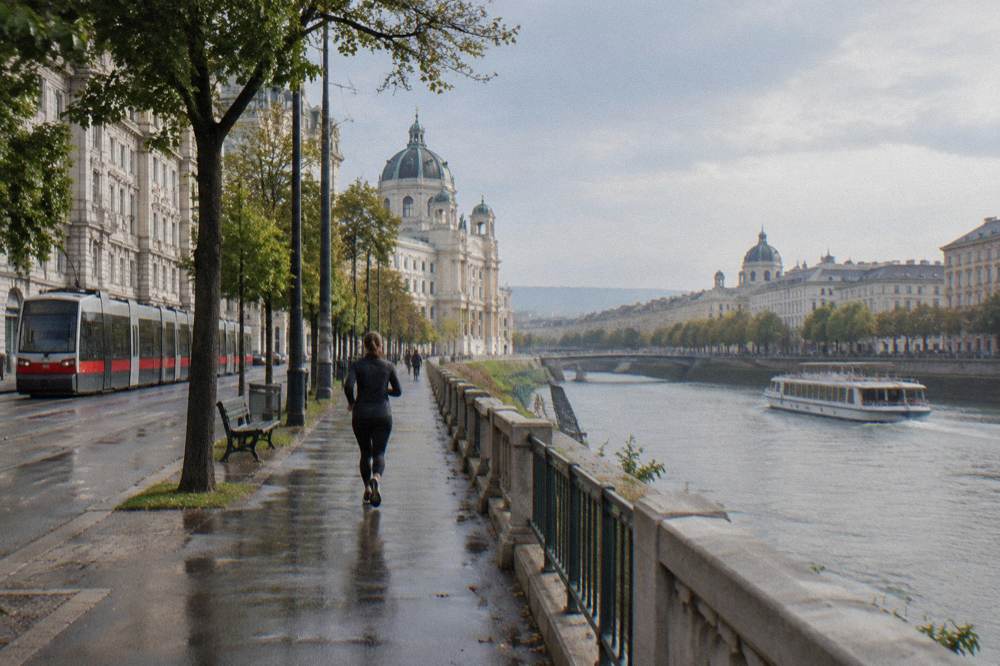
The boat is the scenic variant. Twin City Liner's 2026 season ran winter cruises from 7 February on weekends, opened fully on 20 March, ran three daily sailings each way from 1 May to 2 November, and continues with Advent trips Friday to Sunday from 27 November to 20 December 2026. The journey takes about 75 minutes, with economy one-way fares reported at about 34 to 39 EUR. It is slower and dearer than the train, and it is the version of the corridor travellers remember, which is a fair trade some days. The wider set of guides lives on Bratislava Travel Guide.
Is Bratislava Cheaper Than Prague Once You Arrive?
Bratislava prices in euros run from a 1.20 EUR bus single and a 4 EUR tower ticket up to the 14 EUR castle museum, and the city's tourist tax is 3.50 EUR per person per night in the Old Town and 3.00 EUR elsewhere, capped at 60 nights a year. Slovakia has used the euro since 1 January 2009, so there is no exchange arithmetic to do on arrival.
Comparing the two capitals honestly means comparing what is published, not what is remembered. On the Slovak side, the cost of a sightseeing day is modest: the four euro Old Town Hall tower, the five euro cathedral tourist zone and Primate's Palace, the six euro Michael's Tower, and the free tier that includes the castle grounds, the Blue Church and Slavín. The budget question, including where the money goes and how to keep a lid on it, has its own page in the Bratislava on a budget guide.
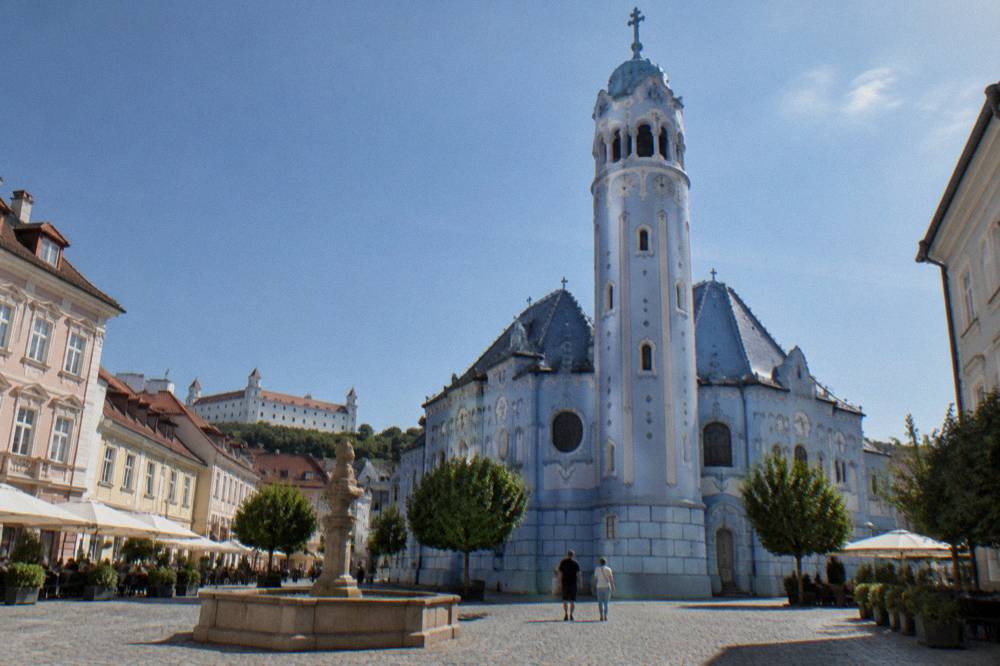
The free list is genuinely load-bearing. The Blue Church of St Elizabeth charges no entrance fee, with doors open for prayer on weekday mornings and evenings; Slavín, the memorial to the Red Army soldiers of April 1945, is an open-air site with no gate to price; and the castle grounds and Baroque Garden cost nothing, with the garden keeping seasonal hours, 09:00 to 16:00 in the November to February months and 09:00 to 21:00 at the June and July end of the year. The full no-cost itinerary is assembled in the free things to do in Bratislava guide.
What Is The Weather Like When You Step Off The Train?
Bratislava's modelled climate normals, ERA5 reanalysis for 1991 to 2020, put July's mean daily high at 26.3 C with 75.8 mm of rain and January's mean daily low at -3.1 C with 34.9 mm, with the year totalling about 641.5 mm of precipitation. These are reanalysis figures for a grid cell over the city, not a station record, and they frame what to pack for either end of the travel year.
The monthly picture, printed plainly:
| Month | Mean high C | Mean low C | Rain mm |
|---|---|---|---|
| Jan | 3.0 | -3.1 | 34.9 |
| Feb | 5.5 | -2.3 | 33.4 |
| Mar | 10.3 | 1.1 | 42.0 |
| Apr | 16.0 | 5.7 | 44.0 |
| May | 20.4 | 10.6 | 69.1 |
| Jun | 24.1 | 14.5 | 73.6 |
| Jul | 26.3 | 16.6 | 75.8 |
| Aug | 26.2 | 16.4 | 66.8 |
| Sep | 20.8 | 12.0 | 67.1 |
| Oct | 15.0 | 7.3 | 48.5 |
| Nov | 8.9 | 3.0 | 46.3 |
| Dec | 3.7 | -1.7 | 40.0 |
March through May carry mean highs from 10.3 C to 20.4 C and the spring months stay under 45 mm of rain, which is the window the best time to visit Bratislava guide builds its case around. July prints 75.8 mm of rain, the highest figure in the table, and June 73.6 mm, so summer visitors trade the warmest means for months that bring more rain. Winter arrivals, unpacked in the Bratislava in winter guide, get means around freezing at night and a city that keeps running: Devin Castle holds its Tuesday to Sunday winter hours, the castle grounds stay open to 22:00, and the Christmas market on Hlavné námestie runs from 26 November 2026 to 3 January 2027, closed only on 24 and 25 December, as the Bratislava Christmas market guide details.
Where Should You Sleep After A Long Train Ride?
The Old Town, Stare Mesto, is the arrival district that puts the walkable core on the doorstep, and it carries the city's higher tourist tax at 3.50 EUR per person per night against 3.00 EUR elsewhere, a levy capped at 60 nights per taxpayer per year. The station area, the riverfront near Eurovea and the leafy quarters behind the castle each trade convenience for quiet at different exchange rates.
The tax difference is small money on most stays, three and a half euros a night at most, but it is the one number that differs by district, so it makes a clean sorting key. The Old Town keeps everything within a flat walk of the squares and the cathedral. The riverfront around Eurovea pairs modern hotels with the Danube promenade. The station area is the zero-effort arrival choice for anyone stepping off a long train at night. The full neighbourhood-by-neighbourhood case, including the budget and hostel tiers, is in the where to stay in Bratislava guide.
What Can You Eat And Drink On Arrival Evening?
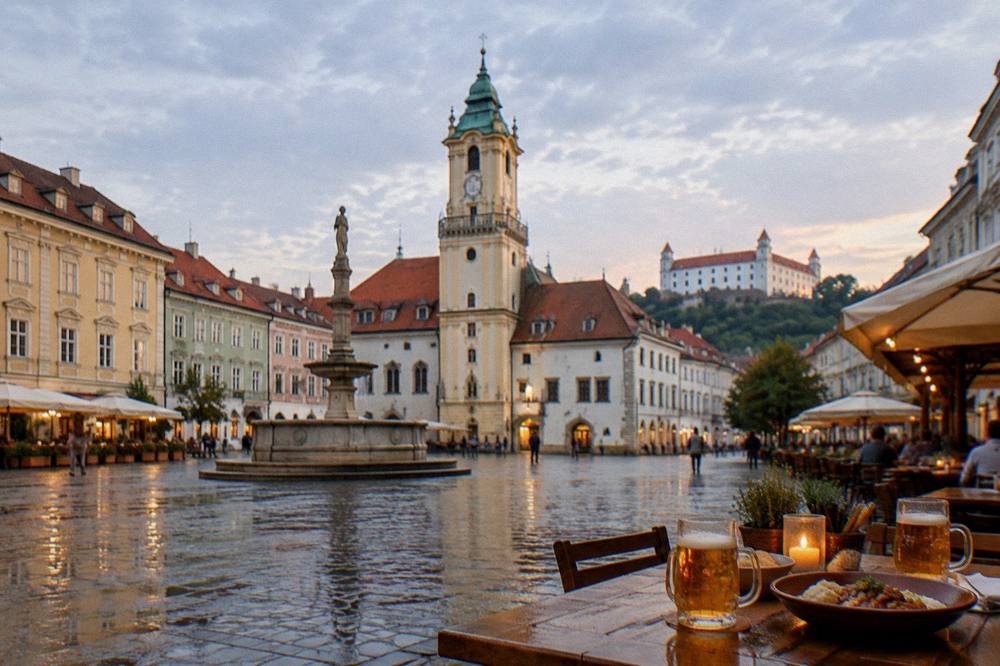
Bratislava's arrival-evening staples are the Slovak pub repertoire, and the city's beer halls and wine bars sit mostly inside the Old Town walk, with the Small Carpathians wine region beginning at the city's western edge and Slovaks marking St Martin's day on 11 November with the first young wine of the year. Tipping runs at a round-up or five to ten percent for good table service.
The desk's food coverage does the detail: what the city is actually known for on the plate is catalogued in the what to eat in Bratislava guide, the restaurant shortlists live in the best restaurants in Bratislava guide, and the beer culture, including where the brewing tradition and the pub crawl scene meet, fills the beer and pubs in Bratislava guide. For the wine angle, the Slovak varietals of the Small Carpathians have their own slovak wine guide, and the cellar villages of Modra and Pezinok are close enough to be a half-day.
How Does Bratislava Compare With Prague As A City Break?
Bratislava is the smaller capital, about 468,000 residents against Prague's well over a million, with a pedestrian Old Town that takes in its main sights on foot in a day, while Prague spreads across a wider river landscape and longer queues; the honest framing, which the site's dedicated comparison page argues in full, is that Bratislava compresses and Prague expands. A combined trip using the train link is the standard way to see both.
The compression is the argument for pairing them. Bratislava's castle, cathedral, squares, UFO deck and Danube bank form a single walkable circuit, its day trips run to Devin, the Small Carpathians wine villages and even Vienna, and its sight prices top out at the castle museum's 14 EUR. The full side-by-side, including the nightlife and food comparisons, sits in the which is better, Prague or Bratislava answer. Travellers doing the corridor in the other direction, or adding Budapest as a third capital, can follow the Bratislava to Vienna guide or the Budapest to Bratislava guide for the next leg.
Should You Book A Guided Tour For Your Arrival Day?
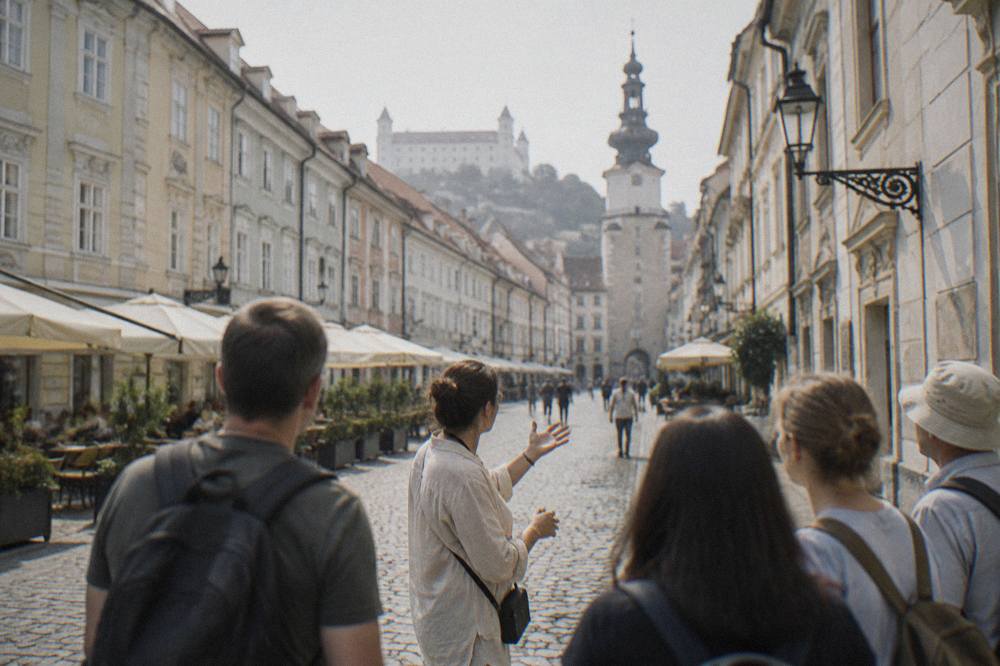
A guided walk is the fastest way for a same-day arrival to convert train legs into orientation, and Bratislava's roster includes a budget-fare Old Town and castle walk, a two-hour sightseeing walk, a guided walk bundled with a castle entry ticket, and a four-hour beer and food tour, all bookable with free cancellation on most listings. The desk's position is book the first morning, then go solo.
The logic is arithmetic. A first-time visitor arriving from Prague has typically spent the morning in transit and has one usable afternoon. A guided walk converts that afternoon into a mapped city, a set of restaurant names and the castle approach already learned, at a price the token blocks below print from current listing data. The craft-beer and food variants fold the evening meal into the same block of time. For travellers stretching into a second or third day, the guided roster widens to history walks on the communist era, bike and Segway circuits, and the river cruise to Devin Castle.
The day-trip tier deserves its own word. Slovakia's headline castles sit outside the capital, and the Bojnice Castle and Banská Štiavnica day trip from Bratislava is the desk's featured pick for a second-day escape, covering two of the country's major inland sights with transport and guiding handled. It pairs with the northern Slovakia and High Tatras day tours for travellers with a spare full day. Tickets and current pricing for the featured pick render on its own page and through the Check availability link in prose here, which is an affiliate link to the operator's live listing, not the castle's own site.
What Should You Know About Money, Tax And Practicalities In Bratislava?
Slovakia adopted the euro on 1 January 2009, so cash machines and cards in Bratislava work in EUR with no local currency to obtain; the emergency number is 112, with 158 for police and 155 for ambulance; tap water in the city is supplied from groundwater sources and disinfected only, per the water company's published quality data; and the tourist tax is 3.50 EUR per person per night in the Old Town, 3.00 EUR elsewhere.
The practical layer is thin by design. Bratislava is a Schengen city, the euro is the only currency a visitor handles, and the single most common arrival question, how the money works, is answered in the euro and money in Bratislava guide. Safety and street sense have their own page in the Bratislava safety guide. For the shopping angle, from malls to markets, the desk's coverage runs in the Bratislava shopping guide.
Common Questions About Prague To Bratislava Travel
Is there a direct train from Prague to Bratislava?
Rail services between the two capitals run as long-distance connections bookable through the train operators, and the live times and fares for your travel date print at the operator's own sales channels. On arrival, trains use Bratislava hlavná stanica, which stays open through the engineering works ending 12 December 2026.
How much does it cost to get from Prague to Bratislava?
The Prague leg's fare is set by the carrier and the booking date, so the operator prints it. The Bratislava end is fixed and cheap: a 30-minute single is 1.20 EUR on paper, a 24-hour day ticket 5.40 EUR, and the airport bus 61 uses the same tickets.
Is Bratislava worth visiting after Prague?
The two capitals compress differently: Prague spreads, Bratislava fits its castle, cathedral, squares and riverbank into a walkable circuit with sight prices from free grounds up to the 14 EUR castle museum. The desk's full side-by-side runs in the Bratislava vs Prague comparison on this site.
Can you fly from Prague to Bratislava instead?
Bratislava has its own airport, BTS, connected to the main station by bus 61 in about 25 to 30 minutes, and Vienna's larger airport is also used for Bratislava arrivals, about 70 minutes from Bratislava by direct coach from 7.90 EUR. The flight options are covered in the flights to Bratislava guide on this site.
Do you need a passport to travel from Prague to Bratislava?
Both cities are inside the Schengen Area, which Slovakia joined on 21 December 2007, so there are no routine border checks on the corridor. Carry a valid ID document, as border authorities retain the right to check within Schengen.
What is the best way to spend the first afternoon in Bratislava?
Walk the Old Town squares to the cathedral, climb to the castle grounds, which are free and open to 22:00 daily, and finish on the UFO deck, open to 23:00, or with a Slovak pub dinner. Avoid Tuesdays for the castle museum and Michael's Tower, both closed that day.
The corridor between the two capitals is short enough that the decision is rarely whether, but in what order and with how many nights given to each city. Bratislava's end of the run rewards the traveller who arrives with two facts in hand: the Tuesday closures that shape the sightseeing week, and the 1.20 EUR single that makes the whole city cheap to move around once the train has stopped.