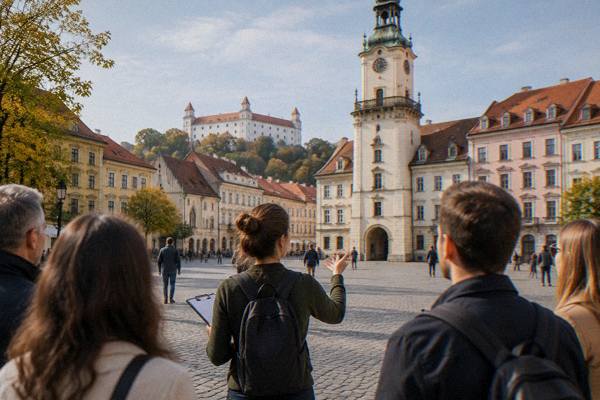
Is Bratislava A Walkable City?
Is Bratislava a walkable city? A sourced answer covering the pedestrian Old Town, the climb to Bratislava Castle, the districts where you need transport, and what a day on foot in Slovakia's capital really involves.
Bratislava, the capital of Slovakia, is a city of about 468,290 residents (24 June 2026, city figure) built around a pedestrian Old Town on the north bank of the Danube. The short answer for anyone asking on a forum: the historic centre is genuinely walkable in the sense that matters, small, largely car-free, and strung between two main squares, while anything beyond it, the castle hill included, turns into a question of legs, footwear and public transport. This page separates what a day on foot in Bratislava actually covers from what it does not, using the city's own published hours, fares and site information rather than impressions.
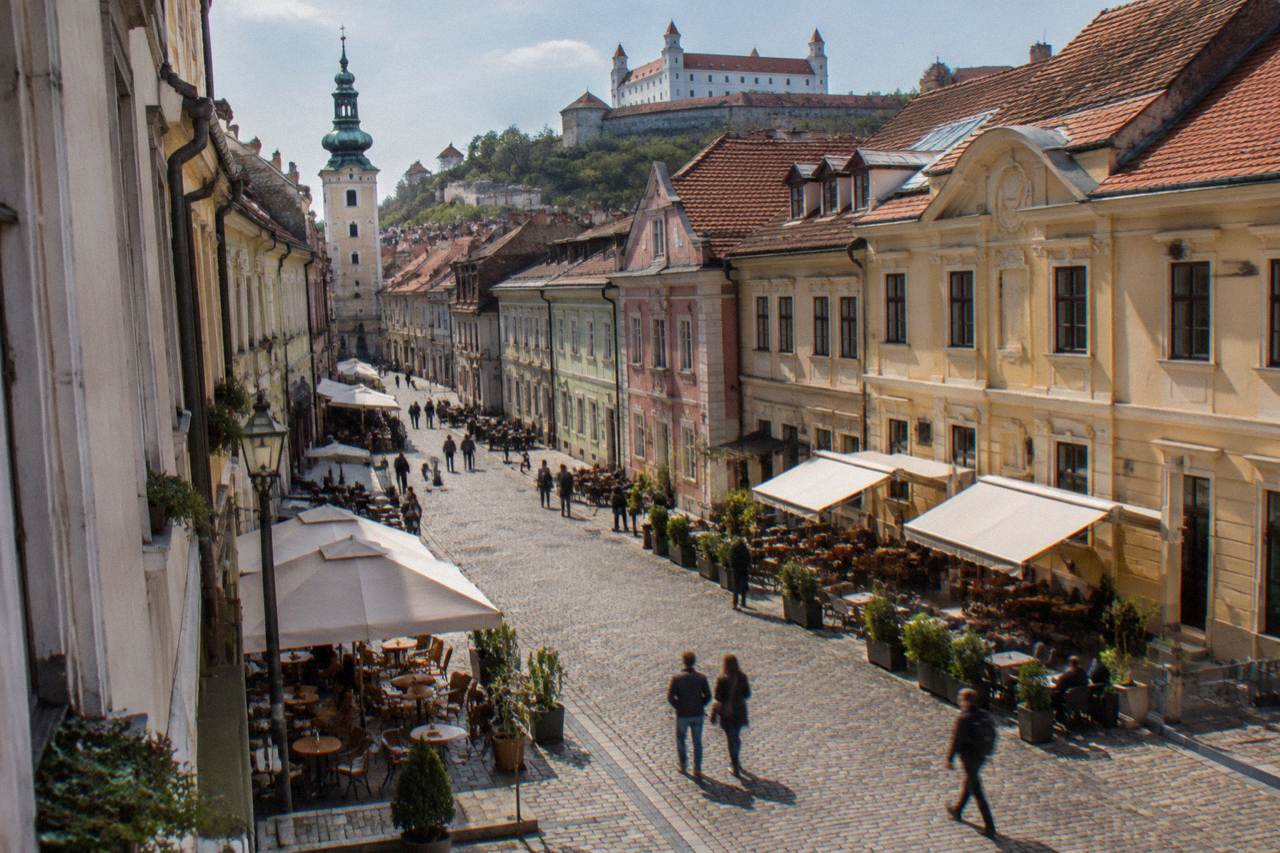
Yes, in its historic core: Bratislava's Old Town is a largely pedestrian district where the main sights, Hlavné námestie, Hviezdoslavovo námestie, Michael's Gate, Primate's Palace and St Martin's Cathedral, sit within a walkable band, and the castle grounds are open on foot daily from 08:00 to 22:00. Outside that core, walkability drops fast: the castle sits on a hill, the river cuts the city in two, and outer districts like Petržalka are transit territory rather than strolling territory.
The Old Town is designed around walking. Its squares and connecting streets form the part of the city where a car is more hindrance than help, and the cluster of sights around them is what gives Bratislava its reputation as an easy city to explore without planning a transport day. Whether the question is is Bratislava worth visiting or how many days to allow, the walkability of that core shapes almost every answer.
What the pedestrian zone does not include is the hill. Bratislava Castle stands above the Old Town, and the site's own pages frame the visit as a climb: the castle grounds are freely open daily 08:00 to 22:00 year-round, which rewards the walk at any hour, but the Museum of History inside keeps museum hours, 10:00 to 18:00 Wednesday to Monday, closed Tuesdays, last admission 17:00. A walker plans the castle like a hill excursion, not a square-to-square stroll.
For orientation, why Bratislava is famous largely comes down to that compact pairing of Old Town and castle, which is also why so many visitors, including day-trippers from Vienna, treat the city as a walking destination first. This Bratislava Travel Guide page breaks the question into its parts: where walking wins, where it loses, and what fills the gap.
How Walkable Is The Old Town Of Bratislava?
The Old Town of Bratislava is walkable by design: Hlavné námestie and Hviezdoslavovo námestie anchor a pedestrian core that contains Michael's Tower, the Old Town Hall, Primate's Palace and Cumil the sewer worker, with the Blue Church and St Martin's Cathedral on its edges, and every one of these sights keeps its own posted hours that a walker can chain into a single loop.
The practical spine of a walk is the sequence of sights and their published opening patterns. Michael's Tower, which houses the City Museum's exhibition, is open Monday and Wednesday to Sunday 10:00 to 18:00 and is closed on Tuesdays, admission 6 EUR general and 4 EUR reduced. The Old Town Hall, a few streets away on Hlavné námestie, runs the opposite week: open Tuesday to Sunday 10:00 to 18:00, closed Mondays, with combined Old Town Hall and Apponyi Palace admission at 8 EUR, and the tower separately at 4 EUR. The two closure days do not overlap, so on any given day at least one tower is open.
Primate's Palace posts its hours week by week on the city's own site: in the sample week of 12 to 18 October 2026 it listed Tuesday to Thursday, Saturday and Sunday 10:00 to 17:00, Friday 14:00 to 17:00, Monday closed, with standard admission 5 EUR and a free audio guide included. St Martin's Cathedral keeps tourist visiting hours around services: Monday to Saturday 09:00 to 18:00 with a break from 11:30 to 13:00, and Sunday from 13:00 to 16:30; the nave is free, and the tourist zone covering the treasury, crypts and gallery is 5 EUR.
| Sight In The Old Town | Hours (Posted) | Closed | Admission |
|---|---|---|---|
| Michael's Tower | Mon, Wed to Sun 10:00 to 18:00 | Tuesday | 6 EUR, reduced 4 EUR |
| Old Town Hall and Apponyi Palace | Tue to Sun 10:00 to 18:00 | Monday | 8 EUR, reduced 4 EUR, tower 4 EUR |
| Primate's Palace | Week of 12 to 18 Oct 2026: Tue to Thu, Sat, Sun 10:00 to 17:00, Fri 14:00 to 17:00 | Monday | 5 EUR, reduced 2.50 EUR |
| St Martin's Cathedral (tourist zone) | Mon to Sat 09:00 to 18:00, break 11:30 to 13:00, Sun 13:00 to 16:30 | None posted | Nave free, tourist zone 5 EUR |
| Blue Church (Church of St Elizabeth) | Mon, Tue, Wed, Sat 06:30 to 07:30, Thu and Fri 17:30 to 19:00, Sun 07:30 to 11:00 and 17:30 to 19:00 | None posted | Free |
The Blue Church row explains itself: the parish lists short interior opening windows for prayer and visits, with the exterior viewable at any time and no entrance fee, so walkers slot it between the longer museum stops. Cumil, the sewer worker statue, sits in the pedestrian streets and has no hours or fee at all, which makes it the most reliable sight on the list.
If you are pairing the walk with a guided version, the roster on this site includes several Old Town walking products, from budget-fare walks to private options, and the trio below covers the spread, including a family-friendly walk where children go free.
Where Does Walking Stop Working In Bratislava?
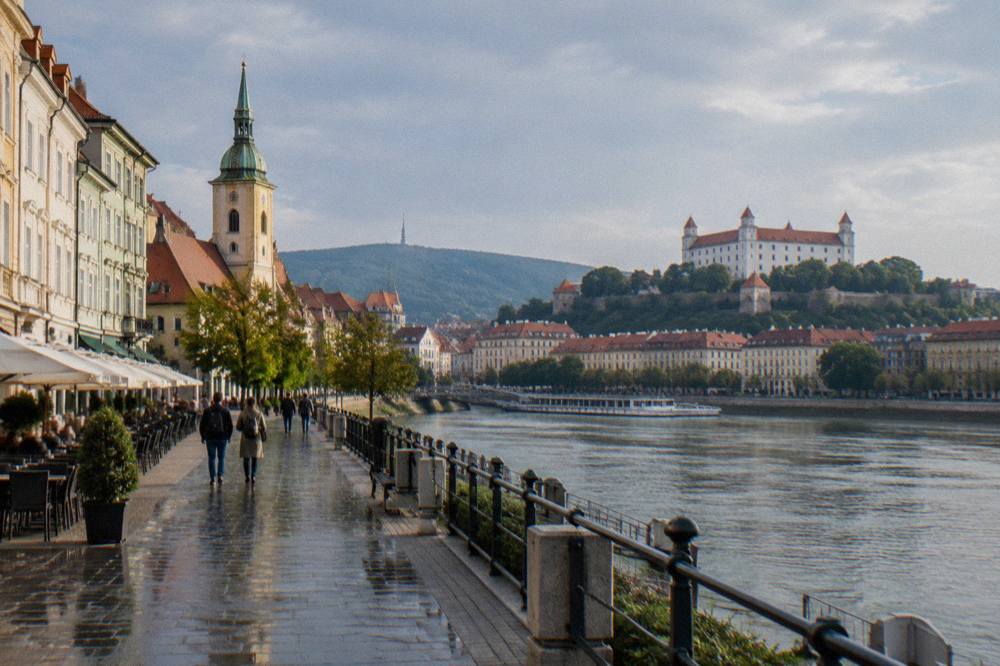
Walking stops being the practical mode in Bratislava beyond the Old Town and the riverfront: the climb to Bratislava Castle is a genuine ascent, Petržalka on the south bank is a residential district spread around transit stops rather than sight-to-sight strolling, and destinations like Devin Castle, Kamzík, the Danubiana museum and the Small Carpathians wine villages are day-trip distances reached by boat, bus or tour.
The castle is the boundary case. Its grounds are free and open 08:00 to 22:00 daily, and the Baroque Garden keeps seasonal hours from 09:00 to 16:00 in January, February, November and December up to 09:00 to 21:00 in June and July, so the hill rewards walkers across the year. But the site's own pages list an underground garage at 3 EUR per hour with a 50 percent museum-visitor discount, a signal that the city expects many visitors to arrive by car rather than on foot. The site overrides are blunt on this point: the Old Town is on foot, the castle is a climb.
Across the river, Petržalka is a different built environment, and the walkable itinerary pages on this site treat it as a district to understand rather than to tour sight by sight. The riverfront strip at Eurovea is pleasant walking, and the Sad Janka Kráľa park on the south bank is one of the listed green spaces, but these are promenade walks, not sight-dense sightseeing.
The far-flung sights make the point sharpest. Devin Castle at the Danube and Morava confluence keeps full castle hours, Tuesday to Sunday, 10:00 to 19:00 in June to August down to 10:00 to 16:00 in November to February, with admission 8 EUR in the April-to-October season and 6 EUR from November to March, but reaching it is a river-cruise or bus proposition. Kamzík, 439 m, with its TV tower and wooden view tower, and the Danubiana art museum on the Danube are likewise transit destinations, and Danubiana charges 12 EUR adult admission with free entry for children under six.
That is also why this page's featured product is not a walk at all but a day tour: the Čičmany, Bojnice, Orava and High Tatras day tour from Bratislava covers exactly the Slovakia that no amount of city walking reaches, and a walker who has finished the Old Town in a morning is the natural customer for it. You can Check availability alongside the Devin Castle guide if the far sights are the draw.
Do You Need Public Transport In Bratislava?
Yes, for anything beyond the Old Town, castle hill and the riverfront, and the IDS BK system is cheap: paper singles are 1.20 EUR for 30 minutes and 1.80 EUR for 60 minutes in zones 100 and 101, e-ticket singles are 1.09 and 1.60 EUR, and a paper 24-hour ticket is 5.40 EUR.
The tariff detail matters because walkability questions quickly become transport questions. The standing prices, in force since 1 June 2025, apply to the two-zone core that covers the areas a visitor walks or rides between. Day tickets in the same zones cost 10.70 EUR for 72 hours on paper, 9.68 EUR as an e-ticket, and the 168-hour e-ticket is 16.20 EUR basic.
| IDS BK Ticket (Zones 100 and 101) | Standing Price | Notes |
|---|---|---|
| Paper single, 30 minutes | 1.20 EUR | Reduced 0.60 EUR |
| Paper single, 60 minutes | 1.80 EUR | Reduced 0.90 EUR |
| Paper 24-hour ticket | 5.40 EUR | Reduced 2.70 EUR |
| eTicket 72-hour ticket | 9.68 EUR | Paper version 10.70 EUR |
| eTicket 168-hour ticket | 16.20 EUR | Reduced 8.10 EUR |
The airport sits inside this logic too: bus 61 links the airport with the main station in about 25 to 30 minutes, using the same zone 100 and 101 tickets, with the N61 night service covering the overnight hours. A traveller landing in Bratislava can therefore walk the Old Town, ride everything else on singles, and never think about a car. Cyclists have separate options, though the site's own research flags a distinction worth knowing: nextbike arrived in Bratislava in July 2026 as a commercial operator of roughly 500 bikes, separate from the long-running Slovnaft BAjk system, so the two are not interchangeable.
For the balance between walking and everything else, see how many days you need in Bratislava and, for the money side of a visit built on foot and single tickets, is Bratislava cheap or expensive.
Is Bratislava Easy To Walk For A Day-Tripper?
For a day-tripper arriving from Vienna, yes: Bratislava's walkable core is precisely what a single day covers, the Old Town's cluster of squares and sights plus the castle hill and the UFO observation deck on the bridge are all reachable without a local transit ticket, and the REX8 train from Vienna Hbf reaches Bratislava hl. st. in 56 minutes, so the walking starts almost on arrival.
The day-trip geometry is favourable. Vienna and Bratislava are among the closest capital-city pairs in Europe, connected by an hourly REX8 service with a 12.70 EUR one-way fare, and the city that greets the visitor is one where the station, the Old Town and the river fit into a day shaped entirely on foot. The UFO observation deck, standing on the Most SNP bridge, is open daily 10:00 to 23:00 with adult admission of 11.50 EUR on weekday mornings before 13:00 and 12.50 EUR at other times, so even the deck fits an evening walk back across the river.
The seasonal angles matter less here than the structural ones. Bratislava's climate normals, modelled ERA5 reanalysis for 1991 to 2020, put July's mean daily high at 26.3 C and January's mean daily low at -3.1 C, with July rainfall at 75.8 mm and February at 33.4 mm, so walking is a year-round activity with clothing adjustments rather than a summer-only one. The best month to visit Bratislava question gets its own page, but no month makes the Old Town unwalkable.
Day-trippers weighing the two capitals against each other can compare on which is nicer, Vienna or Bratislava, and the passport question for the crossing is answered on its own page. The walkability verdict stays the same either way: Bratislava rewards the pedestrian in a way few capital cities of its size manage.
Should You Take A Guided Walk Or Walk Bratislava Alone?
A guided walk earns its place in Bratislava when the walker wants the city's story attached to the streets: the Old Town is easy to navigate alone, every sight posts its own hours and prices, but the castle's history, the communist-era layers and the wine tradition sit in narrative rather than in signage, and the roster on this site spans everything from budget-fare group walks to private city-and-castle tours and, beyond the city, full-day trips into northern Slovakia.
To get the city's story attached to the streets, book an Old Town walking tour here.
The decision splits by depth. A solo walker with the table above can chain the sights efficiently, and the free experiences, the castle grounds, the Blue Church exterior, Cumil, the riverfront, give the day structure without spending anything. A guided product adds interpretation, and the choices run from a walk with castle entry included to a private tour with a named local guide, with the price and rating detail carried on each operator's live listing rather than typed here.
Beyond the city, the walking question inverts. The High Tatras, Orava Castle, Bojnice Castle and the painted village of Čičmany are the reason this page features a guided day tour rather than another walk, and travellers deciding whether to extend a Bratislava stay for them will find is the High Tatras worth visiting and the related is Bratislava a good base for day trips pages useful companions.
Common Questions About Walking In Bratislava
Is Bratislava A Walkable City?
Yes, in its historic core: the Old Town is a largely pedestrian district containing the main squares, Michael's Tower, the Old Town Hall, Primate's Palace and St Martin's Cathedral, and the castle grounds are open on foot daily 08:00 to 22:00. Beyond that core, the castle hill, the south bank and the outlying sights call for transport.
How Big Is Bratislava's Pedestrian Old Town?
The Old Town is compact enough that its main sights chain into a single walking loop: Hlavné námestie, Hviezdoslavovo námestie, Michael's Gate, the Old Town Hall, Primate's Palace, St Martin's Cathedral and the Blue Church all sit within it or on its edges, each with posted hours listed above.
Do You Need Shoes For The Castle In Bratislava?
The site's own setup says yes: Bratislava Castle stands above the Old Town, the grounds are open daily 08:00 to 22:00 year-round for free, and the site even operates an underground garage at 3 EUR per hour, a clear sign that not everyone arrives on foot. Treat the castle as a climb, not a stroll.
Can You Walk Across The Danube In Bratislava?
Yes, the Most SNP bridge carries the UFO observation deck, open daily 10:00 to 23:00, and the Eurovea riverfront and Sad Janka Kráľa park on the south bank are promenade walking. Petržalka beyond them is a residential district better covered by transit than on foot.
Is Everything In Bratislava Closed One Day A Week?
No single day closes everything, but the closure days differ: the castle's Museum of History and Michael's Tower close on Tuesdays, while the Old Town Hall and Primate's Palace close on Mondays, so at least one tower or hall is open any day of the week.
Can You Walk From Bratislava To Devin Castle?
Devin Castle is a day-trip destination at the Danube and Morava confluence, reached by river cruise or bus rather than a city walk, and it keeps its own hours, 10:00 to 16:00 in November to February and up to 10:00 to 19:00 in summer, closed Mondays, with admission of 8 EUR in season and 6 EUR from November to March.
The honest summary: Bratislava is a walkable city in the way that matters to a visitor, with a pedestrian core that holds a full day of sights, a castle hill that asks for effort and rewards it with free grounds until 22:00, and a cheap transit layer for everything the feet decline to cover.