Why Is Bratislava Famous?
Why Bratislava is famous: the castle on the hill, a coronation cathedral, a Danube setting, Soviet-era history and a Christmas market, with prices, hours and visitor figures.
Bratislava is Slovakia's capital, an inland city of about 468,000 residents on the Danube, and its fame rests on a surprisingly short list of things it does extremely well: a castle on a hill above the river, a cathedral tied to royal coronations, a pedestrian Old Town you can cross on foot, a layer of 20th-century history that is still visible in the streets, and a position close enough to Vienna that two capitals sit about an hour apart by train. This page sets out what made the city known rather than the folklore that collects around small capitals.
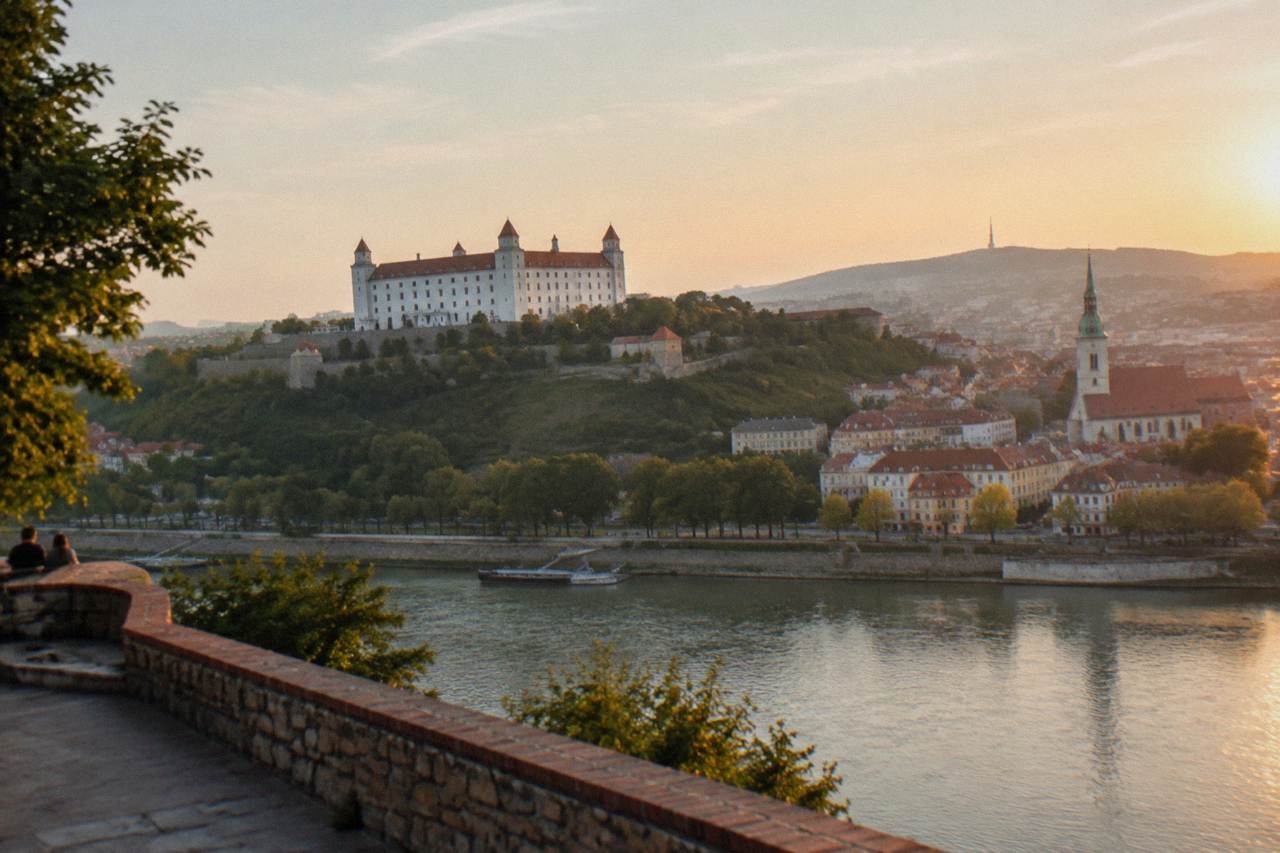
Bratislava is famous for Bratislava Castle and its hillside above the Danube, for St Martin's Cathedral, for a small pedestrian Old Town centred on Hlavné námestie, for a visible communist-era past, and for sitting about 56 minutes from Vienna by direct train. The city recorded 1,188,915 overnight visitors in 2024, and its castle museum charges EUR 14 admission, figures that frame how the city presents itself today.
Each of those claims can be pinned to a primary source. The visitor count comes from Statistical Office data reported by the Bratislava Tourist Board, and the castle price comes from the castle's own listing. The Vienna connection is a fixed fact of geography and timetables: the REX8 runs hourly from Vienna Hauptbahnhof to Bratislava hlavná stanica in 56 minutes, a ride electrified in October 2025.
What surprises many first-time visitors is scale. Bratislava is a capital where the historic core is genuinely walkable, the castle is a climb rather than a commute, and the whole ensemble sits against a river that also carries passenger boats to Vienna. The question of how many days you need in Bratislava usually resolves to two or three, which is part of the appeal.
What Is Bratislava Known For Around The World?
The five things Bratislava is known for are Bratislava Castle, St Martin's Cathedral with its coronation past, the UFO observation deck on the Most SNP bridge, the Slavín war memorial, and a compact Old Town whose squares, Hlavné námestie and Hviezdoslavovo námestie, host one of the region's long-running Christmas markets, running 26 November 2026 to 3 January 2027.
The castle is the city's signature image and its most-visited paid sight. The Slovak National Museum's Museum of History inside the castle charges EUR 14 for basic admission, opens 10:00 to 18:00 Wednesday to Monday, and closes on Tuesdays, while the castle grounds themselves are free and open daily 08:00 to 22:00 year-round. The grounds are the reason many photographs of the city exist at all.
The cathedral is the second pillar of the city's fame. St Martin's, on the edge of the Old Town below the castle, is where Hungarian kings were crowned during the years the coronations took place in Bratislava, and the tower is crowned with a gold replica of the royal crown. Tourists can visit the treasury, crypts and gallery for EUR 5, and the nave itself is free.
The rest of the list is more modern. The UFO, an observation deck and restaurant shaped like a saucer atop the Most SNP bridge pylon, charges EUR 11.50 to 12.50 depending on time of day. Slavín, a memorial and cemetery for 6,845 Soviet soldiers killed in the liberation of April 1945, was built between 1957 and 1960 and remains free to enter. And the Blue Church, the Church of St Elizabeth, charges nothing and is one of the most photographed buildings in the city.
| Sight | Adult price (EUR) | Opening pattern |
|---|---|---|
| Bratislava Castle, Museum of History | 14 | Wed to Mon 10:00 to 18:00, closed Tuesdays; grounds daily 08:00 to 22:00 |
| St Martin's Cathedral, tourist zone | 5 | Mon to Sat 09:00 to 18:00 with a break 11:30 to 13:00; Sun 13:00 to 16:30 |
| UFO observation deck | 11.50 to 12.50 | Daily 10:00 to 23:00 |
| Michael's Tower | 6 | Mon, Wed to Sun 10:00 to 18:00, closed Tuesdays |
| Primate's Palace | 5 | Tue to Sun 10:00 to 17:00, Fri from 14:00, closed Mondays |
| Slavín | free | Open-air memorial |
| Blue Church | free | Limited hours around services |
Those entries are the backbone of almost every list of what not to miss in Bratislava. Guided walks bundle several of them into a single morning, which is why walking tours are among the most-booked products in the city.
Why Is Bratislava Castle Famous As A Symbol?
Bratislava Castle is famous as the rectangular, four-towered silhouette that defines the city's skyline, standing on a hill directly above the Danube, with a museum of history run by the Slovak National Museum, free grounds open from 08:00 to 22:00 all year, and a Baroque Garden whose hours shift by month from 09:00 to 16:00 in winter to 09:00 to 21:00 in midsummer.
The castle's fame is partly geographic and partly political. It overlooks the river at the point where the city meets it, and it has served as a seat of power in successive eras of the country's history, which is why it appears on Slovak euro coins and in nearly every image used to promote the capital. A dedicated page on this site covers why Bratislava Castle is famous in detail.
Practical details matter here more than they do at most symbols, because the visiting pattern is unusual. The museum is closed on Tuesdays, not Mondays, a detail that catches out visitors who assume all state museums share a closing day. The Baroque Garden runs on its own seasonal clock, and the underground garage off Palisady charges EUR 3 per hour with a 50 percent discount for museum visitors. The Bratislava CARD covers museum admission entirely.
Why Is Bratislava Famous For Its Communist-Era History?
Bratislava is famous for a still-visible communist-era layer: the Slavín memorial to 6,845 Soviet soldiers, the Petržalka housing estate of panel blocks across the Danube, and the UFO bridge built in that period, now carrying a paying observation deck. Slovakia adopted the euro on 1 January 2009, and the country's 20th-century history has become one of the capital's main draws for guided tours.
History-themed walks are among the strongest-reviewed products in the city's tour roster, and the reason is physical. Unlike capitals that demolished or gentrified their 20th-century fabric, Bratislava kept it, so a route can move from a coronation cathedral to a war cemetery to a panel-block skyline inside one afternoon. The post-communism themed walks in the city's listings are consistently among the most reviewed products available.
The same history explains part of the city's international profile. Visitors comparing the region's capitals often arrive with a specific question about atmosphere and cost, covered on which is nicer, Vienna or Bratislava, and the honest answer involves both the Baroque Old Town and the concrete of Petržalka. For a fuller itinerary built around the period, see the site's page on whether Bratislava is worth visiting.
Why Is Bratislava Famous For Food And Wine?
Bratislava is famous as a food and wine destination because it sits at the foot of the Small Carpathians wine region, whose villages lie a short trip from the city, and because young Slovak wine is released each year on St Martin's Day, 11 November, when venues across the city pour it. Local costs are in euros, and the city's food tours and wine tastings are among its most-booked products.
The wine connection is unusually deep for a capital. The Small Carpathian wine route begins at the edge of the city, wine tasting in the dark is a genuinely local invention with two competing listings in the city's roster, and the 11 November release of mladé víno, young wine, gives the autumn a fixed date on the calendar. A dedicated page covers what food Bratislava is famous for, from hearty main courses to the pastries sold in the Old Town cafés.
For visitors weighing the budget, the city's cost profile is covered on is Bratislava cheap or expensive. Local prices that can be stated with certainty: the cathedral's tourist zone at EUR 5, the Old Town Hall exhibitions at EUR 8 with the tower at EUR 4, and a 30-minute public transport single at EUR 1.20 on paper or EUR 1.09 in the app, before any temporary promotion.
Why Is Bratislava Famous As A Stop Between Vienna And Budapest?
Bratislava is famous as the middle capital on the Vienna to Budapest axis: Vienna lies about 56 minutes away by hourly direct REX8 train at EUR 12.70 one-way, and the Twin City Liner boat connects the two river cities in about 75 minutes during its season, which in 2026 ran its high-season daily service to 2 November. This position is why day-trippers form a large share of the city's visitors.
The numbers explain the dynamic. Of the 1,188,915 overnight visitors recorded in 2024, 67 percent came from abroad, with Czechia, Germany, Poland, Austria and the United Kingdom the largest source markets. A city of 468,290 residents hosting well over a million overnight guests, with August the peak month at 116,171, is a city whose tourism is built on short stays and day trips. The site's page on whether Bratislava is worth a day trip from Vienna works through the timing in detail.
The practical consequence is that several bookable products in the city's roster start in Vienna, not Bratislava, and are labelled that way. Anyone booking should check where a product departs, because the two starting points produce very different days. Travellers coming the other direction can also use the boat, and there is a full page on the best way to get from Vienna to Bratislava.
| Connection | Journey time | Fare (EUR) | Notes |
|---|---|---|---|
| Vienna Hbf to Bratislava hl. st. (REX8) | 56 min | 12.70 one-way | Hourly, no reservation needed |
| Vienna Hbf to Bratislava-Petržalka (REX6) | 59 min | on the operators' sites | Hourly via Bruck/Kittsee |
| Twin City Liner boat | about 75 min | about 34 to 39 economy one-way | Seasonal; 2026 high season to 2 Nov |
| Slovak Lines Vienna city to Bratislava Airport | about 70 min | from 7.90 | Direct coach |
What Events Make Bratislava Famous?
Bratislava is famous for its main Christmas market on Hlavné námestie and Hviezdoslavovo námestie, which runs 26 November 2026 to 3 January 2027, and for Bratislava Jazz Days, whose 51st edition takes place 23 to 25 October 2026 at the Incheba Expo Arena. The Christmas market's tree lighting opens the season, and the market closes only on 24 and 25 December.
The Christmas market is the city's single biggest annual draw, organised by BKIS on behalf of the city, and its run past Christmas into early January is a scheduling detail visitors often miss: the market is still operating between Christmas and 3 January. This site tracks the dates on its best month to visit Bratislava page alongside the modelled climate normals.
The music calendar carries the rest of the year. The Bratislava Music Festival, the Slovak Philharmonic's festival, ran its 61st edition from 23 September to 11 October 2026, and the jazz festival follows in late October. For anyone planning around weather, the ERA5 reanalysis for Bratislava, 1991 to 2020, shows July averaging a mean daily high of 26.3 C and 75.8 mm of rain, and January a mean daily low of minus 3.1 C, figures that frame the two ends of the visiting year.
Is Bratislava Famous Enough To Plan A Trip Around?
Bratislava is famous enough that 1,188,915 people stayed overnight in 2024, and the city's own prices, EUR 14 castle museum entry, EUR 5 cathedral tourist zone and a free Slavín memorial, make a full day straightforward to plan. Two or three days cover the famous core, with the Small Carpathians wine villages or Devin Castle as the natural extensions, and Vienna an hour away by hourly train.
That is the honest scale of the city's fame. It is not a capital of imperial museums; it is a capital where the famous list is short, walkable and cheap by regional standards, and where the interesting material, coronations, communism, wine, sits within a kilometre or two of the main square. The Bratislava CARD, at EUR 30 for 24 hours with transport, bundles 23 sights including the castle museum and Devin Castle with unlimited public transport across all IDS BK zones.
Visitors with more time can use the city as a base. The northern Slovakia guided day tour from the city's roster reaches well beyond it in a single day, and the Bratislava Travel Guide covers those routes in depth. Before booking any guided product, Check availability on the operator's live listing for the day that suits.
Common Questions About Why Bratislava Is Famous
Why Is Bratislava Famous?
Bratislava is famous for Bratislava Castle above the Danube, St Martin's Cathedral and its coronation past, a compact pedestrian Old Town, its communist-era landmarks such as Slavín and Petržalka, and its position about an hour from Vienna by direct train.
Is Bratislava famous for anything modern?
Yes. The UFO observation deck on the Most SNP bridge, the Slavín memorial built 1957 to 1960 for 6,845 Soviet soldiers, and the Christmas market running 26 November 2026 to 3 January 2027 are all modern landmarks that draw visitors.
Is Bratislava famous for wine?
The city sits at the foot of the Small Carpathians wine region, and young Slovak wine is released each year on St Martin's Day, 11 November, when venues across the city pour it.
How many visitors does Bratislava get?
The city recorded 1,188,915 overnight visitors in 2024, an increase of 3.2 percent on 2023, with 67 percent arriving from abroad.
Is Bratislava walkable?
The Old Town is fully pedestrian and the castle is a climb from it; the details are covered on the site's page on whether Bratislava is a walkable city.