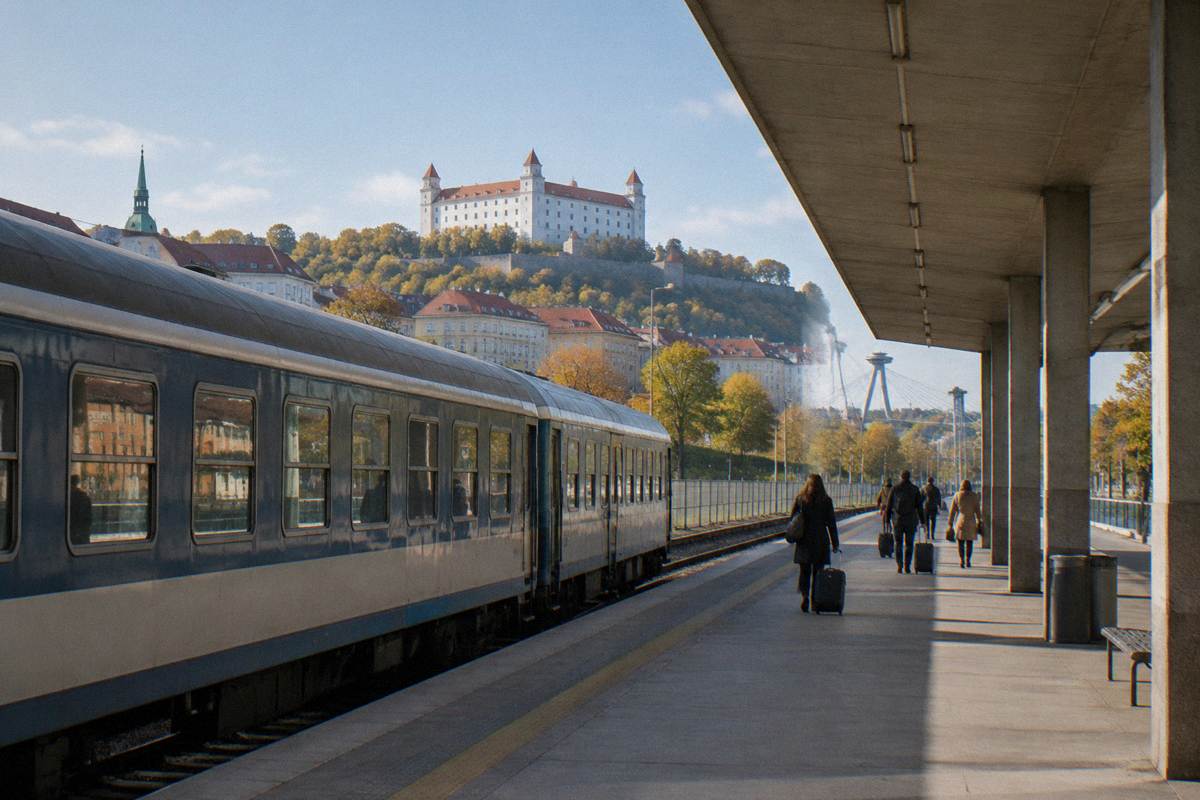
Vienna Day Trip From Bratislava: Trains, Timing And A Plan
Vienna sits about 55 km from Bratislava, and a direct REX8 train covers the distance in 56 minutes, which makes it the easiest big-city day trip available from the Slovak capital.
Short answer
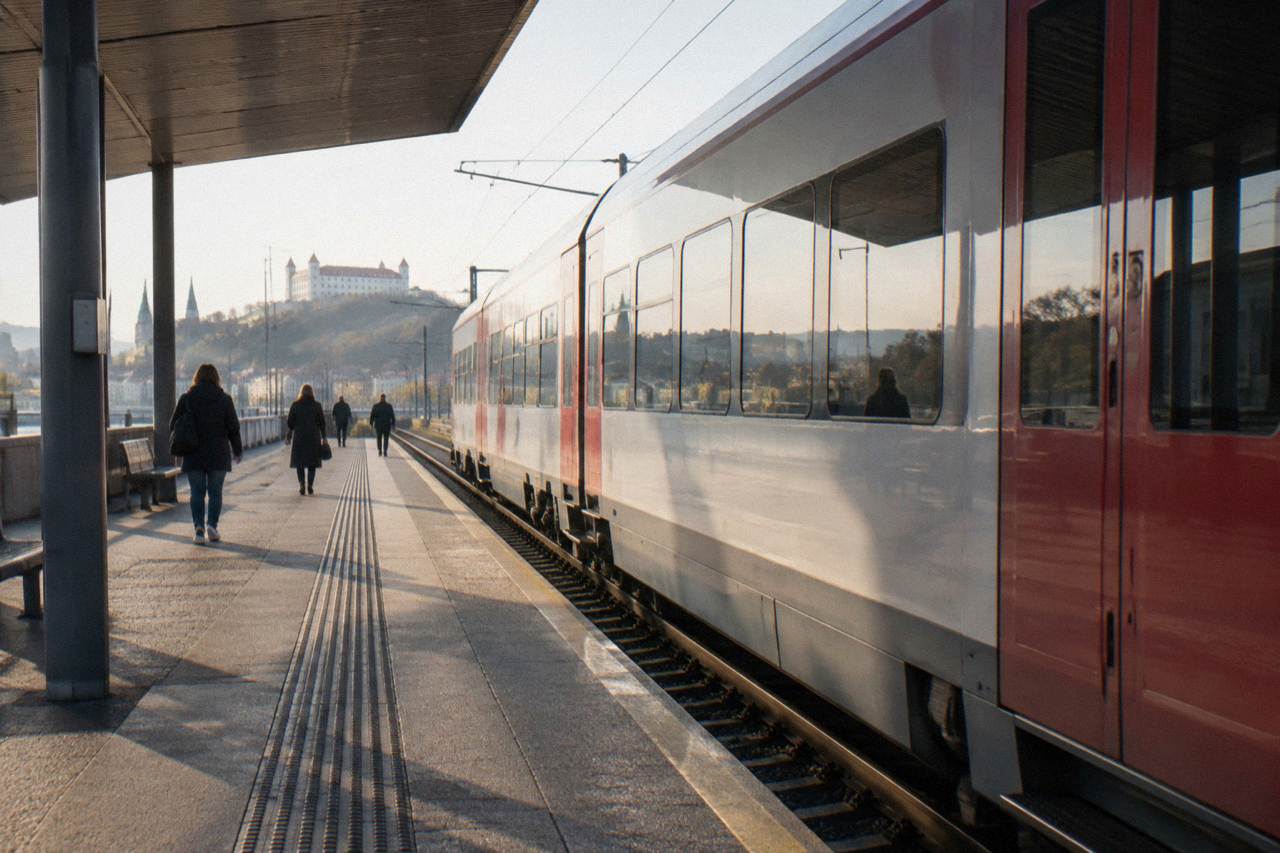
Take the hourly REX8 train from Bratislava hl. st. to Vienna Hbf, a 56-minute direct ride costing about EUR 12.70 one way. Leave early, return late, and plan one compact district rather than the whole city.
Vienna lies about 55 km from Bratislava, straight-line, and the two capitals are tied together by one of the tightest cross-border rail links in central Europe: a direct REX8 train that has run the Bratislava hl. st. to Vienna Hbf route in 56 minutes since the October 2025 electrification. That single number changes what a day trip means. A visitor based in Bratislava can breakfast on Hlavné námestie, spend a full daylight day in Vienna, and sleep back in Slovakia the same night, all on a standard regional ticket. The trains, the boat alternative, the costs, the passport question and a timing plan that respects how short a winter day actually is round out the practical details. The broader destination context lives on the Bratislava Travel Guide homepage.
How Do You Get From Bratislava To Vienna For A Day Trip?
The default answer is the train: the REX8 runs hourly from Bratislava hl. st. to Vienna Hbf via Marchegg, takes 56 minutes, and costs about EUR 12.70 one way, per the route's published details. A second rail option, the REX6, runs hourly to Bratislava-Petržalka from the Vienna side via Bruck and Kittsee in 59 minutes, and the Twin City Liner boat covers the river route in about 75 minutes in high season.
The REX8 is the workhorse. It departs the main station, Bratislava hl. st., roughly every hour and arrives directly at Wien Hbf, Vienna's principal station, with no change of train anywhere along the line. The fare of about EUR 12.70 one way is fixed and needs no reservation, and a return product marketed as the EuRegio or Bratislava Ticket costs about EUR 19 and includes a day of Bratislava public transport on the return side, which matters if the journey home ends with a tram ride to a hotel.
The REX6 matters in one specific case: it serves Bratislava-Petržalka rather than the main station, which sits on the opposite bank of the Danube in the southern part of the city. A traveller staying in Petržalka or the riverfront districts may find the REX6 station the closer departure point, at 59 minutes door to door on the same hourly cadence. Both routes are regional trains, so bicycles, luggage and walk-up tickets are normal parts of the setup.
One autumn 2026 wrinkle affects connections inside Slovakia, not the Vienna line itself. From 1 September to 12 December 2026, reconstruction work around Bratislava hl. st. means the S50 suburban train starts and ends at Bratislava-Nove Mesto instead, running hourly, and the R55 service to Trnava is cancelled outright. The main station itself stays open throughout, so Vienna trains are unaffected, but anyone planning a combined itinerary that touches Trnava or the Nove Mesto area should check the current timetables before committing. The details are laid out in the Bratislava train station guide.
Is There A Direct Train From Bratislava To Vienna?
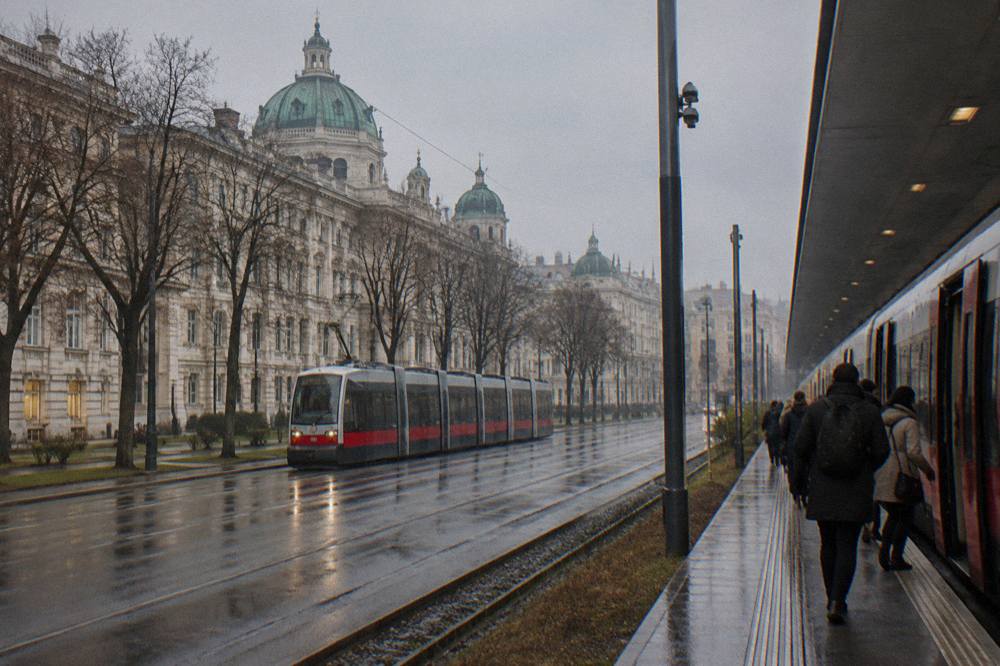
Yes, two direct services connect the cities with no transfer: the REX8 from Bratislava hl. st. to Vienna Hbf in 56 minutes, and the REX6 to and from Bratislava-Petržalka in 59 minutes, both running about hourly. No bus, tram or connection is needed at any point on either route, and both accept walk-up regional tickets.
The direct-train question is really a timing question, because hourly frequency means a missed departure costs a full hour of a short day. A day tripper who targets a Vienna arrival before 10:00 needs to be on a morning REX8 out of Bratislava hl. st. by roughly 09:00 at the latest, allowing for the 56-minute ride plus the walk from Vienna Hbf to the historic core. On the return side, the last evening departures from Vienna Hbf keep the day long, but the exact final departure time shifts with the timetable, so checking the day's schedule in the station or an app is part of the plan rather than an optional extra.
The direction of travel matters for readers arriving from the other side. The question "is there a direct train from Vienna to Bratislava" has the same answer in reverse, and it is answered in full on the direct train answer page, with the same REX8 and REX6 details. Day trippers from Vienna into Bratislava can read a complete arrival plan on the Vienna to Bratislava guide, and the whole comparison of the two cities as destinations is handled separately in Bratislava vs Vienna.
What Does The Vienna Day Trip Cost In Transport And Timing?
Budget about EUR 12.70 each way by train as the fixed single fare, while the EuRegio-style return at about EUR 19 adds a Bratislava transport day on the back end and undercuts the price of two separate singles. The boat costs more, with economy one-way fares reported at about EUR 34 to 39, and the day itself needs a minimum of 12 hours door to door to be worth the travel.
Transport is the cheap part of this trip. The table below pulls the numbers together.
| Option | Route | Time | Fare (EUR) | Frequency |
|---|---|---|---|---|
| REX8 train | Bratislava hl. st. to Vienna Hbf | 56 min | about 12.70 one way | hourly |
| REX6 train | Bratislava-Petržalka to Vienna | 59 min | regional fare | hourly |
| EuRegio return | Both cities, same day | 56 min each way | about 19 | daily validity |
| Twin City Liner boat | Central Vienna to central Bratislava | about 75 min | about 34 to 39 one way, economy | 3 daily each way, high season |
Note the boat fares carry a "reported" caveat: the schedule is drawn from the operator's ticketing page, but the per-class pricing is a secondary-source figure, so treat the range as a planning estimate and confirm at booking. The train fares are the fixed published singles, and the return product's transport inclusion is what makes it the better arithmetic for almost everyone: 19 EUR against the cost of two separate singles, plus a day of trams and buses back in Bratislava thrown in.
Timing arithmetic is the part first-time visitors get wrong. A 56-minute train ride is not a 56-minute trip. Add the walk or tram to Bratislava hl. st., the platform margin, the ride, and the transfer from Vienna Hbf into the centre, and the realistic door-to-city-centre budget is closer to two hours each way. That leaves roughly nine usable hours in Vienna on a summer departure and six or fewer on a deep-winter one, because the ERA5 reanalysis for Bratislava puts the December mean daily high at just 3.7 C and daylight is at its shortest. The same modelled normals put July at a 26.3 C mean high with 75.8 mm of rain across the month, so summer days are long but carry the year's highest monthly rain total in this dataset.
What Does A Realistic One-Day Vienna Plan Look Like From Bratislava?
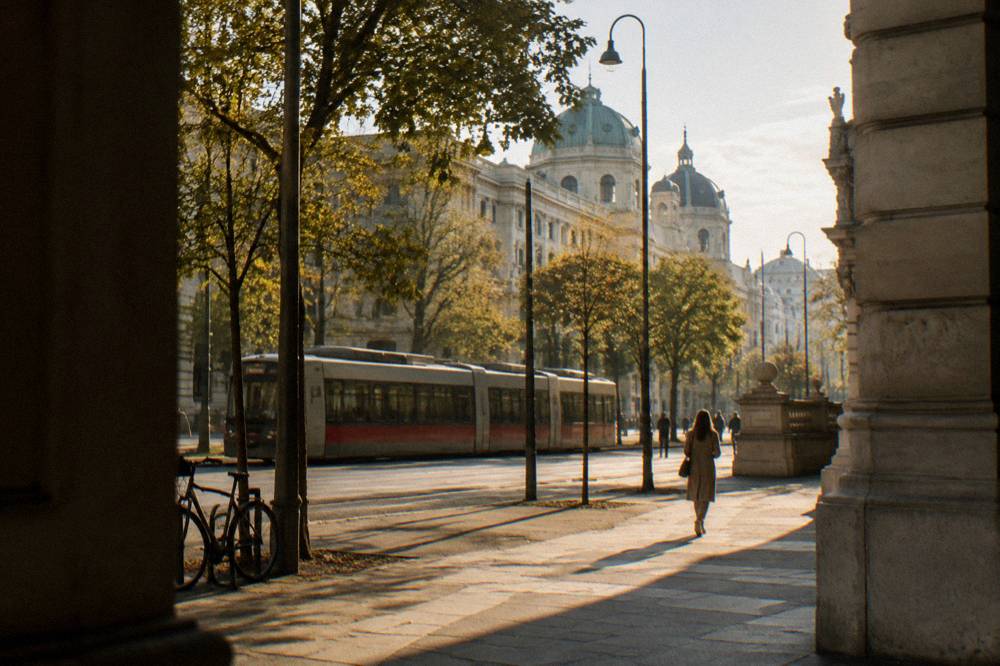
A realistic plan is one district, not the whole city: arrive by mid-morning on the REX8, spend the daylight hours inside a single walkable central area, and take an evening train back so the return lands in Bratislava before the night network thins out. Anything that involves crossing Vienna twice in one day will collapse into transport time rather than sightseeing.
The structure that works is a triangle anchored on Vienna Hbf. The station sits south of the historic core, so the natural day moves inward from arrival, loops through the centre on foot, and returns to the station the same way. Vienna's inner city is compact and flat in its central parts, and a pedestrian day there pairs naturally with the pedestrian Old Town habits a Bratislava visitor already has from Hlavné námestie and Hviezdoslavovo námestie.
A sample clock, written in structure rather than in sight-by-sight claims, since Vienna's own attraction hours and prices sit outside this site's scope:
| Time | Block | Notes |
|---|---|---|
| 07:30 | Tram or bus to Bratislava hl. st. | Allow 30 min from the Old Town |
| 08:00 | REX8 departure | Hourly; a missed train costs an hour |
| 09:00 | Arrive Vienna Hbf | 56-minute ride, no changes |
| 09:30 to 13:00 | First central district on foot | One area, done slowly |
| 13:00 to 14:00 | Lunch stop | Book nothing that needs a deadline |
| 14:00 to 18:00 | Second area or a museum block | Shorter in winter daylight |
| 19:00 to 20:00 | Return REX8 from Vienna Hbf | Check the day's evening departures |
| 21:00 | Back at Bratislava hl. st. | Night buses cover late arrivals |
The one-day discipline also argues against combining Vienna with anything else. Readers who want two capitals in one stroke should look at the Bratislava Vienna Budapest itinerary instead, which spreads the three cities across more days, or the dedicated Budapest day trip page, since Budapest lies about 162 km from Bratislava and is not a comfortable add-on to a Vienna day.
Boat Or Train: When Does The Twin City Liner Make Sense?
The Twin City Liner makes sense as a one-way ingredient, not a return recipe: ride the boat one direction for the river views and the train the other for speed and price. The boat takes about 75 minutes against the train's 56, its economy one-way fare of about EUR 34 to 39 reported is roughly triple the rail single, and its schedule is seasonal, with three daily departures each way only during the high-season window from 1 May to 2 November.
The operator's ticketing calendar shapes the decision. Winter cruises ran on Saturdays and Sundays from 7 February, the season opened properly on 20 March, the high-season three-sailings-a-day rhythm runs 1 May to 2 November, and Advent trips operate Friday to Sunday from 27 November to 20 December. Outside those windows the boat simply is not there, which is itself the answer for most of a Bratislava winter.
The split-day pattern, boat out and train back, gives the traveller the Danube approach into one city and the fast regional ride home. The fare asymmetry is the price of the view. Anyone planning a river-focused Slovakia trip can extend the logic with the Bratislava river cruises guide, which covers the Danube options based in the city itself, including the run up to Devin Castle.
Do You Need A Passport To Travel From Bratislava To Vienna?
For most travellers, no document check happens on the Bratislava to Vienna route, because both cities sit inside the Schengen Area and the trains cross the border as a domestic-style journey; Slovakia has been in Schengen since 21 December 2007, a reported status, and Austria is a founding member. Carrying a passport or national ID card is still the standard advice, because carriers and authorities can ask for one and non-EU nationals' entry rules depend on their own status.
The practical version of the question, including the edge cases that actually catch people out, is answered in full on the passport question page. The short planning point is that a day trip across this border feels like a regional train ride anywhere in Europe: no gates, no stamp, no separate border station. The exception logic belongs to the traveller's nationality, not the route, so anyone whose citizenship requires a visa or a stay calculation should carry the documents that their situation demands rather than infer anything from the absence of checks.
When Is The Best Month For A Vienna Day Trip From Bratislava?
The modelled ERA5 reanalysis normals for the Bratislava grid cell, 1991 to 2020, point to April, May, September and early October as the balanced months, with mean daily highs of 16.0 C, 20.4 C, 20.8 C and 15.0 C respectively and monthly rain between 44.0 and 67.1 mm; the boat season's 1 May to 2 November high-season window overlaps most of that sweet spot.
The full monthly picture, which is the same climate the day trip departs into, since the two cities sit 55 km apart:
| Month | Mean high C | Mean low C | Rain mm |
|---|---|---|---|
| Jan | 3.0 | -3.1 | 34.9 |
| Feb | 5.5 | -2.3 | 33.4 |
| Mar | 10.3 | 1.1 | 42.0 |
| Apr | 16.0 | 5.7 | 44.0 |
| May | 20.4 | 10.6 | 69.1 |
| Jun | 24.1 | 14.5 | 73.6 |
| Jul | 26.3 | 16.6 | 75.8 |
| Aug | 26.2 | 16.4 | 66.8 |
| Sep | 20.8 | 12.0 | 67.1 |
| Oct | 15.0 | 7.3 | 48.5 |
| Nov | 8.9 | 3.0 | 46.3 |
| Dec | 3.7 | -1.7 | 40.0 |
These are modelled reanalysis values for a grid cell, not a station record, so they should be read as "about" figures. They still carry the planning signal: July carries the highest monthly rain total in the table at 75.8 mm, February the lowest at 33.4 mm, and the November to February band pairs single-digit highs with short daylight, which squeezes a walking-heavy Vienna day hardest. Winter has its own compensation, since Bratislava's main Christmas market runs 26 November 2026 to 3 January 2027 and Vienna's own markets draw cross-border visitors in the same weeks, but a winter day trip needs the tightened timetable discipline described above.
Vienna Or Budapest: Which Day Trip Works Better From Bratislava?
Vienna is the closer and cheaper day trip by every number: about 55 km away against Budapest's about 162 km, 56 minutes by direct train against a rail link whose times and fares are not published, and a fixed about-EUR 12.70 single against a competitor figure. Budapest rewards an overnight; Vienna rewards the clock.
The distance table for Bratislava's main day-trip options makes the geography plain:
| Destination | Straight-line km from Bratislava | Verified rail link |
|---|---|---|
| Carnuntum | 19 | none published here |
| Pezinok | 20 | none published here |
| Modra | 26 | none published here |
| Trnava | 44 | R55 cancelled to 12 Dec 2026 |
| Vienna | 55 | REX8, 56 min |
| Nitra | 75 | none published here |
| Mikulov | 81 | none published here |
| Bojnice Castle | 129 | none published here |
| Budapest | 162 | times and fares not verified |
Two conclusions follow. First, Vienna is the only major capital within comfortable same-day range, and its hourly frequency means the trip is forgiving of a late start or a long lunch. Second, the small-Slovakia options, from the Small Carpathian wine villages to Carnuntum's Roman-site area, fill the days when a Vienna repeat is unnecessary; the Carnuntum day trip page covers the nearest of them at 19 km. Readers weighing the two capitals as rivals for a longer stay can take the comparison further in which is nicer, Vienna or Bratislava, and anyone planning the Hungarian leg has a dedicated is Bratislava worth a day trip from Budapest answer to work from.
When Does A Guided Tour Beat The Independent Train?
A guided tour earns its place when the traveller wants Vienna, or a second capital, delivered without any of the timetable arithmetic this page has done, or when the trip actually starts from Vienna rather than Bratislava; the roster's Vienna-start products depart Vienna, and that starting point is fixed, so a Bratislava-based reader books them for a Vienna-centred itinerary rather than a same-day outbound from Slovakia.
Want the whole day taken care of by a guide? Book a private Bratislava day tour here.
The guided category on this site splits by origin. Products flagged as Vienna-start, including the two-capitals day trips, begin in Vienna, and the Bratislava day tour from Vienna page covers the reverse-direction logic for travellers based in Austria. A Bratislava reader who wants the guided experience for their own city instead of for Vienna can browse the things to do in Bratislava index, or the one day in Bratislava itinerary for an independent equivalent.
For the specific case of pairing Vienna with Budapest under a guide's clock, the related product below is the roster's dedicated option, and it departs from Vienna. Its live details, including price and rating, render in the operator's own listing: Check availability.
What Should You Pack And Know Before The Return Train?
Pack for a borderless but full-length day: a passport or ID card despite the absence of checks, euro cash or cards valid in both capitals since Slovakia adopted the euro on 1 January 2009 and Austria uses it too, water because the tap supply in Bratislava is treated and monitored, and a plan to be back at Vienna Hbf with an hour of margin in winter, when the last useful evening departures arrive into a Bratislava night network that thins after midnight.
A few practical anchors for the Bratislava end of the day. Emergency numbers in Slovakia are 112 for the universal EU line, 155 for ambulance and 158 for police. The tourist tax, if the night before or after is spent in accommodation, runs EUR 3.50 per person per night in the Old Town district and EUR 3.00 elsewhere, capped at 60 nights per taxpayer per year. The airport, for anyone ending the trip with a flight, connects to Hlavná stanica by bus 61 in about 25 to 30 minutes, with the N61 night service covering late hours.
The return-side logistics are also covered in depth on the how to get to Bratislava guide, and the Vienna airport to Bratislava guide handles the case where the day trip ends at Vienna's airport instead of its station. For a budget-conscious framing of the whole exercise, the Bratislava on a budget guide puts the transport costs above in the context of a low-cost stay.
Common Questions About A Vienna Day Trip From Bratislava
Is there a direct train from Vienna to Bratislava?
Yes. The REX8 runs hourly from Vienna Hbf to Bratislava hl. st. in 56 minutes, and the REX6 serves Bratislava-Petržalka in 59 minutes, both without a change of train.
How much does the train from Bratislava to Vienna cost?
The fixed one-way fare is about EUR 12.70 on the REX8, and a return product at about EUR 19 includes a day of Bratislava public transport on the return side.
Can you do Vienna as a day trip from Bratislava?
Yes, comfortably. The 56-minute direct train and hourly frequency make it the closest capital-to-capital day trip in the region; the constraint is daylight, not distance, especially from November to February.
Does the Twin City Liner run all year?
No. High-season sailings run three times daily each way from 1 May to 2 November, with Advent trips Friday to Sunday from 27 November to 20 December and winter cruises on weekends from early February. Journey time is about 75 minutes.
Do I need a passport for Bratislava to Vienna?
Both cities are in the Schengen Area, so there is no routine border check on the route, but carrying a passport or national ID card remains the standard advice, and entry rules for non-EU nationals depend on nationality.
Which is the better day trip from Bratislava, Vienna or Budapest?
By the numbers, Vienna: about 55 km and a 56-minute direct train against Budapest's about 162 km and no direct rail timing. Budapest rewards an overnight stay rather than a same-day return.
The train does the heavy lifting on this route: 56 minutes, about EUR 12.70, hourly, direct. Everything else on this page, from the boat calendar to the winter daylight arithmetic, exists to protect the hours between the two rides.