Is Bratislava Worth A Day Trip From Vienna?
Is Bratislava worth a day trip from Vienna? A straight answer built on train times, sight entry prices and opening days, with a realistic one-day plan.
Vienna sits roughly 55 km from Bratislava, the capital of Slovakia, an inland city of about 468,000 residents on the Danube. The REX8 train covers the route hourly in 56 minutes since the October 2025 electrification, at a fare of about EUR 12.70 one way. That proximity is the whole case: two capitals, one hour apart, both in the eurozone. The question is whether the city itself rewards the journey, and the honest answer is that it rewards a specific kind of day, one built around a compact pedestrian Old Town, a castle hill and a riverside walk, rather than around blockbuster museums. This page sets out what the numbers say so the decision can be made on facts rather than slogans.
Yes, for most schedules, because the transfer cost is close to zero, the Old Town is walkable end to end, and the headline sights cost EUR 5 to EUR 14 each in a city that uses the euro. The REX8 runs hourly from Vienna Hbf and reaches Bratislava hl. st. in 56 minutes, so a full day on the ground is realistic without an early start.
The trade-off is scale: Bratislava is a compact capital of about 468,000 people, so a day trip works best when the aim is atmosphere and a castle view rather than a packed museum marathon.
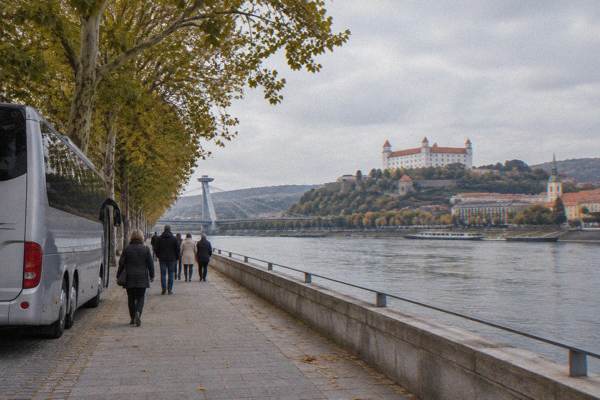
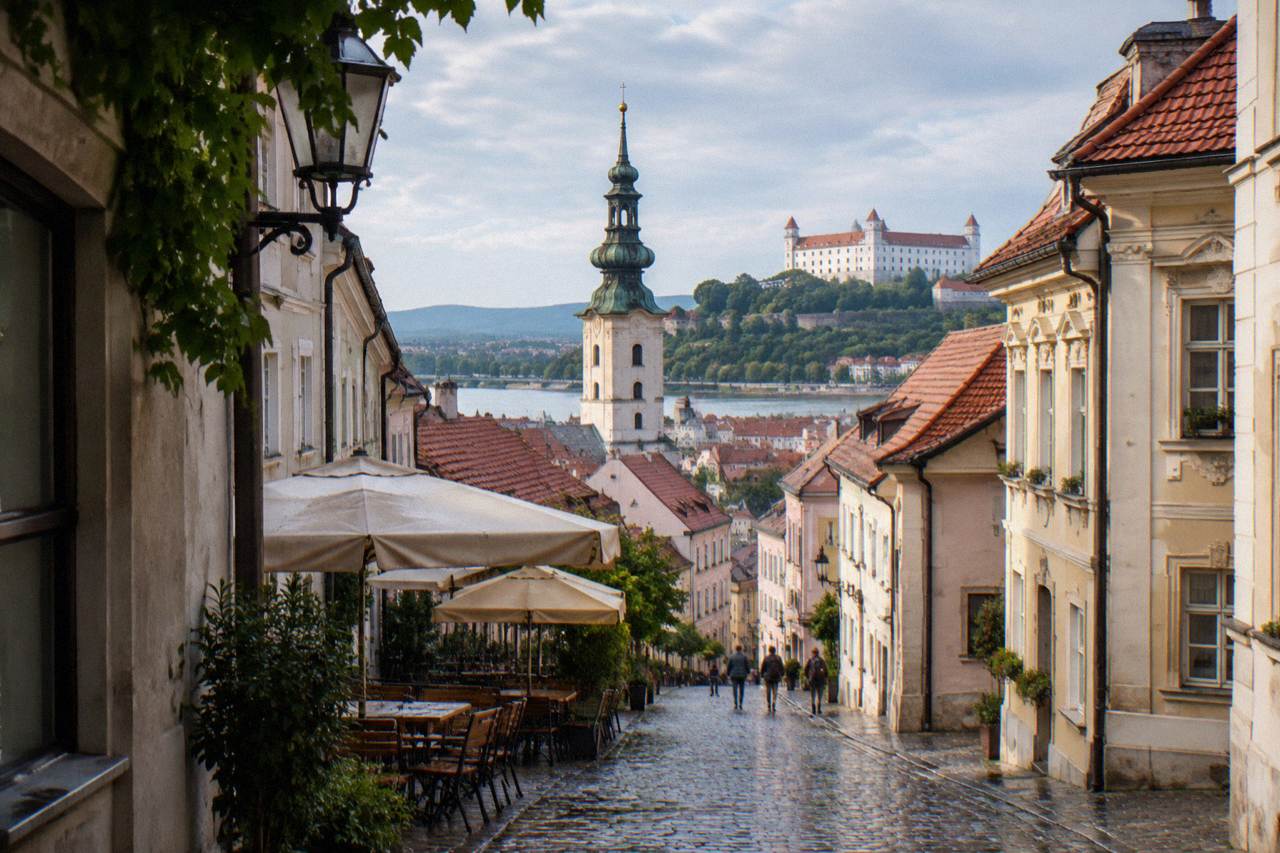
The verdict depends on pacing. Bratislava's Old Town centre, around Hlavné námestie and Hviezdoslavovo námestie, is pedestrianised, and the walk from the Main Square up to Bratislava Castle is a genuine climb, so comfortable shoes matter more than transport. The castle grounds are open daily 08:00 to 22:00 year-round at no charge, and the Museum of History inside costs EUR 14, closed Tuesdays. That Tuesday closure is the single biggest planning trap for day trippers, because Vienna's own museum day off is different and visitors often assume the pattern carries over.
If you would rather have a guide lead the way, book a guided walking tour here.
One more thing the schedule controls: from 1 September to 12 December 2026, engineering works around Bratislava's main station mean the S50 starts and ends at Bratislava-Nove Mesto and the R55 to Trnava is cancelled. The main station itself stays open, and Vienna trains are unaffected, but any onward rail planning inside Slovakia that autumn needs checking first.
How Do You Get From Vienna To Bratislava?
The default is the train: the REX8 leaves Vienna Hbf hourly via Marchegg and reaches Bratislava hl. st. in 56 minutes for about EUR 12.70, while the REX6 runs hourly to Bratislava-Petržalka via Bruck and Kittsee in 59 minutes. The alternative is the Twin City Liner river boat, about 75 minutes, with high season service of three daily departures each way from 1 May to 2 November 2026.
Road transfer by Slovak Lines to the airport area is also available, with direct service about 70 minutes from about EUR 7.90.
| Option | Route | Time | Fare | Notes |
|---|---|---|---|---|
| REX8 train | Vienna Hbf to Bratislava hl. st. | 56 min | about EUR 12.70 | Hourly, via Marchegg |
| REX6 train | Vienna Hbf to Bratislava-Petržalka | 59 min | about EUR 12.70 | Hourly, via Bruck and Kittsee |
| Twin City Liner boat | Vienna to Bratislava city centre | about 75 min | about EUR 34 to 39 economy | High season 3 daily each way, 1 May to 2 Nov 2026 |
| Slovak Lines bus | Vienna city centre to Bratislava Airport | about 70 min | from EUR 7.90 | Airport stop, not the Old Town |
The boat deserves a second look for a day trip, because it arrives close to the Old Town rather than at the rail station. Its 2026 calendar runs as follows: winter cruises ran from 7 February on weekends, the season opened 20 March, high season runs three sailings each way daily from 1 May to 2 November, and Advent trips run Friday to Sunday from 27 November to 20 December. The journey time of about 75 minutes and economy fares of roughly EUR 34 to 39 are reported figures, so confirm them at the operator before booking. More detail on all of this sits in the Vienna to Bratislava route guide and the answer on whether a direct train exists.
If the whole point of the trip is efficiency, a guided product removes the timetable question entirely. The Budapest add-on trip is the strongest of them for anyone torn between two destinations: Check availability on the operator's live listing.
What Can You Actually See In One Day In Bratislava?
A realistic day covers the pedestrian Old Town around Hlavné námestie, St Martin's Cathedral, the climb to Bratislava Castle with its free grounds, and either the UFO observation deck or a riverbank stroll, with paid entries running EUR 5 to EUR 14 per sight. The castle grounds are open daily 08:00 to 22:00 free of charge, the Museum of History costs EUR 14 and is closed Tuesdays, and St Martin's tourist zone costs EUR 5. Nothing on that list needs a car or a tour bus.
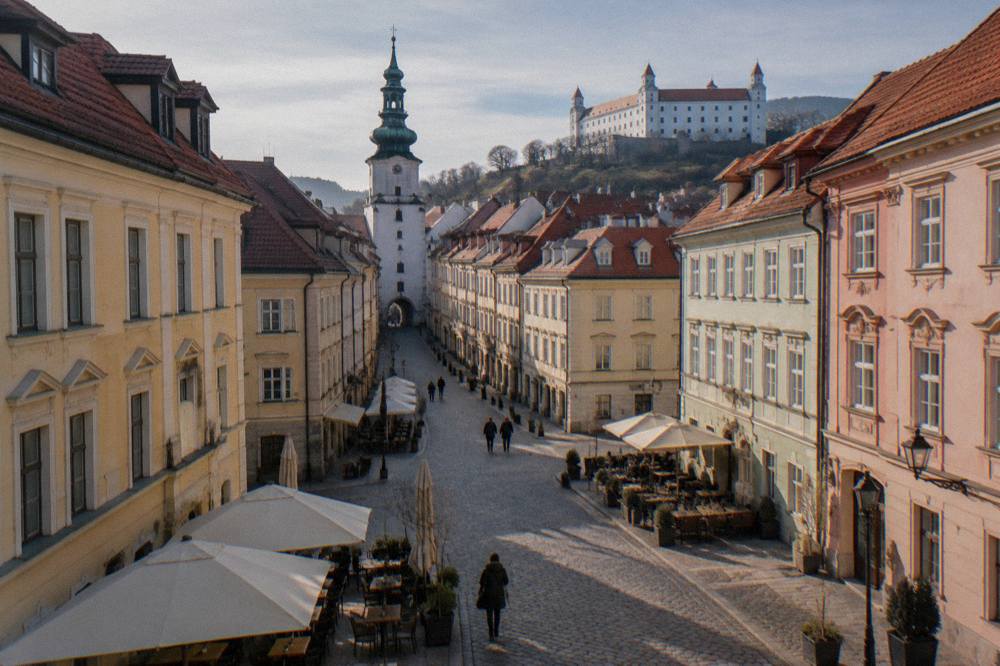
The shape of the day writes itself from the geography. Start in the Old Town, where the Main Square and Hviezdoslavovo námestie sit a short walk from the cathedral. St Martin's tourist zone, covering the treasury, crypts and gallery, costs EUR 5, with visiting hours Monday to Saturday 09:00 to 18:00 broken by a closure from 11:30 to 13:00, and Sunday afternoons only. The nave itself is free. From there the climb to the castle is the day's one real effort, rewarded by grounds that cost nothing and stay open until 22:00.
| Sight | Entry | Hours | Closed |
|---|---|---|---|
| Bratislava Castle grounds | Free | Daily 08:00 to 22:00 | Never |
| Castle Museum of History | EUR 14 | 10:00 to 18:00, last entry 17:00 | Tuesdays |
| St Martin's Cathedral tourist zone | EUR 5 | Mon to Sat 09:00 to 18:00, break 11:30 to 13:00; Sun 13:00 to 16:30 | Services |
| Old Town Hall museum | EUR 8 | 10:00 to 18:00 | Mondays |
| Michael's Tower | EUR 6 | 10:00 to 18:00 | Tuesdays |
| UFO observation deck | EUR 11.50 to 12.50 | Daily 10:00 to 23:00 | 24 December |
| Blue Church | Free | Short daily windows for prayer | None |
Two traps in that table. The castle museum and Michael's Tower close on Tuesdays, the Old Town Hall closes Mondays, and day trippers who pick the wrong weekday lose a sight. The Blue Church charges nothing but opens its interior only in short windows, mornings on most weekdays and around services at weekends, so it works as a drive-by exterior stop if the timing does not line up. A fuller sequence for exactly this schedule is laid out in the one day in Bratislava from Vienna itinerary.
How Much Does A Day Trip To Bratislava Cost?
Transport is the fixed cost, roughly EUR 12.70 each way by train or about EUR 34 to 39 one way by boat, and the variable cost is modest: castle museum EUR 14, cathedral EUR 5, Old Town Hall EUR 8, and public transport singles from EUR 1.20 for 30 minutes on paper tickets or EUR 1.09 in the app. A tourist tax of EUR 3.50 per person per night applies only to overnight stays, so a day tripper never pays it.
Local costs are in euros, since Slovakia adopted the currency on 1 January 2009, and there is no exchange friction for anyone arriving from Vienna. Within the city the IDS BK network covers the zones a visitor needs, and a paper single for zones 100 and 101 costs EUR 1.20 for 30 minutes or EUR 1.80 for 60, with app versions slightly cheaper at EUR 1.09 and EUR 1.60. A 24-hour paper day ticket is EUR 5.40.
For anyone weighing the cities against each other on cost, the honest framing is that only some elements compare directly: the euro is shared, the train fare is fixed and published, and each city's own sight prices are what they are. The cheaper than Vienna question gets its own treatment elsewhere on this site, and the broader budget guide to Bratislava breaks the daily spend down line by line.
Should You Take A Guided Tour Or Go Independently?
Independent travel is easy here because the train is hourly, the centre is pedestrianised and the sights post their own prices, but a guided day trip earns its fee when the day includes a second city or a driver-handled itinerary, since the Vienna-start products depart from Vienna and remove every transfer decision. The choice is really between EUR 12.70 in train fares plus walk-up entries, and a single booking that runs the whole day.
The independent route suits confident travellers who are happy climbing to the castle on foot and reading a map in a compact centre. The guided route suits anyone who wants Budapest folded into the same day, or a private local-led format, or simply not to think about the S50 engineering works at Bratislava-Nove Mesto. Every Vienna-start product on this site departs from Vienna; that is stated plainly because presenting one as a Bratislava departure would be false. The comparison between the two cities on their own merits, rather than as a day trip, sits in which is nicer, Vienna or Bratislava.
There is also the middle path: go independently but spend the money on one strong product on the ground, such as a food walk or a tasting, and keep the rest of the day free.
When Is The Best Time Of Year For This Day Trip?
Late spring through early autumn is the safe window, with modelled ERA5 climate normals for 1991 to 2020 showing July mean highs of 26.3 C and January mean lows of about -3.1 C, and rain fairly evenly spread across the year rather than concentrated in one season. December has a specific draw: the main Christmas market on Hlavné námestie and Hviezdoslavovo námestie runs 26 November 2026 to 3 January 2027.
The climate figures are modelled reanalysis values, not a station record, so treat them as planning normals. July carries the highest monthly rain total at 75.8 mm and February the lowest at 33.4 mm, which means no month is dry enough or wet enough to rule the trip in or out on weather alone. What the seasons actually change is the schedule: Devin Castle, at the Danube and Morava confluence, keeps winter hours of 10:00 to 16:00 from November to February and stays open, contrary to a persistent myth that it closes for winter, with winter admission of EUR 6 against EUR 8 from April to October.
The Advent window deserves a special mention. Twin City Liner runs Friday to Sunday sailings from 27 November to 20 December 2026, the main market runs into early January, and the castle's Baroque Garden keeps shorter winter hours of 09:00 to 16:00. A winter day trip is entirely workable; it just trades garden hours for mulled wine.
Common Questions About A Bratislava Day Trip From Vienna
Is Bratislava Worth A Day Trip From Vienna?
Yes, on the strength of the transfer alone: an hourly 56-minute train at about EUR 12.70 each way makes it one of the cheapest capital-to-capital day trips in Europe, and the compact pedestrian Old Town plus the free castle grounds fit a single day well. It suits travellers after atmosphere and a river-and-castle walk rather than a full museum city.
How Far Is Bratislava From Vienna?
About 55 km in a straight line. The REX8 train covers Vienna Hbf to Bratislava hl. st. hourly in 56 minutes, and the REX6 reaches Bratislava-Petržalka in 59 minutes.
What Is Closed On Tuesdays In Bratislava?
The Bratislava Castle Museum of History and Michael's Tower are both closed on Tuesdays. The Old Town Hall is the one closed on Mondays, and Devin Castle closes Mondays but stays open all winter on reduced hours.
Do You Need Euros In Bratislava?
Yes, Slovakia has used the euro since 1 January 2009. Cards are widely accepted, and public transport tickets can be bought in the IDS BK app.
Can You Combine Bratislava And Budapest In One Day From Vienna?
Yes, guided products that start in Vienna cover both cities in one day, and the related day trip on this page is exactly that format. Doing both independently by train in one day is a different proposition.
Is The Boat From Vienna To Bratislava Worth It?
It takes about 75 minutes against 56 by train and costs more, roughly EUR 34 to 39 economy, but it arrives near the centre and the river crossing is the point. High season runs three sailings each way daily from 1 May to 2 November 2026, with Advent trips Friday to Sunday from 27 November to 20 December.
The Bratislava Travel Guide covers the city sight by sight, season by season, for anyone whose one-day trip turns into plans for a second visit.