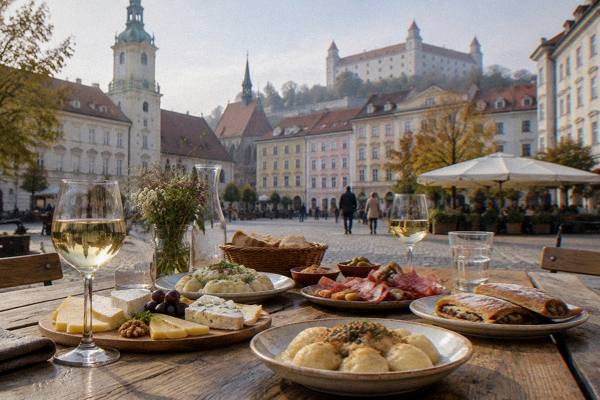
What Food Is Bratislava Famous For?
Bratislava's food identity explained: the Slovak dishes the city is known for, where to eat them, the wine and beer culture, and how food tours and the Christmas market fit into a visit.
Bratislava, the inland capital of Slovakia on the Danube, is famous for a food culture built on Slovak home cooking rather than fine dining. The dishes the city is known for are the ones Slovakia itself is known for: bryndzové halušky, small potato dumplings served with bryndza sheep cheese and fried bacon; roast goose or duck with braised red cabbage; kapustnica, a sour cabbage soup; and thick goulash stews. Around them sits a drinking culture with real local depth, from Small Carpathian white wines poured in the city's cellars to Slovak lagers in the Old Town pubs. The essentials are what to eat, where the food actually happens in Bratislava, and how the calendar shapes the table.
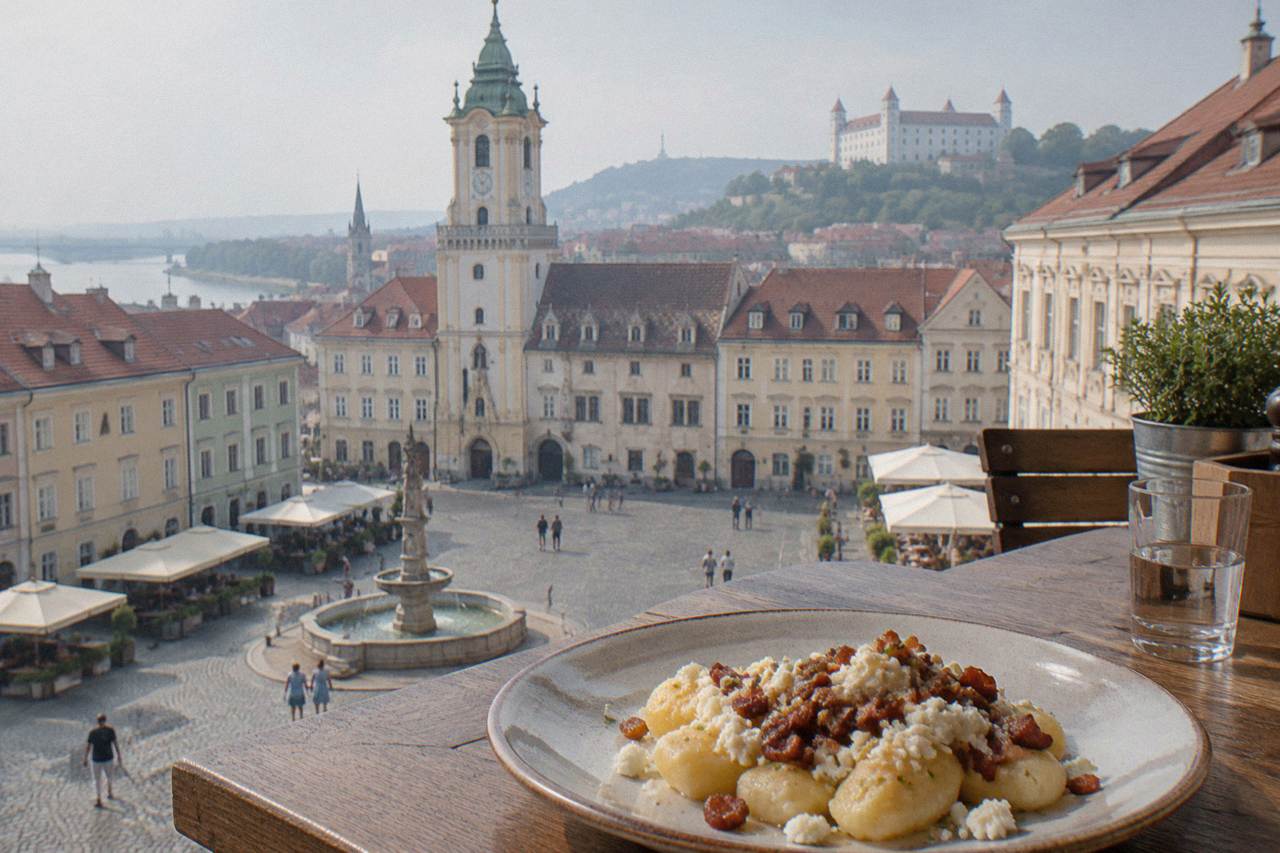
Bratislava is famous for the cornerstone dishes of Slovak cuisine: bryndzové halušky, potato dumplings tossed with bryndza sheep cheese and bacon bits, plus roast goose and duck with cabbage and dumplings, kapustnica sour cabbage soup, goulash, and fried cheese with tartar sauce. The city also carries a strong local drinking culture built on Small Carpathian wines and Slovak beer, and a street-food scene centred on chimney cake and grilled sausages.
Bryndzové halušky is the national dish, and in Bratislava it functions as the benchmark meal: nearly every traditional restaurant in the Old Town carries a version of it, and it is the plate against which locals measure a kitchen. The dish is built on halušky, small irregular dumplings made from raw potato dough, boiled and then mixed with bryndza, a soft sheep-milk cheese with a sharp tang, and finished with smoked bacon and its rendered fat. It is heavy food, designed for the cold half of the year, and a full portion is a meal in itself.
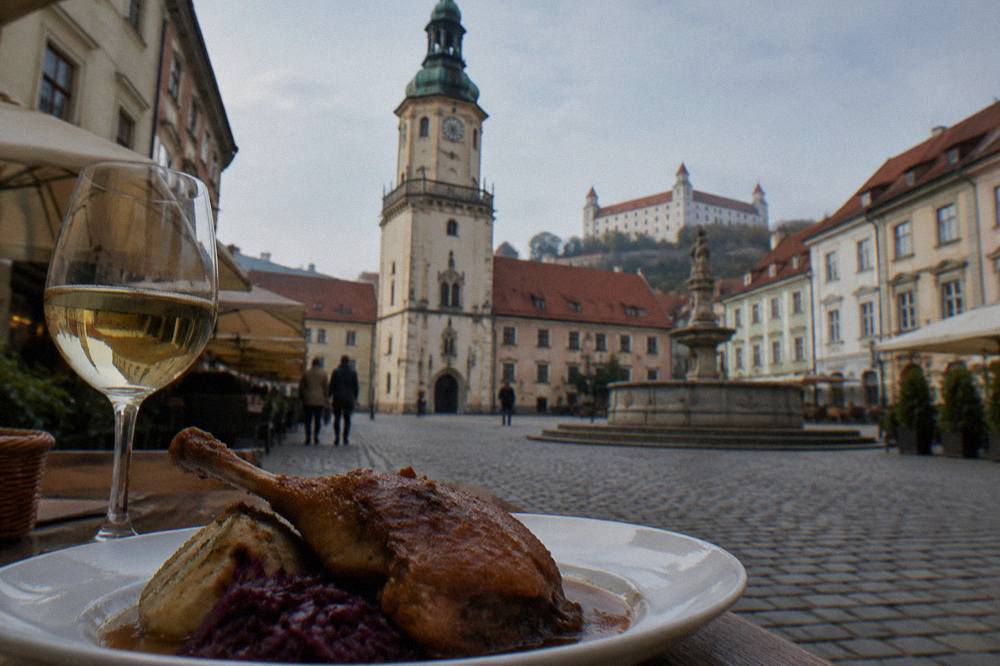
Alongside it sit the other pillars of the Slovak table. Roast duck and roast goose, served with bread or potato dumplings and braised red or white cabbage, are the festive centre of the cuisine, and goose dinners are a specialty of the Small Carpathian wine villages just outside the city. Kapustnica, a sour cabbage soup often cooked with smoked meat and dried mushrooms, is the Christmas dish in most Slovak households. Fried cheese with tartar sauce and boiled potatoes is the default quick lunch, and goulash in a bread bowl is the market and festival food.
| Dish | What It Is | When Slovaks Typically Eat It |
|---|---|---|
| Bryndzové halušky | Potato dumplings with bryndza sheep cheese and bacon | The everyday national dish, all year |
| Roast goose or duck | Roasted bird with dumplings and braised cabbage | Festive meals and wine-village dinners |
| Kapustnica | Sour cabbage soup with smoked meat | Christmas and winter |
| Fried cheese | Breaded deep-fried cheese with tartar sauce | Quick lunches |
| Goulash | Beef and paprika stew, served with bread | Markets and festivals |
| Trdelník | Sweet pastry rolled and roasted over flame | Street food in the Old Town |
None of this is fussy food. It comes from a farming tradition in a country with cold winters, and it is priced and portioned accordingly: Slovak cooking fills you up first and experiments later. Visitors comparing the city with its neighbours can read more in why Bratislava is famous and in what not to miss in Bratislava.
Where To Eat Traditional Food In Bratislava?
The traditional eating in Bratislava is concentrated in the pedestrian Old Town, around Hlavné námestie and the lanes running off it, where most of the city's Slovak restaurants sit within a few minutes' walk of each other. Beyond the centre, food happens at the Christmas market on the main squares, at the markets covered in the city's market guide, and on food tours that move between Old Town kitchens.
The Old Town is small and walkable, which is why food writers treat it as one extended dining district. Slovak restaurants cluster around the Main Square and Hviezdoslavovo námestie, and the side streets between them hold the cellars and pubs where the local beer and wine drinking happens. Because the centre is pedestrian, an eating walk between a restaurant, a cellar and a pub is a normal evening rather than a planned route. For orientation, is Bratislava a walkable city covers the geography in detail.
Outside the historic core, the food scene spreads along two lines. One is the market line: covered markets and the seasonal Christmas market, where grilled sausages, goulash, lángos fried dough and chimney cake are eaten standing at wooden tables. The main Christmas market runs on Hlavné námestie and Hviezdoslavovo námestie from 26 November 2026 to 3 January 2027, with the tree lighting on opening day at 18:00, organised by the city through BKIS. The other line runs out of the city entirely: the Small Carpathian wine villages to the north, where goose dinners and wine tastings are the draw, covered in the site's guide to Bratislava's markets and its wine-tour pages.
One practical note shapes any eating plan: restaurant kitchens in the centre are geared to the day-trip rhythm, with lunch service starting around noon and dinner from early evening. Sittings are unhurried, and the portions mean that a starter is rarely necessary.
Are Food Tours In Bratislava Worth It?
Food tours in Bratislava are worth it for visitors who want the city's food explained rather than just found, because the Old Town's traditional kitchens sit close together but the dishes, their names and their ordering logic are not obvious without translation. The site's roster carries several food walks, from a long foodie tour to shorter tasting walks, and the operator's live listing carries the current price, rating and duration.
To have the dishes and their stories explained, book a foodie tour here.
The argument for a food tour here is linguistic and structural rather than logistical. A Slovak menu is a wall of unfamiliar words, and the difference between a tourist-oriented kitchen and a serious one is not visible from the street. A guided tasting walk solves both problems at once: the guide translates the menu culture, the group moves between kitchens chosen in advance, and the dishes arrive already explained. The site's featured pick, the Old Town and Castle walking tour, adds the sightseeing half so the food stop lands inside a full Old Town circuit. Check availability on the operator's live listing for current dates and pricing.
Visitors who prefer to eat independently can do it easily: pick two or three traditional dishes from the table above, order them across a lunch and a dinner, and use the money saved for a wine tasting. The cost comparison between the two approaches is covered in is Bratislava cheap or expensive.
What Does Bratislava Drink: Wine, Beer And The November Young Wine?
Bratislava drinks two things with equal seriousness: beer and white wine. The city sits at the foot of the Small Carpathian wine region, whose cellars and family wineries supply the Old Town's tasting rooms, while Slovak lagers anchor the pub culture. The calendar also has a fixed wine moment: young St Martin's wine is released each year from 11 November, reported as the traditional date, and pours across the city's bars and cellars.
The wine story is the one that surprises visitors. Bratislava is the wine capital of Slovakia in practice, because the Small Carpathian wine route begins at the city's edge and runs through villages like Modra and Pezinok, where white varieties dominate. In the city itself that translates into wine bars and tasting experiences, including tasting sessions held in complete darkness, an audioguided format that removes sight from the tasting. The site's slovak wine guide and the Small Carpathians pages cover the region in depth.
Beer is the other half. Slovak brewing produces crisp bottom-fermented lagers, and the Old Town pubs pour them alongside the food above. Beer-and-food pairing walks exist on the tour roster for visitors who want the pub culture translated the same way a food tour translates the kitchens.
The calendar matters for wine drinkers. The St Martin's young wine release on 11 November is the moment the new vintage reaches glasses, reported by local sources as the fixed traditional date. It lands days before the Christmas market opens on 26 November, which makes late November the single best food-and-wine window of the Bratislava year: new wine first, then the market's standing food.
| Drink | Where It Comes From | When It Peaks |
|---|---|---|
| White wine | Small Carpathian region villages near the city | Tastings all year |
| St Martin's young wine | The new vintage, released from 11 November | Late November |
| Slovak lager | Domestic breweries, poured in Old Town pubs | All year |
| Mulled wine | Christmas market stalls | 26 Nov 2026 to 3 Jan 2027 |
What Should You Eat At The Bratislava Christmas Market?
At the Bratislava Christmas market you should eat the standing Slovak festival foods: goulash and sausages from the grill stalls, lángos fried dough, chimney cake for dessert, and mulled wine or hot mead to drink, all eaten at the wooden benches on Hlavné námestie and Hviezdoslavovo námestie, where the main market runs from 26 November 2026 to 3 January 2027.
The Christmas market is Bratislava's food event of the winter, and its menu is essentially the festival half of Slovak cooking. The stalls sell the food that can be held or eaten from a bowl at a standing table: grilled klobása sausages with mustard and bread, goulash served in a hollowed bread roll, fried potato pancakes, lángos, and trdelník pastry turning on open grills. Mulled wine and hot mead are the drinks, and the whole thing runs daily on the two main squares, closed only on 24 and 25 December, with the tree lit on 26 November at 18:00.
For visitors planning a winter trip around it, the site's pages on is Bratislava nice at Christmas and the best month to visit cover the timing. One practical point: the market is the cheapest way to try four or five Slovak dishes in one evening, because every stall sells a single thing done simply, and sharing portions across a group is normal market behaviour.
How Many Days Do You Need To Eat Your Way Around Bratislava?
Two days is enough to eat the core of Bratislava's food culture: one lunch and one dinner of traditional Slovak dishes, a beer stop, a wine tasting, and a market or street-food round. A third day adds the Small Carpathian wine villages with their goose dinners and cellar tastings, which is the food experience the city itself cannot fully replicate.
The math is simple. The Old Town holds everything within a walk, and Slovak portions are large, so a visitor manages roughly two serious food events a day plus one drinking stop. Day one: a traditional restaurant lunch, a walk, and a cellar or pub in the evening. Day two: the market or street-food circuit, a food tour if booked, and the second traditional dinner. That covers the famous dishes, the beer and the local wine. The question of overall trip length is handled in how many days you need in Bratislava.
The third day is the different one. The Small Carpathian villages change the register entirely: family wineries, goose restaurants, and cellar doors that exist because the vineyards are there, not because tourists are. Modra, with its private winery tastings, and Pezinok are the two names that recur on the wine route, and the site's wine-route pages plan that day out.
The Bratislava Travel Guide keeps the dish list on this page deliberately unpriced, because restaurant and market prices change faster than any page should, and the token blocks above carry the tour figures instead.
Common Questions About Bratislava Food
What Food Is Bratislava Famous For?
Bratislava is famous for Slovak home cooking: bryndzové halušky potato dumplings with sheep cheese and bacon, roast goose and duck with cabbage, kapustnica sour cabbage soup, goulash, fried cheese, and chimney cake as street food, all supported by Small Carpathian white wine and Slovak lager.
Is food in Bratislava expensive?
By Western European standards, no: Slovakia uses the euro and traditional eating is mid-priced rather than premium. The comparison with Vienna and other neighbours is covered on the site's cost page.
What is the national dish of Slovakia?
Bryndzové halušky, potato dumplings mixed with bryndza sheep cheese and topped with fried bacon. It appears on nearly every traditional menu in Bratislava's Old Town.
When is the best time of year for food in Bratislava?
Late November into December: the St Martin's young wine arrives from 11 November, reported as the traditional release date, and the main Christmas market runs from 26 November 2026 to 3 January 2027 on the two main squares.
Can you drink the local wine in Bratislava without leaving the city?
Yes. The Old Town has wine bars and tasting experiences, including tastings held in the dark, and the Small Carpathian vineyards begin at the city's edge for a half-day or full-day trip.
Is Bratislava good for vegetarians?
Traditional Slovak menus centre on meat and cheese, but fried cheese with tartar sauce, potato dishes and market options like lángos and chimney cake give vegetarians workable choices, and modern Old Town kitchens broaden the range further.