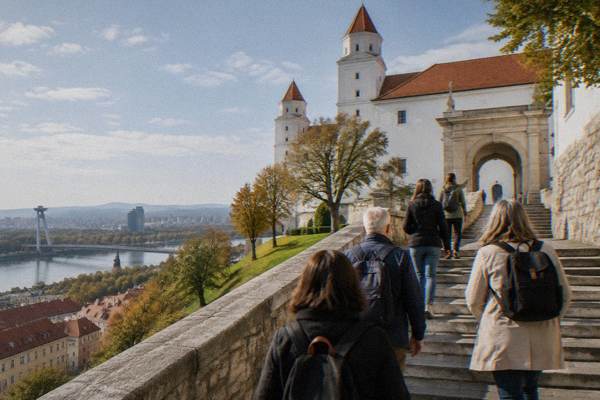
What Is The Weather Like In Bratislava In Winter?
Winter in Bratislava is cold but manageable: modelled daily highs around 3 to 9 C from December through February, light precipitation, and short days. Here is what the climate data says.
Bratislava, the capital of Slovakia, sits on the Danube some 60 km from Vienna, and its winter is the winter of an inland Central European lowland city: cold, grey-skied at times, and dry. The climate figures on this page are modelled normals from the ERA5 reanalysis for the 1991 to 2020 period, computed for the grid cell covering the city, not a weather-station record. In plain terms, winter days in Bratislava average a high near or just above freezing, nights a few degrees below, and precipitation spread thinly across eight to eleven rainy or snowy days a month. The Bratislava Travel Guide desk has assembled what the modelled data and the city's own winter schedules say, so the page answers one practical question: what the weather is actually like in Bratislava in winter, and what that means for a visit.
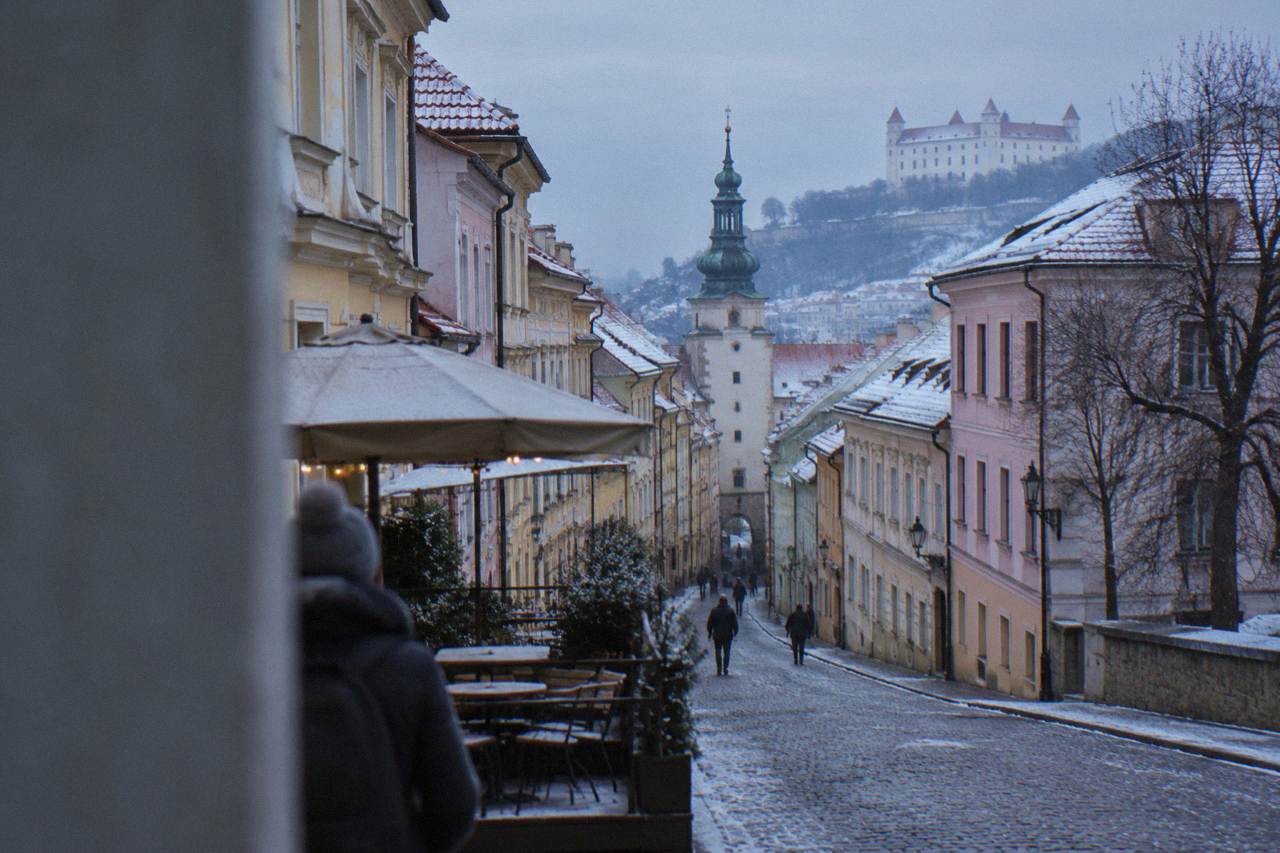
Winter in Bratislava is cold but not severe: modelled daily highs run about 3.0 C in January, 3.7 C in December and 5.5 C in February, with mean nightly lows around minus 3 C, and monthly precipitation stays modest at 34.9 to 46.3 mm across the three months. The figures are ERA5 reanalysis climate normals for 1991 to 2020, not station readings. Snow falls, but deep, lasting snow cover is not the norm on the city streets.
That single paragraph carries most of the answer, and the rest of this page unpacks it. The numbers come from modelled data, so they are best read as "about" values: a typical January afternoon in Bratislava sits a few degrees either side of 3 C, and a typical January night a few degrees either side of minus 3 C. Daylight is short in December, and the Christmas market, which the organiser's page runs from 26 November 2026 to 3 January 2027, is timed to exactly that window of early darkness.
The practical picture is friendlier than the raw numbers suggest. The Old Town is compact and pedestrian, museums and cafés are dense, and the sights that matter most indoors, from the Castle Museum of History to the Slovak National Gallery, keep full winter hours from 1 November. The city is not on the sea and gets no maritime moderation, but neither does it get continental extremes: the modelled January numbers are a long way from what the High Tatras, two plus hours north by road, see in the same months.
For readers weighing Bratislava against its neighbours at the same time of year, the comparison pages on whether Bratislava is worth visiting and what makes Bratislava famous cover the non-weather half of that decision.
How Cold Does Bratislava Get Each Winter Month?
Month by month, the modelled 1991 to 2020 normals give a December high of 3.7 C and low of minus 1.7 C, a January high of 3.0 C and low of about minus 3 C, and a February high of 5.5 C and low of minus 2.3 C. March stays winterish at 10.3 C by day and 1.1 C by night, and November sits between autumn and winter at 8.9 C and 3.0 C.
Every ERA5 reanalysis figure here carries an "about".
Here is the full cold-season table, taken from the same modelled dataset:
| Month | Mean daily high | Mean daily low | Precipitation |
|---|---|---|---|
| Nov | 8.9 C | 3.0 C | 46.3 mm |
| Dec | 3.7 C | -1.7 C | 40.0 mm |
| Jan | 3.0 C | about -3 C | 34.9 mm |
| Feb | 5.5 C | -2.3 C | 33.4 mm |
| Mar | 10.3 C | 1.1 C | 42.0 mm |
Two readings of that table matter for planning. First, the November to February window never averages below freezing by day, so the city stays walkable in ordinary winter clothing: a real coat, a hat, gloves, and shoes with grip for the occasional icy pavement. Second, February already trends upward, and by March afternoons push past 10 C on average, which is why the last weeks of the market season and the first weeks of spring sightseeing overlap in the city's calendar.
The question of which month is best for a visit depends on more than temperature, but on pure numbers the shoulder edge of winter, late February into March, is where the modelled curve turns.
One caution the desk will state plainly: these are 30-year modelled averages, not a forecast. Any given December week can run well above or well below them, and the model cannot tell you whether a specific bridge deck or castle courtyard will be under snow on a specific day.
Does It Snow Or Rain More In Bratislava In Winter?
Bratislava's winter precipitation is light and mixed: the modelled monthly totals are 46.3 mm in November, 40.0 mm in December, 34.9 mm in January and 33.4 mm in February, spread over roughly eight to eleven days with precipitation each month. That is roughly a third of what the same months deliver in wetter European climates, and at sub-zero temperatures what falls is often snow rather than rain, without heavy accumulation on the streets.
The comparison within the year is the useful part. July, at 75.8 mm, carries the highest monthly total in the modelled table; February, at 33.4 mm, the lowest. Winter is therefore the drier half of the Bratislava year by total water, even though it can feel damper on the ground because cold air holds the grey in. Snow that does settle in the centre tends to be thin and short-lived, because average daytime highs sit at or above freezing in every winter month.
What this means for a visit is mostly about footwear and plans. Ice on Old Town cobblestones and on the castle hill path is a bigger practical issue than snow depth, and the castle grounds, open daily 08:00 to 22:00 year-round, ask for attention underfoot in the mornings after a frosty night. Museums are the natural bad-weather buffer, and the winter schedule notes on the Bratislava in winter guide list which sights switch hours on 1 November.
What Should You Pack For Bratislava In Winter?
Pack for a city that averages between minus 3 and plus 4 C from December through February, with light, mixed precipitation: a proper insulated coat, warm layers, hat and gloves, and above all shoes or boots with real grip for icy cobblestones, plus a compact umbrella for the drizzle days. No arctic equipment is needed, and the modelled data shows no winter month averaging below freezing by day.
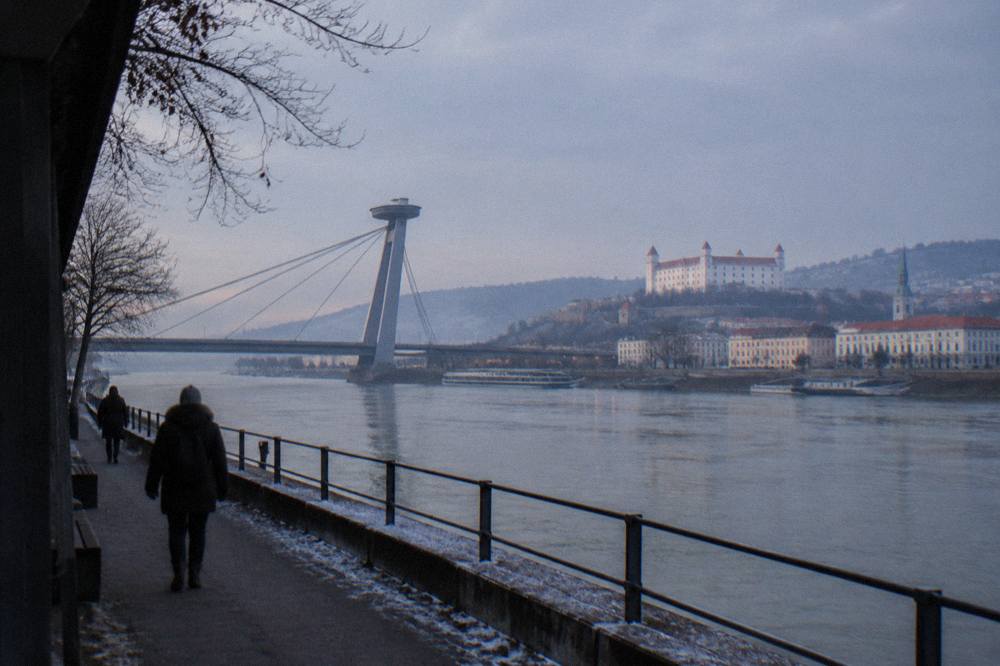
The packing logic follows directly from the table above. Daytime highs near 3 C with wind on the Danube riverfront, where the UFO observation deck and the Twin City Liner terminal sit, can feel several degrees colder than the sheltered lanes of the Old Town, so layers beat a single heavy garment. The UFO deck's own page lists daily opening from 10:00 to 23:00, and standing 95 metres above the river in January is a wind event whatever the thermometer says.
The Old Town is pedestrian, sightseeing is walking, and the climb to Bratislava Castle is on foot, so the shoes carry the whole trip. Smooth soles on frosty stone are the single most common winter complaint the desk hears about, and it is entirely avoidable.
If the forecast turns genuinely snowy, the indoor roster is deep enough to fill days: the Castle Museum of History, the Slovak National Gallery with its free first Sunday of the month, the Old Town Hall exhibitions, and the Danubiana art museum downstream on the Danube. The Bratislava weather guide keeps the full rundown.
Is Winter A Good Time To Visit Bratislava?
Winter is a good time to visit Bratislava if cold is acceptable, because the modelled climate is mild for the latitude, precipitation is light, the Christmas market runs 26 November 2026 to 3 January 2027, and the indoor sight roster keeps full hours from 1 November. The trade-offs are short December daylight and a landscape of bare trees and grey river rather than summer colour.
The market is the anchor event. The organiser's page puts the main market on Hlavné námestie and Hviezdoslavovo námestie, with the tree lighting at 18:00 on opening day and daily trading into the evening. Mulled wine and the December cold are the pairing the whole format is built around, and Bratislava's modelled 3.7 C December high is comfortably within the range where standing outside with a hot cup is a pleasure rather than an endurance test.
Away from the market, winter prices and winter crowds in the city's museums are a different question from the weather, and the page on whether Bratislava is cheap or expensive covers costs. What the climate data adds is simple: nothing about the modelled winter numbers argues against travelling. The city does not shut down, the castle grounds stay open until 22:00 daily, and Devin Castle remains open through the winter season, Tuesday to Sunday 10:00 to 16:00 from November to February, with lower winter admission of 6 EUR against the 8 EUR summer ticket.
What To Do In Bratislava In Winter When The Cold Sets In?
The winter answer is a mix of indoor museums, the castle grounds and Old Town walks on the clearer afternoons, the Christmas market in its late-November to early-January window, and, for properly cold weather, day trips into the mountains and caves of northern Slovakia where winter is the point rather than the problem. The city's compactness means no plan depends on the forecast.
The mountain option deserves the emphasis. The Čičmany, Bojnice, Orava and High Tatras day tour runs north into country where January snow is a feature, pairing painted village houses with Bojnice Castle and the Tatras themselves, and it can be booked with Check availability through the operator's live listing. A Demänovská Cave and Orava Castle day trip makes the same logic work underground, where the temperature holds steady whatever the surface is doing.
In the city itself, the desk points winter readers at the classics in cold-weather order: the castle museum, the galleries, St Martin's Cathedral, and the UFO deck at dusk, when the early winter darkness arrives well before the 23:00 close. The full checklist lives on the things to do in Bratislava page, which is sorted by interest rather than by season.
For travellers who want the cold to be the spectacle rather than the obstacle, that northern loop is the pick of the roster, and it needs no forecast to be worth it. The rest of the city's winter programme, from the market stalls to the museum halls, runs on schedules rather than weather.
Common Questions About Winter Weather In Bratislava
What Is The Weather Like In Bratislava In Winter?
Modelled ERA5 normals for 1991 to 2020 give daily highs of about 3.7 C in December, 3.0 C in January and 5.5 C in February, with nights around minus 3 C at the January low point. Monthly precipitation runs 33.4 to 40.0 mm across the deep-winter months, falling as rain, drizzle or light snow.
Does It Snow A Lot In Bratislava?
Not in the sense of deep, lasting cover. Winter monthly precipitation totals are modest, and because average daytime highs sit at or above freezing in every winter month, snow that settles in the centre is usually thin and short-lived. Ice on pavements and cobblestones is the more common hazard.
How Should I Dress For Bratislava In Winter?
An insulated coat, warm layers, hat and gloves for the riverfront wind, and boots or shoes with genuine grip for frosty cobblestones and the castle hill path. A compact umbrella covers the drizzle days. Nothing in the modelled averages calls for extreme-cold gear.
Is Bratislava Too Cold To Visit In December?
No. The modelled December high of 3.7 C is ordinary Central European winter cold, the Christmas market runs from 26 November 2026 to 3 January 2027, and indoor sights keep full winter hours from 1 November. Short daylight is the bigger adjustment.
Where Can I Find Snow Near Bratislava In Winter?
The High Tatras and the cave and castle country of northern Slovakia, both reachable on organised day trips, offer reliable winter conditions. In the city itself, the Kamzík hill and its TV tower lookout stand above the centre and can hold snow when the riverside does not.
The short version stands: Bratislava in winter is a cold, mostly dry, walkable city with a market in the middle of it, and the modelled numbers behind every claim on this page come from the ERA5 reanalysis for 1991 to 2020, read as averages rather than forecasts.