Bratislava Weather By Month: Heat, Frost And Rain
Bratislava sits inland on the Danube, and its year runs from about -3 C winter nights to about 26 C summer afternoons. Here is what the modelled climate normals say, month by month, and what each stretch of the year means for a visit.
Short answer
Modelled 1991-2020 climate normals for Bratislava show mean daily highs of about 3 C in January rising to about 26 C in July, with monthly rainfall ranging from about 33.4 mm in February to about 75.8 mm in July. Winters bring frost, summers bring heat, and rain falls somewhere in every month.
Bratislava, the capital of Slovakia, sits inland on the Danube, and its weather follows the rhythm of a Central European lowland city: cold, frosty winters, warm summers, and rain distributed across every month of the year. The figures on this page come from modelled climate normals, the ERA5 reanalysis for a grid cell at the centre of Bratislava covering 1991 to 2020, not from a weather station record, so every number is an "about" and a single year can land well above or below it. Read them as the shape of a typical year, then plan around the practical consequences: winter sightseeing schedules that start on 1 November, summer afternoons that belong outdoors, and a shoulder season that splits the difference. For the broader planning picture, the best time to visit Bratislava page adds crowds and events to the climate story.
What Is The Weather Like In Bratislava Across The Year?
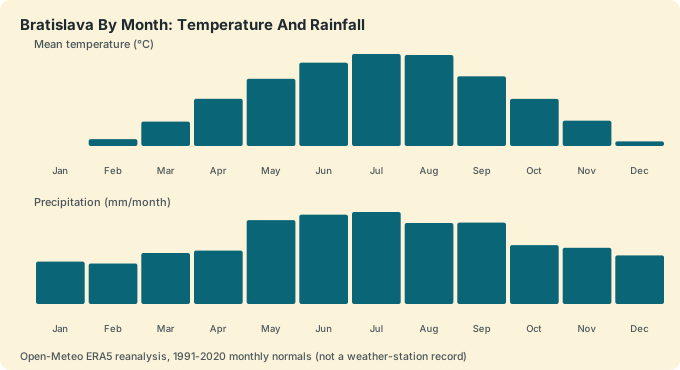
Bratislava has a temperate continental climate with four distinct seasons: modelled mean daily highs run from about 3.0 C in January to about 26.3 C in July, mean daily lows from about -3.2 C in January to about 16.6 C in July, and total precipitation across a modelled year comes to about 641.5 mm, spread through all twelve months. The city is roughly 152 m above sea level on the Danube, far from any sea, so winters cool hard enough for frost while summers build real heat. Nothing in the normals suggests a dry season or a monsoon: rainfall rises through late spring, peaks in the July figure of 75.8 mm, and eases through autumn back toward the winter thirties in millimetres.
Two things follow from that spread. First, there is no month when rain is off the table, so a packable layer and a plan for indoor hours matter year round, which is exactly what the Bratislava in the rain itinerary is built for. Second, the temperature swing between January and July is close to thirty degrees on the daily high, so the wardrobe that works for one season is actively wrong for the other.
Bratislava Weather By Month: The Full Modelled Table
The modelled 1991-2020 normals for Bratislava read as follows: highs climb from 3.0 C in January through 10.3 C in March and 16.0 C in April to 26.3 C in July, then fall back through 20.8 C in September to 3.7 C in December, while monthly rainfall runs from 33.4 mm in February up to 75.8 mm in July. Every figure below is a modelled mean for the grid cell at the centre of the city, printed with the "about" a reanalysis deserves. Use the table to place your travel dates on the curve, then check a live forecast close to departure, because a modelled normal tells you the centre of the distribution, not any specific week.
| Month | Mean daily high | Mean daily low | Rainfall |
|---|---|---|---|
| January | about 3.0 C | about -3.2 C | about 34.9 mm |
| February | about 5.5 C | about -2.3 C | about 33.4 mm |
| March | about 10.3 C | about 1.1 C | about 42.1 mm |
| April | about 16.0 C | about 5.7 C | about 44.0 mm |
| May | about 20.4 C | about 10.6 C | about 69.1 mm |
| June | about 24.2 C | about 14.5 C | about 73.6 mm |
| July | about 26.3 C | about 16.6 C | about 75.8 mm |
| August | about 26.2 C | about 16.4 C | about 66.8 mm |
| September | about 20.8 C | about 12.0 C | about 67.1 mm |
| October | about 15.0 C | about 7.3 C | about 48.5 mm |
| November | about 8.9 C | about 3.0 C | about 46.3 mm |
| December | about 3.7 C | about -1.7 C | about 40.0 mm |
The table rewards a close read. March and April almost double the daily high between them, which is why spring in Bratislava can feel like two different cities a fortnight apart. September keeps a summer-like 20.8 C mean high while shedding almost a degree a month from the lows onward. And the rainfall column never drops below the February figure of 33.4 mm, the clearest signal in the whole dataset that waterproof planning is not seasonal here but permanent.
Grouped by season, the same numbers look like this:
| Season | Months | Mean high range | Mean low range | Rainfall range per month |
|---|---|---|---|---|
| Winter | Dec, Jan, Feb | about 3.0 to 5.5 C | about -3.2 to -1.7 C | about 33.4 to 40.0 mm |
| Spring | Mar, Apr, May | about 10.3 to 20.4 C | about 1.1 to 10.6 C | about 42.1 to 69.1 mm |
| Summer | Jun, Jul, Aug | about 24.2 to 26.3 C | about 14.5 to 16.6 C | about 66.8 to 75.8 mm |
| Autumn | Sep, Oct, Nov | about 8.9 to 20.8 C | about 3.0 to 12.0 C | about 46.3 to 67.1 mm |
Those seasonal bands shape what kind of trip each stretch of the year supports, and the sections below take them one at a time. If you are already leaning toward a particular window, the question page what is the best month to visit Bratislava works through the same decision with events and prices in view.
How Cold Does Bratislava Get In Winter?
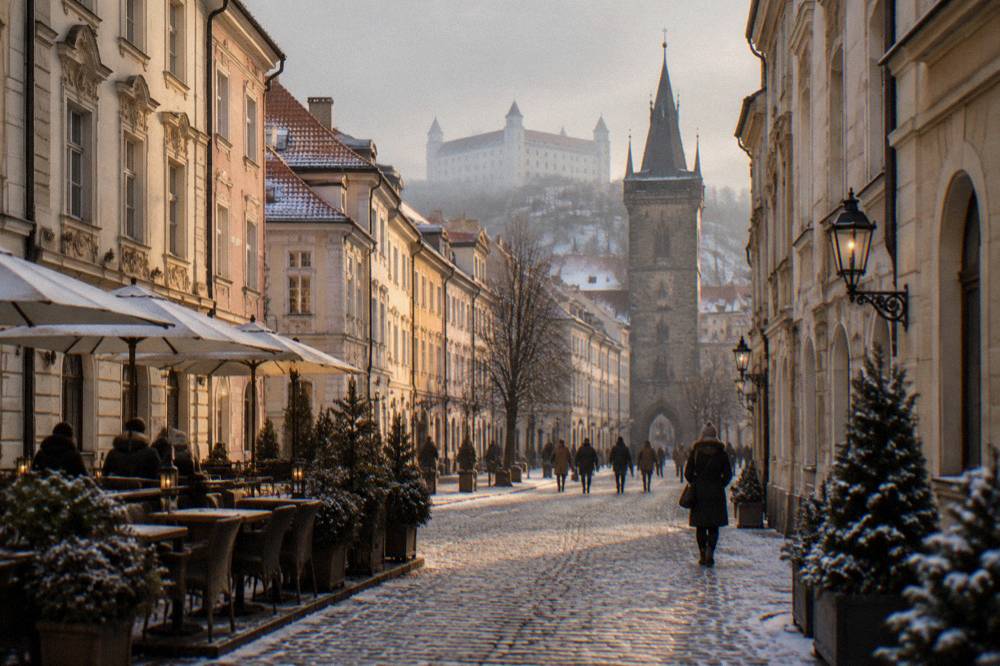
Modelled winter normals put Bratislava's mean daily lows at about -3.2 C in January, -2.3 C in February and -1.7 C in December, with mean highs of only about 3.0 to 5.5 C, so frost is a normal feature of all three months rather than an exception. The January figures make it the coolest month of the modelled year on both the high and the low column, a detail the coolest month in Bratislava question page covers in the same terms. Rainfall does not disappear in winter: December, January and February each still show about 34.9 to 40.0 mm in the modelled table, some of which arrives as snow when the temperature column supports it.
The practical winter story is bigger than the thermometer. From 1 November the seasonal attractions switch to winter schedules: Devin Castle stays open through the colder months, Tuesday to Sunday 10:00 to 16:00 from November to February with the last entry at 15:15, while its exposition and exhibition close for the winter season, and winter admission drops to 6 EUR from the summer 8 EUR. The castle grounds at Bratislava Castle stay open daily 08:00 to 22:00 year round, but the Baroque Garden trims its hours to 09:00 to 16:00 in January, February, November and December. Daylight is the other constraint: plan the outdoor hours for midday and keep museums and restaurants for the late afternoon.
Winter also has its compensations. The main Christmas market on Hlavné námestie and Hviezdoslavovo námestie runs 26 November 2026 to 3 January 2027, and the whole Bratislava Christmas market season turns the frost into atmosphere rather than an obstacle. The Blue Church keeps its free opening hours through the winter months, and the UFO observation deck stays open daily 10:00 to 23:00 with the city under it. For the full cold-weather picture, see what the weather is like in Bratislava in winter.
How Hot Is Bratislava In Summer?
Modelled summer highs in Bratislava reach about 26.3 C in July and 26.2 C in August, with June at about 24.2 C, while overnight lows sit around 14.5 to 16.6 C, so summer days are warm rather than searing and nights stay mild enough for open windows. Those are means across 1991 to 2020: individual heat events push well past the modelled line, and the same reanalysis shows July carrying the year's highest monthly rainfall figure at 75.8 mm, with June at 73.6 mm and August at 66.8 mm. Summer heat here arrives with thunderstorm potential, not with a dry desert stretch.
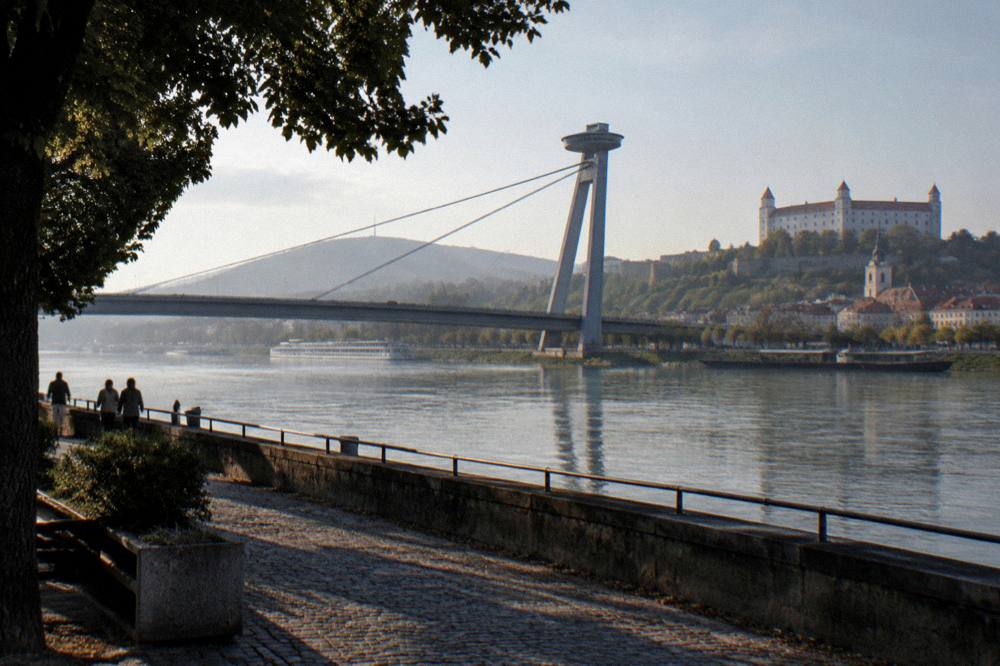
That combination makes summer the season for splitting the day. Mornings and evenings belong to the pedestrian Old Town, the castle hill climb and the Danube riverfront, and the middle of the day suits the indoor stops: the Museum of History at Bratislava Castle, the Old Town Hall exhibitions, a long lunch. The Bratislava in summer guide lays out that rhythm in full. On the river, the open-deck panorama cruise is the obvious warm-weather option, and the deck of the UFO structure stays open until 23:00 daily for late sunset views.
Hydration and shade are the two summer verbs that matter. The modelled normals describe the average, so treat the table as a floor for planning, not a ceiling, and build the midday hours around air conditioning and a cold Slovak lager, a pairing the beer and pubs in Bratislava guide maps out.
When Does It Rain In Bratislava?
Rainfall in Bratislava is a year-round presence in the modelled normals: every month shows at least about 33.4 mm, the late spring and summer months rise to about 66.8 to 75.8 mm, and the annual modelled total is about 641.5 mm, so there is no dry season and no month where an umbrella is a mistake. The rainfall column climbs steeply between April (about 44.0 mm) and May (about 69.1 mm), holds its highest values in June and July, and then descends through autumn to the winter thirties. The shift from April to May, about 25.1 mm in a single step, is one of the sharpest month-to-month moves in the whole table.
| Period | Modelled rainfall | What it means for a visit |
|---|---|---|
| December to February | about 33.4 to 40.0 mm per month | Lowest totals of the year, some arriving as snow |
| March to April | about 42.1 to 44.0 mm per month | Showery, changeable, layer-dependent |
| May | about 69.1 mm | The spring jump: pack for real rain |
| June to August | about 66.8 to 75.8 mm per month | The year's highest monthly figures, often convective |
| September to November | about 46.3 to 67.1 mm per month | A steady descent back toward winter totals |
A rain plan in Bratislava is not a defensive measure, it is standard equipment. The Old Town's density makes it easy to shift an hour from a square to a museum without redoing the day, and the covered options are strong: the Museum of History inside the castle, the City Museum sites around the Old Town Hall and Michael's Tower, the Danubiana art museum downstream, and the café culture the cafes of Bratislava pages cover. For a structured wet-day route, the Bratislava in the rain itinerary sequences exactly those moves.
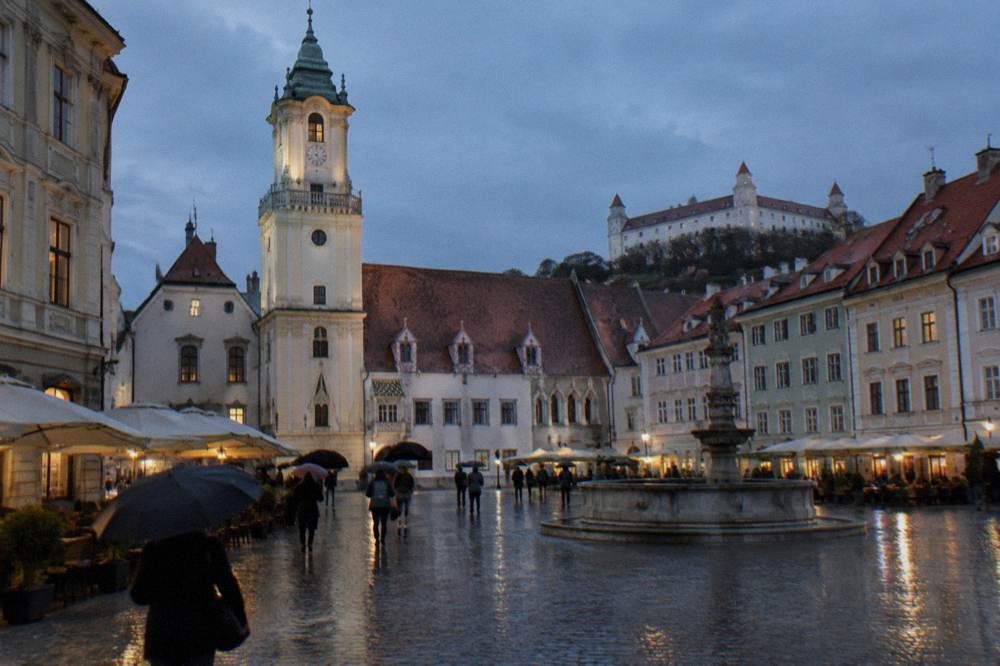
One structural note about the rain column: because the ERA5 figures are modelled for a grid cell rather than recorded at a station, they describe the climate signal, not the timing of any specific front. A July visit can still deliver a dry fortnight, and a February one can deliver a wet one. Plan for the distribution, book with cancellation flexibility where it matters, and let the forecast in the final week make the call on which day gets the indoor slate. The wider set of guides lives on Bratislava Travel Guide.
What Should You Pack For Bratislava's Seasons?
For Bratislava, pack for the modelled means plus the extremes: January needs real winter kit for lows about -3.2 C, July needs light clothing plus a rain layer for 75.8 mm of modelled rainfall, and the shoulder months of April, May, September and October each span roughly ten degrees between their daytime highs and overnight lows, which makes layers the universal answer. Footwear is the constant: the Old Town is a pedestrian zone of cobblestones and the castle is a climb, in every season, so the shoes do more work than the jacket does.
| Season | Modelled conditions | Packing core |
|---|---|---|
| Winter (Dec to Feb) | Highs about 3.0 to 5.5 C, lows about -3.2 to -1.7 C, about 33.4 to 40.0 mm rain per month | Insulated coat, hat and gloves, boots with grip, warm layers |
| Spring (Mar to May) | Highs about 10.3 to 20.4 C, lows about 1.1 to 10.6 C, rainfall rising to about 69.1 mm | Layered clothing, waterproof jacket, scarf into April |
| Summer (Jun to Aug) | Highs about 24.2 to 26.3 C, lows about 14.5 to 16.6 C, about 66.8 to 75.8 mm rain per month | Light clothing, sun protection, compact rain layer |
| Autumn (Sep to Nov) | Highs about 8.9 to 20.8 C, lows about 3.0 to 12.0 C, about 46.3 to 67.1 mm rain per month | Layers, waterproof, warm evenings by November |
The transition months deserve a specific warning. March can deliver a morning at about 1 C and an afternoon at about 10 C in the same modelled day, and October compresses almost eight degrees between its high and low means. A packable down layer under a shell covers both months better than a single heavy coat does. And whatever the season, the rain column never reads zero, so the umbrella travels in the bag from January to December.
Does Weather Change How Sightseeing Works In Bratislava?
Yes, and the mechanism is the calendar more than the thermometer: from 1 November the seasonal sights switch to winter schedules, so Devin Castle runs 10:00 to 16:00 Tuesday to Sunday with its indoor exposition closed, while year-round sites like the castle grounds (daily 08:00 to 22:00), the UFO deck (daily 10:00 to 23:00) and the Old Town's museums keep hours that hold through the cold months. The modelled 8.9 C November high is not what limits a November itinerary; the shortened opening windows and the early dusk are. In summer the constraint inverts: the heat of the middle day pushes sensible sightseeing to the shoulders of the day, and the river becomes the main stage.
The day trip calendar bends the same way. Castle routes out to Bojnice, Beckov and Trenčín are outdoor-heavy propositions, and their value scales with the season: the modelled May to September window gives them long daylight and warm stone, while a January version at about 3 C means bundling up on ramparts. The Three Castles day trip, which pairs those fortresses in one route, is the related pick for this page because it is exactly the kind of product the weather decides, and the operator's live listing carries the current dates and availability: Check availability. Details and what the route covers sit on the Three Castles day trip page.
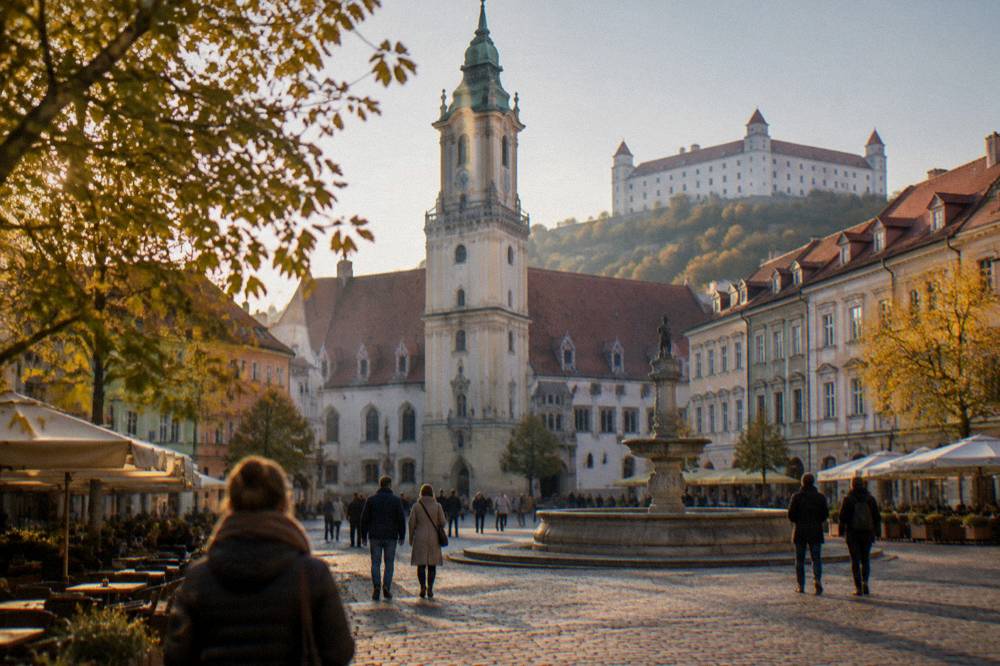
Weather also moves the indoor-outdoor balance of the city's own sights. The Baroque Garden at Bratislava Castle stretches to 09:00 to 21:00 in June and July but contracts to 09:00 to 16:00 in the winter months, which makes it a summer feature plain and simple. The Blue Church's free visiting windows are short and set by parish life rather than climate, so a winter trip works around them the same as a summer one. The constant in every season is the pedestrian Old Town itself, which functions in frost, heat and rain alike, just with different footwear.
Which Months Suit Which Kind Of Bratislava Trip?
By the modelled numbers, December to February suits a Christmas market and museum trip built around lows of about -3 C, May to September suits an outdoor and riverfront trip with highs of about 20 to 26 C but the year's highest rainfall figures, and the April, May, September and October shoulders deliver mild highs of about 15 to 20 C with rainfall totals below the summer peak, which makes them the flexible default. No month is disqualified by the table, because no month is either rain-free or unbearably hot, and every month keeps at least the year-round core of sights open.
| Month | Modelled high / low | Modelled rain | Best suited to |
|---|---|---|---|
| January | about 3.0 / -3.2 C | about 34.9 mm | Frost walks, museums, low-season prices |
| February | about 5.5 / -2.3 C | about 33.4 mm | The lowest rainfall figure of the year, cold-weather sightseeing |
| March | about 10.3 / 1.1 C | about 42.1 mm | Changeable but thawing, castle grounds reopening fully |
| April | about 16.0 / 5.7 C | about 44.0 mm | Mild days, layer-heavy evenings |
| May | about 20.4 / 10.6 C | about 69.1 mm | Warm and green, rain jacket required |
| June | about 24.2 / 14.5 C | about 73.6 mm | Long days, riverfront evenings |
| July | about 26.3 / 16.6 C | about 75.8 mm | Peak warmth, the year's highest rainfall figure |
| August | about 26.2 / 16.4 C | about 66.8 mm | Peak-season buzz, warm nights |
| September | about 20.8 / 12.0 C | about 67.1 mm | Summer feel, shorter queues likely, check listings |
| October | about 15.0 / 7.3 C | about 48.5 mm | Golden light, jackets at night |
| November | about 8.9 / 3.0 C | about 46.3 mm | Winter schedules start, indoor-heavy planning |
| December | about 3.7 / -1.7 C | about 40.0 mm | Christmas market season, frost and glow |
Two soft spots in the calendar deserve the planning attention. November is the month where the modelled temperature is still workable but the seasonal schedules and early dusk pull the most outdoor content off the table, so it rewards a museum-forward plan. And the second half of February, with the year's lowest rainfall figure in the modelled table at 33.4 mm and highs already edging toward 6 C, is a quiet window that pairs well with the city's indoor depth, from the museums of Bratislava to the long lunch tradition covered under what to eat in Bratislava.
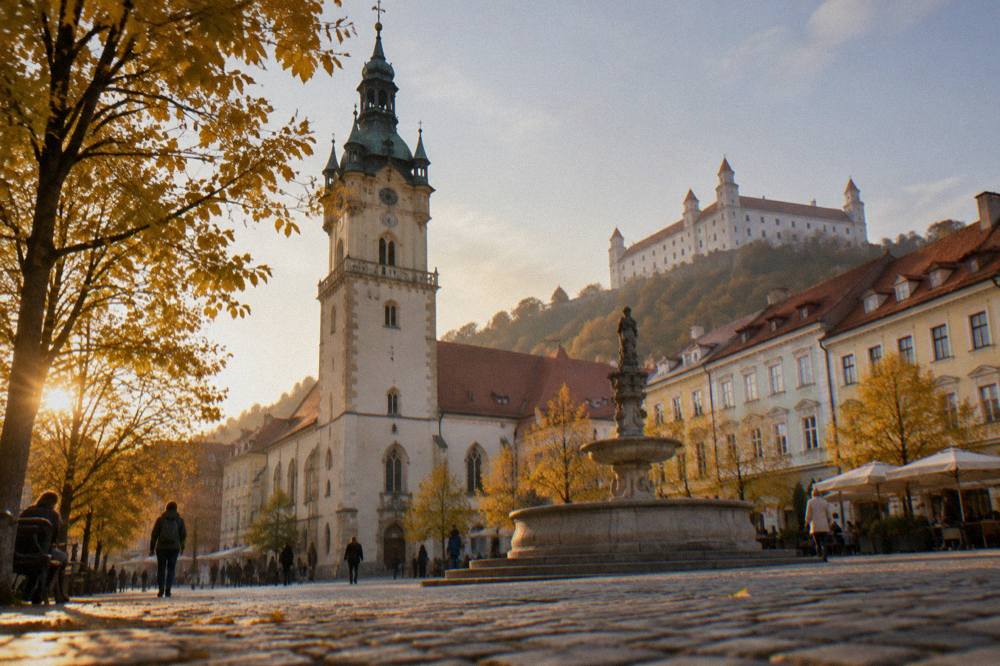
For travellers using the city as a base, the climate interacts with the day trip map too. The warmer half of the modelled year is the natural season for the farther reaches, and products like the Čičmany, Bojnice, Orava and High Tatras day tour are built for long daylight and clear roads. Free cancellation terms are the practical hedge on any of them, since a mountain forecast is its own subject and the Danube lowland's modelled numbers say nothing about conditions in the Tatras.
The same logic applies inside the city. A guided walk with a castle entry ticket bundles the outdoor route and the indoor museum into one product, which is a useful shape for a day where the forecast is uncertain: if the sky closes, the museum half carries the afternoon, and if it holds, the route does. The operator's listing carries current departure details, and the castle entry ticket walk page describes what the route covers.
How Do You Read A Forecast Against The Modelled Normals?
A modelled normal is the 1991-2020 average for a grid cell, and a forecast is a prediction for a specific place and day, so the right method is to use the normals to choose the season and the forecast to choose the day: expect January around a 3 C high, but trust the live forecast, not the table, when it says a particular week will run ten degrees above that. The ERA5 values describe the centre of a distribution, and Central European variability is wide enough that any given January afternoon can land at 12 C or at -8 C without either being a signal about the climate. The normals answer "what is this month usually like"; the forecast answers "what is my week actually doing".
Between the two sits the seasonal infrastructure, which is fixed and knowable in advance. Winter schedules at the seasonal sights start on 1 November and hold through the cold months. The Christmas market window, 26 November 2026 to 3 January 2027, is set regardless of what the thermometer does. The river cruise season on the Danube runs its main daily service from 1 May to 2 November, with limited Advent sailings in the late November to December stretch. Those dates, not the weather, define the skeleton of any plan, and the weather decides how each day on that skeleton feels.
Common Questions About Bratislava Weather
What is the coolest month in Bratislava?
January, on the modelled 1991-2020 ERA5 normals: a mean daily high of about 3.0 C and a mean daily low of about -3.2 C, the lowest figures in both columns of the table. December and February sit close behind, at mean lows of about -1.7 C and -2.3 C.
What is the warmest month in Bratislava?
July, with a modelled mean daily high of about 26.3 C, fractionally ahead of August at about 26.2 C. July also carries the year's highest monthly rainfall figure in the modelled table, about 75.8 mm, so the warmth comes with storm potential rather than dry heat.
Does it snow in Bratislava?
Frost is a normal feature of the modelled winter, with January lows about -3.2 C, and the winter months each show about 33.4 to 40.0 mm of precipitation in the modelled table. Some of that precipitation arrives as snow when temperatures support it, but the modelled rainfall figures do not separate snow from rain, so no snowfall total can be stated from them.
What is the rainiest part of the year in Bratislava?
The modelled rainfall column peaks in July at about 75.8 mm, with June at about 73.6 mm and August at about 66.8 mm, so late spring and summer carry the highest monthly totals. No month drops below about 33.4 mm, so rain is possible at any time of year.
Is Bratislava weather similar to Vienna's?
Bratislava and Vienna are about an hour apart by train, in the same Central European lowland climate zone, so their seasons run in the same shape: cold winters, warm summers, year-round rainfall.
When do winter schedules start for Bratislava sights?
From 1 November. Devin Castle keeps winter hours of 10:00 to 16:00 Tuesday to Sunday from November to February, with the last entry at 15:15 and the indoor exposition closed for the season, while year-round sites such as the castle grounds and the UFO deck hold their daily hours through the cold months.
The modelled table is the honest version of a weather promise: about 3 C in January, about 26 C in July, and rain somewhere in every month. Pick the season that matches the trip you want, pack for the column edges rather than the means, and let the fixed seasonal dates, from the 1 November schedule switch to the 26 November market opening, do the rest of the planning for you.