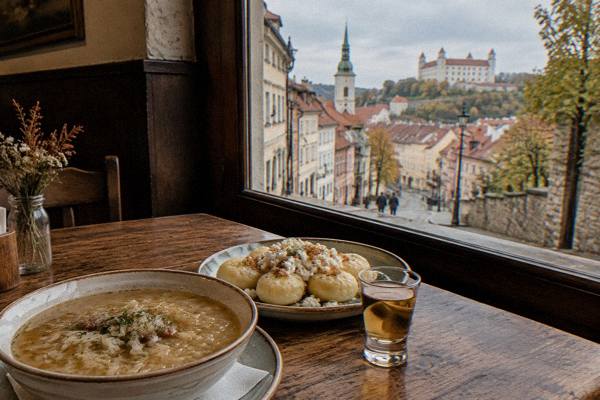
What To Eat In Bratislava: Halušky, Bryndza And Slovak Plates
Bratislava's food identity runs through sheep cheese, potato dumplings, river fish, cabbage and the white wines of the Small Carpathians, eaten in a compact Old Town you can cross on foot between courses.
Short answer
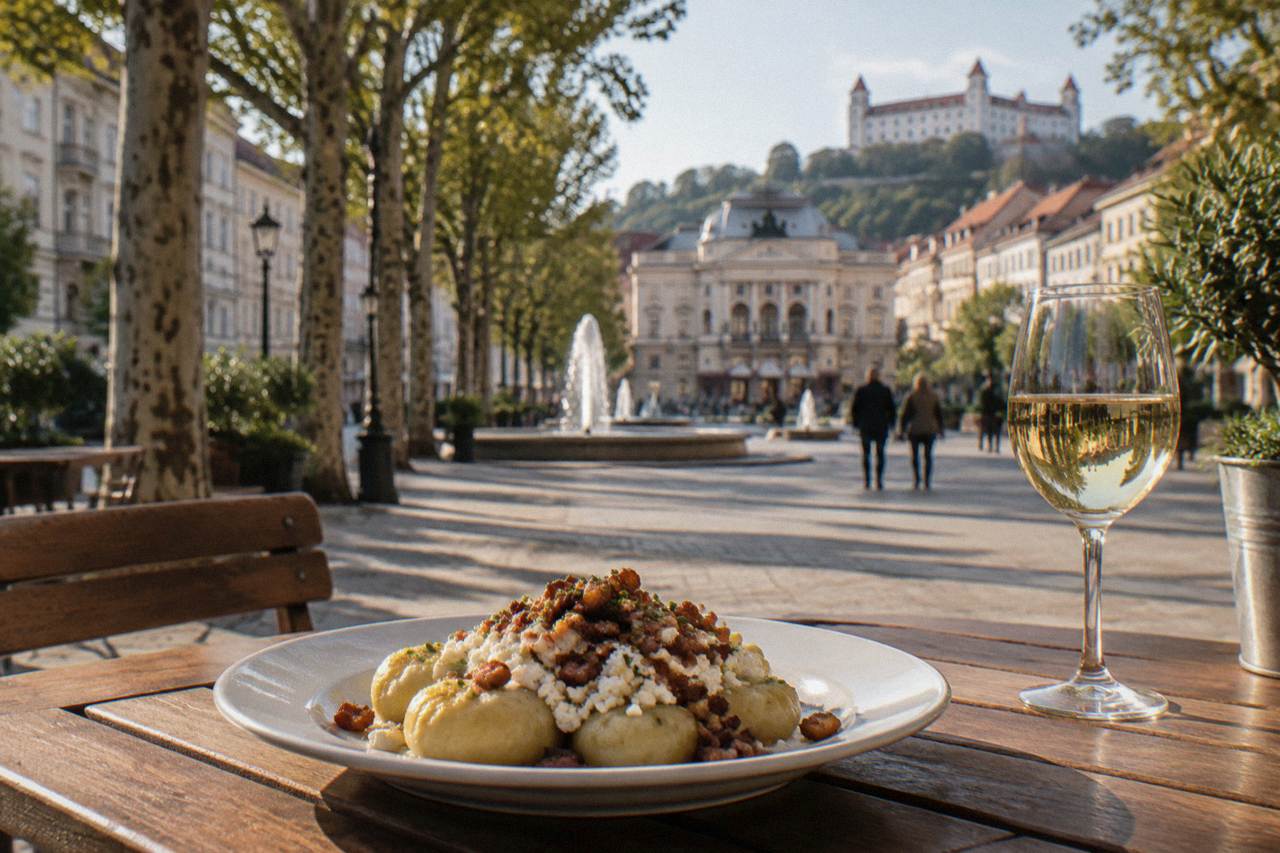
Eat bryndzové halušky as the anchor plate, pair it with Small Carpathians white wine, snack at the Christmas market stalls from late November, and use a guided food walk to reach dishes you would not order alone.
Bratislava, the capital of Slovakia, eats the way an inland Central European city eats: potato dumplings, sheep cheese, pork, cabbage, river fish and sweet pastries, washed down with lager and with the white wines of the Small Carpathian hills that begin at the western edge of town. The Old Town is small and pedestrian, which matters for eating, because the distance between a castle viewpoint and a dinner table is a short walk. The dishes, the drinks, the seasons and the practical habits come together dish by dish, without printed prices or named venues, since plate prices in Bratislava move with the season and the street. Everything here is general planning guidance: for the current price of any specific plate, read the menu at the table.
What Should You Actually Eat In Bratislava?
The short list of Slovak plates worth ordering in Bratislava runs: bryndzové halušky as the national dish, kapustnica as the sour cabbage soup, schnitzel-style fried meat, grilled pork with dumplings, goulash, and pirohy dumplings, with lokše potato pancakes and štrúďaľ or trdelník as the sweet layer, all of it found within the Old Town's walking radius. None of it needs translating into a plan more complicated than "order the thing you cannot pronounce." The portions run generous, the cooking is built for the climate, and the dishes repeat across menus, so one good plate teaches you the vocabulary for the whole stay. Start with the halušky, then work outward.
Slovak home cooking, and by extension Bratislava's traditional restaurant cooking, is a dairy-and-root-crop kitchen shaped by mountain shepherding in the north of the country and by wine growing in the hills beside the city. That geography explains the two pillars of a Bratislava plate: bryndza, a soft tangy sheep cheese, and the white wines that come from villages like Modra and Pezinok, which this site covers in its Small Carpathians wine guide. The same menus usually carry Czech-style lager on tap, covered separately in the guide to beer and pubs in Bratislava.
| Dish | What it is | How it arrives |
|---|---|---|
| Bryndzové halušky | Potato dumplings tossed with bryndza sheep cheese | Hot, topped with fried bacon bits and rendered fat |
| Kapustnica | Sour cabbage soup, often with smoked meat and sausage | A bowl, usually before the main plate |
| Vyprážaný rezeň | Breaded fried cutlet, pork or chicken | With potato salad or boiled potatoes |
| Pečené bravčové | Roast pork with dumplings and cabbage | Sauce-heavy, the classic Sunday plate |
| Pirohy | Filled dumplings, cheese or potato filling | Buttered, sprinkled with fried onion |
| Lokše | Thin potato pancakes | Plain, or filled with sweet or savoury fillings |
The one habit worth importing into your trip: treat lunch as the traditional-cooking meal and the evening as the wine-and-snack meal. Menus do not change much between the two, but the portion logic does. A midday plate of halušky leaves the afternoon free for walking it off; the same bowl at nine in the evening sets a different tone for the night.
What Is Bryndzové Halušky And Why Is It The Plate Everyone Names?
Bryndzové halušky is the Slovak national dish: small potato dumplings, similar in shape to gnocchi, mixed with bryndza, a spreadable sheep cheese with a sharp tang, and finished with cubes of fried bacon and the fat they cooked in, served hot as one filling bowl, and every traditional menu in Bratislava carries it. The dumplings are the vehicle; the bryndza is the point. It is a protected, distinctly Slovak product, and no other city's version tastes quite like the one made from it. Order it once on day one and you will know whether the rest of the menu is for you.
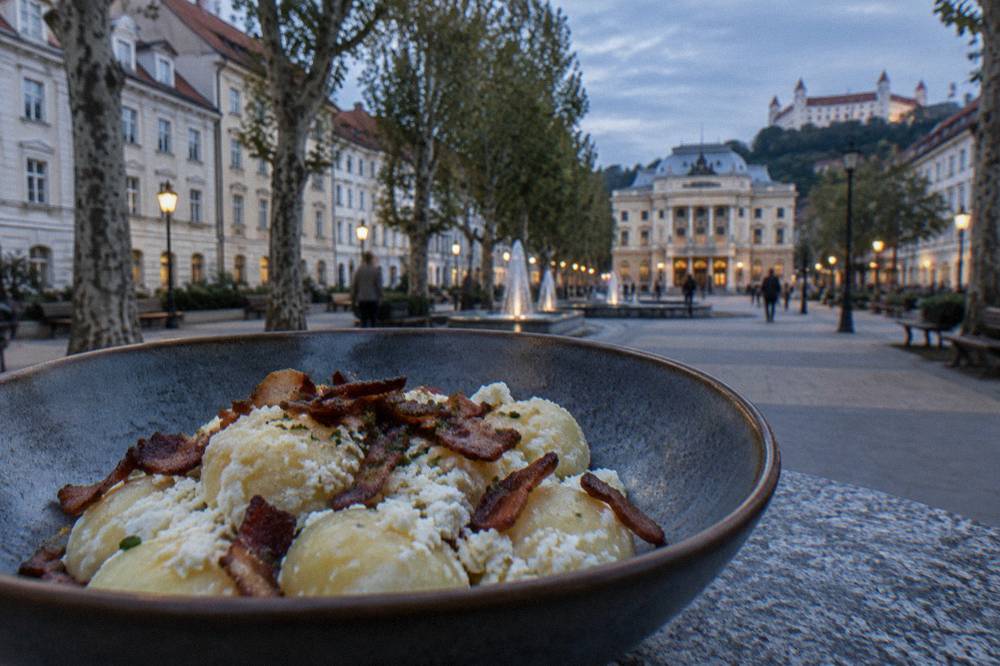
Two practical notes. First, the dish is heavy by design: it comes from a shepherd's working lunch, not from a tasting menu, so treat one bowl as a full meal rather than a starter. Second, the name travels badly and the dish travels well: point at the menu entry if the pronunciation stalls, halušky is said roughly "HAH-loosh-ki" and bryndzové roughly "BRIN-dzoh-veh", a small effort the language guide expands on. Many kitchens also offer a lighter variant, and vegetarian versions replace the bacon, though purists argue the fat is half the dish.
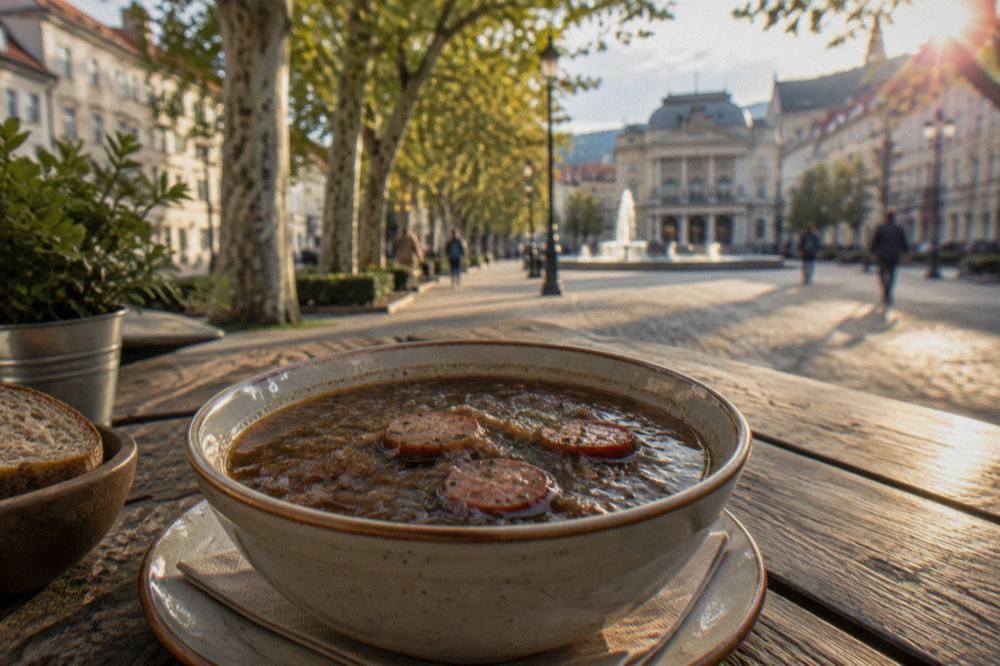
The cabbage soup, kapustnica, deserves its own order. It is sour where halušky is rich, usually carrying smoked sausage, and it is the dish Slovaks associate with Christmas, which tells you how central it is. In December the Christmas market stalls, running 26 November 2026 to 3 January 2027 on Hlavné námestie and Hviezdoslavovo námestie, sell it by the cup in the open air, covered in detail in the Christmas market guide.
Where Do You Find Traditional Plates In Bratislava's Old Town?
The traditional restaurants cluster in the pedestrian lanes of the Old Town, within a ten-minute walk of Hlavné námestie, and the reliable approach is to eat inside the Old Town for classic Slovak plates and step out to the castle hill and riverfront for views with simpler food, since the whole area is walkable and needs no car. The Old Town is the part of Bratislava built for walking, which is the site's standing advice for the city generally, and it concentrates the cooking you came for. There is no single ranking of venues; the workable method is menu-based rather than name-based.
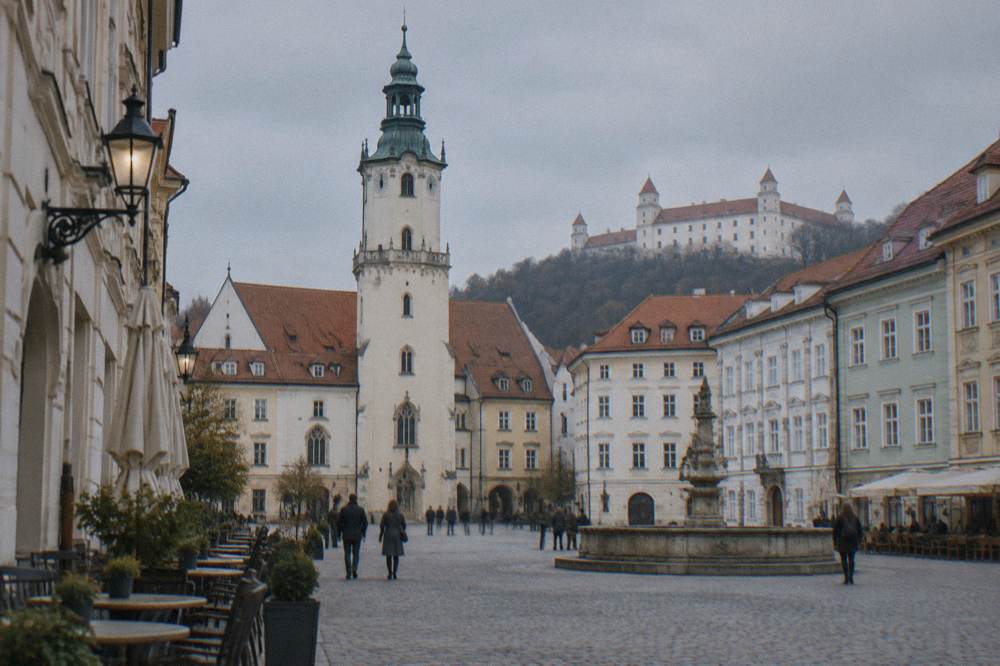
Read a menu before you sit down and look for three signals: bryndzové halušky priced as a main rather than a novelty, a short list rather than a pan-European one, and Slovak wine by the glass. That screen outperforms any star rating for this cuisine. The restaurant guide covers how to read the scene in more depth, and the sightseeing pattern that pairs with it is simple: Bratislava Castle's grounds are open daily 08:00 to 22:00 and free to walk, so the climb can be timed to end at a table. The castle is a climb, and doing it before the big plate rather than after is the sequencing most people regret getting backwards.
A guided walk that covers the city and the castle, such as the Story of Bratislava walk, ends where the eating streets begin, which makes it a natural first-morning move. For a deeper table-to-street pairing, the site's food tour page explains what a guided tasting walk adds over self-directing.
What About Breakfast And Sweets In Bratislava?
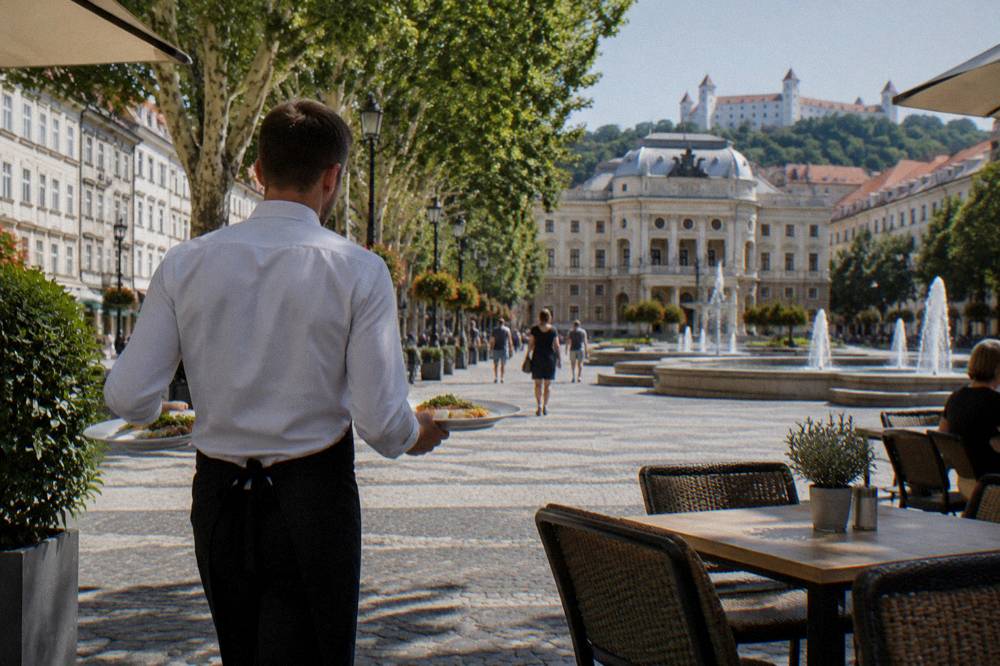
A Slovak breakfast table typically runs to bread with cheese and cold cuts, eggs, and pastries, with bryndza spread on fresh bread as the distinctly local element, and the sweet layer in Bratislava is trdelník rolled pastry, štrúďaľ poppy-seed and walnut rolls, and lokše potato pancakes, so breakfast and dessert together cover a whole second vocabulary of the cuisine. The full morning picture, including what counts as typical before work rather than before sightseeing, is laid out in the site's answer page on a typical Slovak breakfast.
Cafés in the Old Town open early and serve the pastry case with coffee, which in Slovakia means espresso-bar coffee culture rather than filter. The poppy seed roll, makový štrúďaľ, is the one to learn first: dense, dark and only mildly sweet. Trdelník, the chimney pastry rolled over a spit and coated in sugar and nuts, is the street version, and in late November through December it belongs to the market stalls rather than the cafés.
| Sweet | Base | When Slovaks eat it |
|---|---|---|
| Makový štrúďaľ | Yeast roll, poppy seed filling | Christmas season, café cases |
| Orechovník | Yeast roll, walnut filling | Christmas season, family baking |
| Trdelník | Spit-roasted dough, sugar and nuts | Street stalls, markets |
| Lokše | Potato pancake | Filled sweet or savoury, any time |
| Palačinky | Thin filled pancakes | Dessert in restaurants |
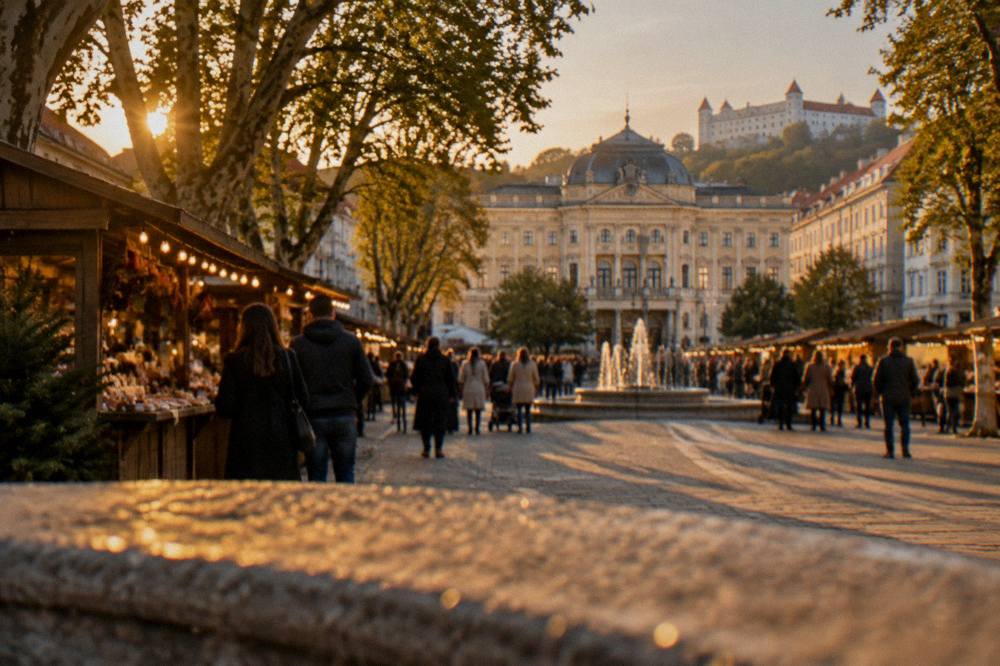
One planning note: the sweet layer peaks in December because the Christmas baking season does, and the main market's run from 26 November 2026 to 3 January 2027, closed only on 24 and 25 December, is when the pastry stalls, the cups of kapustnica and the mulled wine all sit in the same square. Palačinky, the thin filled pancakes, are the restaurant dessert that never leaves the menu, filled with jam, sweet cheese or chocolate, and rolled rather than stacked.
What Should You Drink With A Slovak Plate In Bratislava?
The two local answers are Small Carpathians white wine and Czech-style lager: the wine comes from the hill villages west of the city, where the local varieties have grown for centuries of family cellars, and the lager arrives on tap nearly everywhere, while the third local drink to know is slivovica, a plum brandy offered as a digestif, and in November the young St Martin's wine. The wine story is the one that surprises visitors, because Bratislava sits at the eastern end of a wine route that runs through Modra and Pezinok, close enough that a cellar visit fits an afternoon.
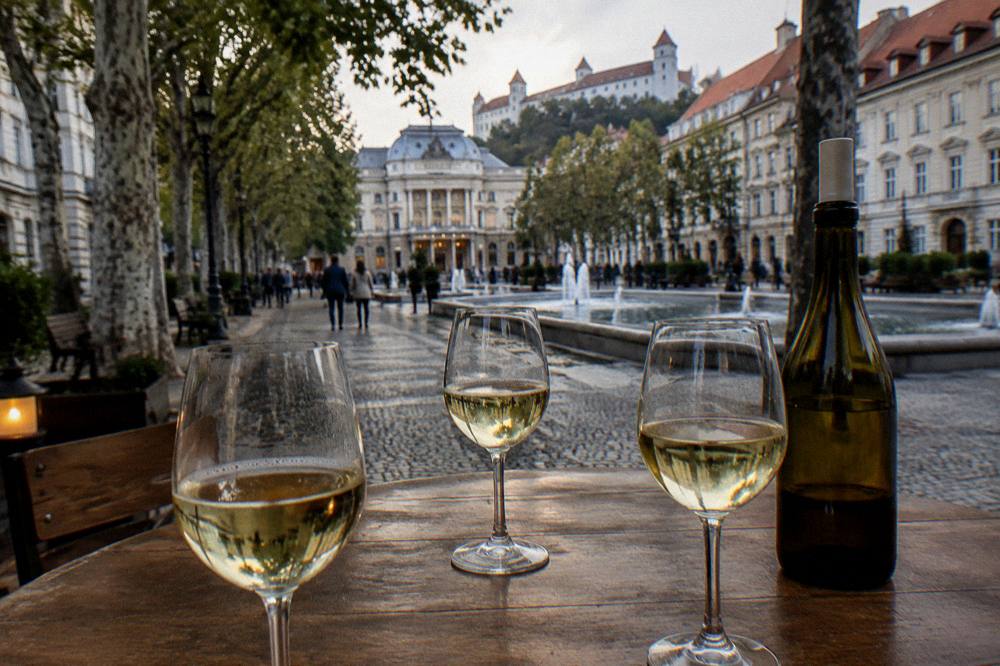
Reported tradition holds that young wine, mladé víno, is released from 11 November for St Martin's Day, and it appears by the glass in the weeks after; treat the date as reported custom and check what is on the board rather than assuming. The fuller wine picture, including the route through the cellar villages and what the tastings cover, sits in the Slovak wine guide. In the city itself, a guided tasting removes the language barrier from the label, and an unusual variant does it entirely in the dark, which changes how the wine reads.
| Drink | What it is | How it fits a meal |
|---|---|---|
| Small Carpathians white | Local still whites from the hills west of the city | The default pairing for halušky |
| Local lager | Czech-style pilsner on tap | The default pairing for fried and pork plates |
| Slivovica | Plum brandy | A small glass after the meal |
| Mladé víno | Young wine from 11 November | Seasonal, by the glass |
For pairing logic, keep it simple: the sheep-cheese plate wants the acidity of a white, the fried cutlet wants the lager, and the cabbage soup takes either. None of this is rule-bound, and the city's bars, covered in the pub guide, pour both lists side by side.
How Does Eating In Bratislava Change With The Seasons?
The plates barely change but the setting does: from late November to early January the eating moves outdoors to the Christmas market on Hlavné námestie and Hviezdoslavovo námestie, running 26 November 2026 to 3 January 2027 with the tree lit at 18:00 on opening day, while in the warmer months tables spread across the squares and the wine season runs from the 11 November release of young wine onward. The climate frames it: the modelled ERA5 reanalysis for Bratislava, 1991 to 2020, puts July's mean daily high at 26.3 C and January's at 3.0 C, with July carrying 75.8 mm of rain and February 33.4 mm.
| Period | Mean high (ERA5 1991-2020) | Rain mm | What the food year does |
|---|---|---|---|
| Dec to Feb | 3.0 to 5.5 C | 33.4 to 40.0 mm | Christmas market, hot cups, heavy plates |
| Mar to May | 10.3 to 20.4 C | 42.0 to 69.1 mm | Tables move outdoors, Easter baking |
| Jun to Aug | 24.1 to 26.3 C | 66.8 to 75.8 mm | Riverfront eating, white wine season |
| Sep to Nov | 8.9 to 20.8 C | 46.3 to 67.1 mm | Harvest, young wine from 11 November, market opens 26 November |
The numbers above are modelled climate normals, not a station record, and they are the honest way to plan: winter eating in Bratislava is indoor-and-market eating, summer eating spills onto squares and the Danube riverfront at Eurovea. Christmas Day itself, 25 December, the market is closed along with 24 December, so plan the market visit before the holiday or between Christmas and 3 January.
Can You Turn Eating Into A Guided Experience In Bratislava?
Yes, and it is often the efficient way in: Bratislava carries guided food walks that move through the Old Town with a local guide and a string of tasters, wine tastings that include a guided session in the dark, and beer-and-food walks, and a guided first evening teaches the dish vocabulary faster than a menu-reading evening alone. The site's tour pages print the prices, ratings and durations for each. The decision is really about depth: a taster walk samples, a traditional food walk sits down, a tasting in the dark is purely about the glass.
Want to taste your way across the Old Town? Book a Bratislava food tour here.
The pairing that works for a first visit is a city walk in the morning and a food walk in the evening of the same day; the walks cover different ground, and the second one ends at a table. Where a guided plate goes further than self-directing is reach: dishes that read as risky orders from a foreign menu, like the pig-heavy winter plates or the offal-adjacent classics, arrive as explained tasters instead of gambles. Anyone wanting the beer side of the ledger rather than wine gets the same structure in a combined walk, listed on the food tour page, with availability through Check availability.
How Do You Build A Full Food Day In Bratislava?
A workable food day: coffee and pastry in the Old Town in the morning, bryndzové halušky as a sit-down lunch, a walk up to the castle grounds, open daily 08:00 to 22:00, in the afternoon, a Small Carpathians white or a lager with a snack at the riverfront, and kapustnica or a roast plate for dinner, with the whole route on foot because the Old Town and the castle sit inside one walkable district. That spine bends with the season: in December the market stalls on both main squares replace the afternoon snack, and in summer the riverfront at Eurovea carries the evening.
| Stop | What to eat or drink | Verified practical anchor |
|---|---|---|
| Morning, Old Town café | Coffee, pastry case | Cafés cluster in the pedestrian centre |
| Midday, traditional menu | Bryndzové halušky | Old Town, walkable radius |
| Afternoon, castle grounds | Nothing required, walk it | Grounds daily 08:00-22:00, free |
| Late afternoon, riverfront | White wine or lager | Eurovea riverfront |
| Evening | Kapustnica, roast plate | Market stalls in winter season |
One caution that is not about food: the castle's Museum of History, which is the indoor reason to enter, is closed on Tuesdays, as is Michael's Tower; the Old Town Hall is closed Mondays. The grounds themselves never close for a weekly day off. None of this touches the dinner plan, but it shapes the afternoon if the food day doubles as a sightseeing day, and the site's one-day itinerary pages cover the sequencing in full.
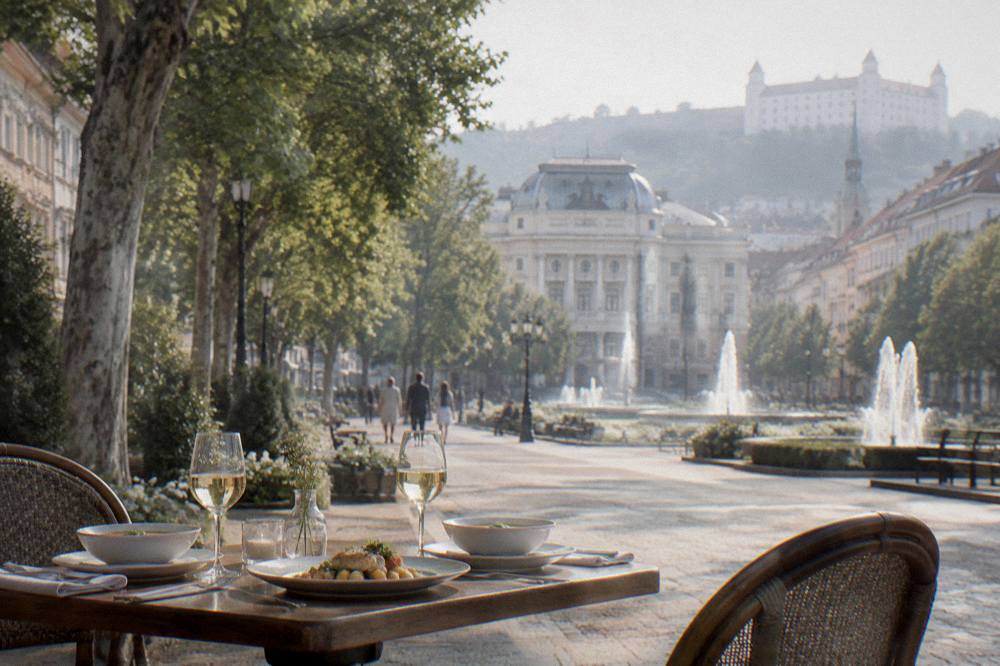
The final quarter of a Bratislava food trip is the cellar country: Modra and Pezinok sit close enough that a half-day reaches the tasting rooms, and the wine route, along with Bratislava Travel Guide's day-trip pages, lays out how to sequence it. But as a purely eating proposition the city itself holds: one national dish, one soup, one sweet, two drinks, and a walkable centre to digest them in.
Common Questions About Eating In Bratislava
What is the national dish of Slovakia?
Bryndzové halušky: potato dumplings mixed with bryndza sheep cheese and topped with fried bacon, served as one filling hot bowl.
What should I eat in Bratislava?
Order bryndzové halušky first, kapustnica sour cabbage soup second, then a roast pork plate or a fried cutlet, with lokše or a poppy-seed roll as the sweet layer.
What do Slovaks drink with dinner?
Lager on tap and white wine from the Small Carpathians are the two standards, with slivovica plum brandy as an after-dinner pour.
When does the young wine come out in Bratislava?
Reported custom places the release of St Martin's young wine at 11 November each year; it is served by the glass in the weeks that follow.
Is the Christmas market a good place to eat?
Yes. The main market on Hlavné námestie and Hviezdoslavovo námestie runs 26 November 2026 to 3 January 2027, closed 24 and 25 December, and the stalls carry the soup, grill and pastry layer of the cuisine.
What is a typical Slovak breakfast?
Bread with bryndza spread, cheese and cold cuts, eggs and pastries; the site's dedicated page on a typical Slovak breakfast covers the full morning table.