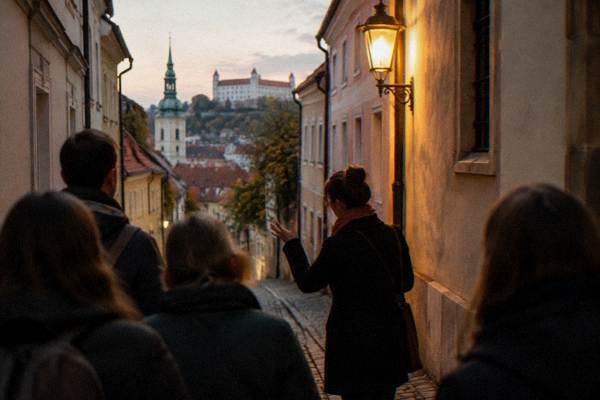
How Do You Say Hi In Slovak?
The Slovak greetings visitors to Bratislava actually need: ahoj, dobry den, dovidenia and a few polite phrases, with pronunciation help and when to use the formal form.
Bratislava, the capital of Slovakia, is a Slovak-speaking city, and the single most useful word a visitor can carry is a greeting. The good news is that Slovak hellos are short, logical and forgiving of an accent, and the choice between them comes down to one simple rule of formality rather than grammar. This page from the Bratislava Travel Guide lays out the greetings that matter, how to pronounce them, when formal speech is expected, and what to expect when you switch to English. A few Slovak words, used well, also unlock the everyday courtesies of shops, restaurants and wine bars across the Old Town.
What Are The Basic Slovak Greetings?
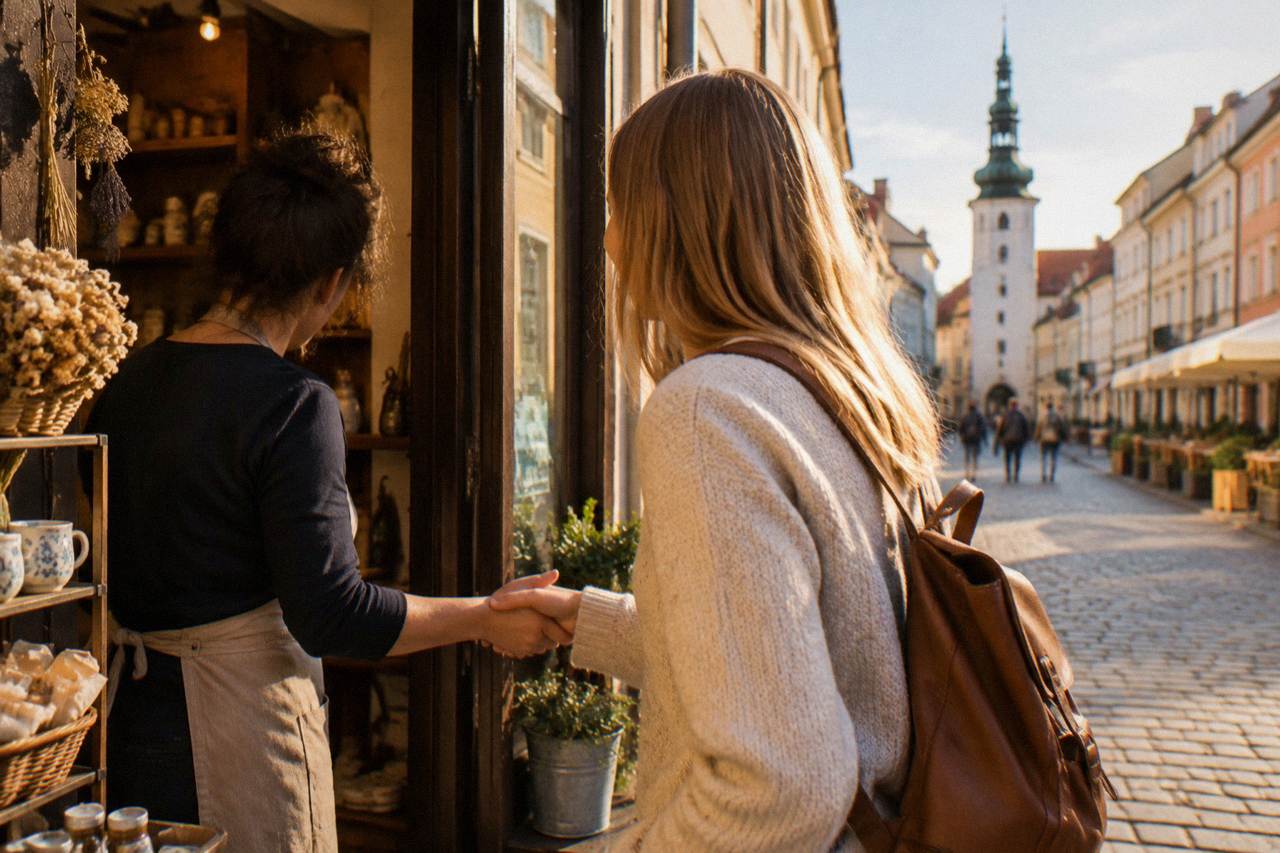
The two greetings that cover nearly every situation in Bratislava are ahoj, the informal hello used with friends, children and people your own age in casual settings, and dobry den, the formal daytime hello used with staff, strangers and anyone older, and the pair costs nothing to learn. Dobry vecer replaces dobry den in the evening, dobre rano starts the morning, and dovidenia closes every formal encounter.
Slovak is a West Slavonic language, closely related to Czech, and its greetings are built from everyday words rather than formulas you have to memorise. Dobry den literally means "good day", and the same pattern produces dobre rano (good morning) and dobry vecer (good evening). That internal logic helps: once you know dobry means good, the greeting family assembles itself.
Ahoj works differently. It is the casual hello, borrowed from the sailor's call that spread across Central Europe, and it is what friends say to each other on the street, in cafes and on the tram. Children say it to children. Adults say it to friends. A visitor who uses ahoj with a museum cashier or a waiter has misfired slightly, but Slovaks take the attempt graciously; nobody in a tourist city expects perfect register from a foreigner on a weekend break.
One more word earns its place in any pocket list: dovidenia, "goodbye", the formal parting phrase. Its casual counterpart is ciao, spelled cau in Slovak, which serves as both hi and bye between friends. A shopkeeper who says dovidenia as you leave has given you the cue to return it.
| Slovak | Rough Meaning | Where It Fits |
|---|---|---|
| Ahoj | Hi (informal) | Friends, children, peers in casual settings |
| Dobry den | Good day (formal) | Shops, museums, restaurants, strangers |
| Dobre rano | Good morning | Morning greeting, any register leans formal |
| Dobry vecer | Good evening | Formal evening greeting |
| Cau | Hi / bye (informal) | Friends only |
| Dovidenia | Goodbye (formal) | Parting in shops, venues, restaurants |
How Do You Say Hi In Slovak?
You say hi in Slovak as ahoj (ah-HOY) when the setting is informal, and as dobry den (DOH-bree DYEN) when it is formal, and the choice is the whole skill: ahoj for friends, peers and children, dobry den for staff, officials, older strangers and any service situation, with dobry vecer taking over in the evening. Dovidenia is the matching formal goodbye.
Pronunciation is friendlier than the diacritics suggest. Slovak is written almost exactly as it sounds, with a stress that falls reliably on the first syllable of a word. Ahoj therefore starts strong, AH-hoy, with the j pronounced like the y in "boy". Dobry den gets its weight on both first syllables, DOH-bree DYEN, where the y sounds close to a short i in English ears.
The accents you see on Slovak letters are there to help you, not to trap you. A caron, the little hook over letters like š and ž, signals sounds English already owns: š as in "shoe", ž as in "vision". An acute accent, as in á or é, simply makes the vowel long. Dovidenia, written with its full diacritics as do videnia, means literally "until seeing", and every syllable is pronounced in turn.
Say the greeting at a normal volume with a nod and you have done everything the situation requires. In Bratislava's Old Town, at Bratislava Castle's ticket desk, in a restaurant on Hlavné námestie or at a Small Carpathians wine tasting, the pattern is identical: walk in, catch the staff member's eye, and say dobry den.
When Should You Use The Formal Or Informal Form In Bratislava?
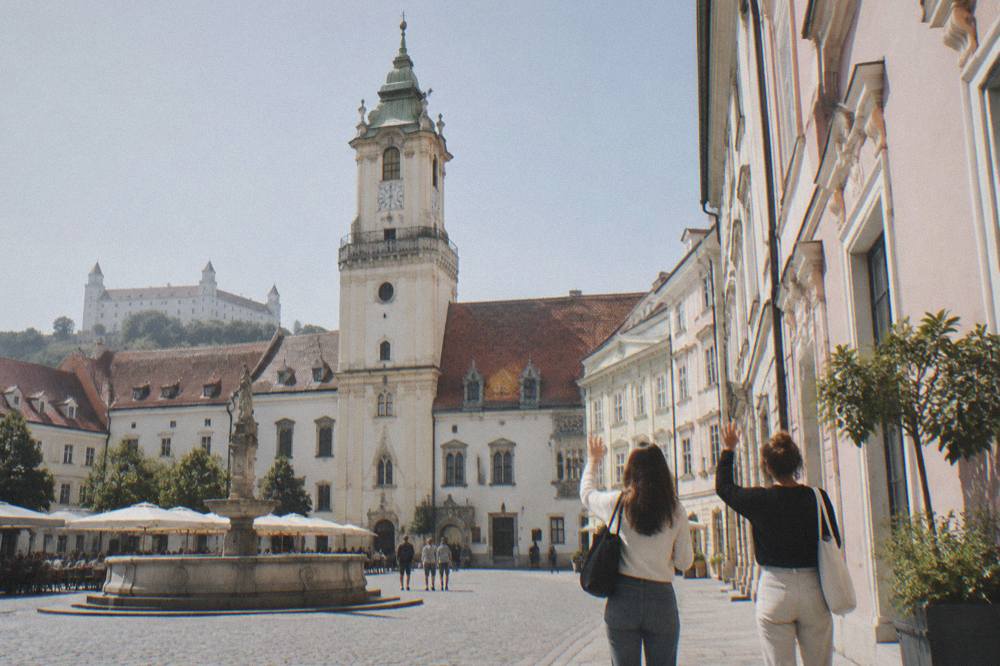
The formal form is the safe default for a visitor in Bratislava: dobry den and the formal vy addressing work in every shop, museum, restaurant, hotel and ticket counter, while ahoj and the informal ty belong to friends, family, children and clearly casual encounters, and switching to ty with a stranger or staff member reads as overfamiliar.
Slovak, like German or French, keeps a firm line between the formal and informal you: vy versus ty. The same line governs the greetings. A local uses ahoj and ty with classmates, cousins and colleagues they know well, and dobry den and vy with everyone else, including, notably, older relatives in traditional families. The formal register is not cold; it is simply polite, and it is the register service staff will use with you.
For a visitor, the calculation is easy. Address anyone in a working role, dobry den. Address anyone visibly older, dobry den. Address a child waving at you on the tram, ahoj works. If someone greets you first with ahoj and you are among friends of friends at a table, returning ahoj is right, and the mismatch, if you get it wrong, is a shrug-level error in a city that sees millions of visitors.
Two politeness habits travel well alongside the greeting. Dakujem, thank you, pronounced roughly DAH-koo-yem, fits after any purchase or favour. Prosim, please, also used as "you're welcome" and even as "come in" when answering a knock, is the workhorse courtesy word of the language. A visitor armed with dobry den, dakujem and prosim covers the entire courtesy budget of a short stay.
| Situation In Bratislava | Say | Register |
|---|---|---|
| Entering a shop or cafe | Dobry den | Formal |
| Museum ticket counter | Dobry den | Formal |
| Evening restaurant arrival | Dobry vecer | Formal |
| Leaving any venue | Dovidenia | Formal |
| Greeting a child | Ahoj | Informal |
| Friends at a pub table | Ahoj or Cau | Informal |
| After receiving anything | Dakujem | Either |
Do You Need Slovak In Bratislava, Or Is English Enough?
English carries a visitor through most of Bratislava without difficulty: the city's tourist infrastructure, menus in the centre, museum signage aimed at visitors and the younger population generally handle English, and the 2024 figures show 1,188,915 overnight visitors, 67 percent of them from abroad, so the service economy is built for non-Slovak speakers. A greeting in Slovak still earns warmth that English alone does not.
The practical reality is layered. Staff at hotels, mainstream restaurants, ticket desks and the castle speak enough English for transactions. Older residents and smaller neighbourhood shops outside the centre may have less, and a dobry den plus patience covers those moments better than louder English. Slovak is the state language, and Hungarian has a significant presence in the country's linguistic makeup, but the visitor's two practical languages in the capital are Slovak and English.
German serves reasonably in the tourist sector given Austria's proximity, and Czech is mutually intelligible with Slovak to the point that Czech visitors need no translation at all. But a first hello in Slovak, rather than a first hello in English, marks you as someone making an effort, and that small gesture shapes how the rest of the exchange goes. The page on whether you can speak English in Bratislava goes deeper on the language landscape.
For a structured introduction to the city in English, the guided walking tour with castle entry pairs an Old Town walk with a Bratislava Castle ticket, and you can Check availability for your dates. A guided walk is also where a question like "how do you pronounce this street name" gets answered on the spot, which no phrasebook manages.
What Other Slovak Phrases Help In Bratislava?
A short second tier of Slovak phrases covers food, directions and courtesy: prosím for please and you're welcome, ďakujem for thank you, prepáčte for excuse me, dobrú chuť to wish good appetite, and na zdravie as the toast, and these five plus a greeting handle nearly every interaction a visitor has at a table or on a street in Bratislava.
Food matters in this city, and the table phrases come up constantly. Dobru chut, literally "good taste", is what Slovaks say before eating, the equivalent of bon appétit, and saying it at a shared table marks you as fluent in custom even when your Slovak stops there. Na zdravie, "to health", is the standard toast over beer or wine, and the pub and beer culture guide covers where to practise it.
| Slovak Phrase | What It Means | When To Use It |
|---|---|---|
| Prosím | Please / you're welcome / come in | Handing over money, answering thanks |
| Ďakujem | Thank you | After any service or purchase |
| Prepáčte | Excuse me | Getting attention or squeezing past |
| Dobrú chuť | Enjoy your meal | Before eating at a shared table |
| Na zdravie | Cheers / to health | Raising a glass |
| Koľko to stojí? | How much does it cost? | Markets, small shops |
| Hovoríte po anglicky? | Do you speak English? | Opening a switch to English |
Questions close the loop. Kolko to stoji asks how much something costs, useful at a market stall where prices may not be displayed. Hovorite po anglicky, "do you speak English?", is the graceful way to switch: it asks permission rather than assuming, and the question itself shows you tried. Numbers one to ten are worth a glance too, since a market vendor will answer kolko to stoji with digits you want to recognise.
Ordering in the food-and-drink context is where these phrases cluster, and the guide to what to eat in Bratislava names the dishes worth pointing at when vocabulary runs out. Slovak service culture appreciates the greeting before the request, so dobry den first, then the question, then dakujem, is the sequence locals use in every shop in the country.
Does Slovak Pronunciation Have Any Tricks For Visitors?
Slovak pronunciation is regular enough that reading it aloud usually lands close: stress falls on the first syllable, every letter is pronounced, š sounds like sh, ž like the s in vision, c like ts, and the letter j always sounds like y, so ahoj is ah-HOY and never ah-HOZH, and ch counts as a single letter sounding like the ch in Bach.
That regularity is rare among European languages and it is the visitor's biggest advantage. English spelling hides its sounds; Slovak spelling shows them. Once you internalise five or six letter values, street names like Obchodná, Michalská and Hviezdoslavovo stop being intimidating strings and become pronounceable words. Hviezdoslavovo námestie, for the record, starts with a sound like hv in "ahead-vee" run together quickly, and even locals deliver it at speed.
The d and t plus soft vowels combinations, ď and ť, carry a palatal softness English lacks, as in ďakujem. An approximation that Slovaks accept happily: think of the d in "due" and the t in "tea", said quickly and lightly, rather than the flat d and t of "do" and "top". The letter r can act as a vowel, as in the infamous bridge name Most SNP's neighbourhood Petržalka, where the ž is "zh" and the first r carries its own beat.
Length matters more than in English. The acute accent marks a long vowel, and Slovak distinguishes words by length alone. In greetings, the risk is minimal: ahoj, dobry den and dovidenia survive any reasonable accent. The reward for a little effort is real, because a street name said recognisably gets you pointed in the right direction, while the same name mangled into English phonetics often draws a blank.
Common Questions About Saying Hi In Slovak
How Do You Say Hi In Slovak?
Say ahoj in informal settings and dobry den in formal ones. Ahoj (ah-HOY) is for friends, children and peers; dobry den (DOH-bree DYEN) is for shops, restaurants, museums and strangers. In the evening the formal greeting becomes dobry vecer, and the matching formal goodbye is dovidenia.
Is Ahoj Formal Or Informal?
Ahoj is informal. It is the hello for friends, family, children and casual encounters, and it pairs with the informal ty form of address. With staff, officials, older strangers or any service situation in Bratislava, dobry den is the correct choice.
Do People In Bratislava Speak English?
Yes, in the tourist infrastructure and among younger residents English is widely usable, and the 2024 figures show 1,188,915 overnight visitors of whom 67 percent came from abroad. Hotel staff, central restaurants and ticket desks handle English transactions. A greeting in Slovak first still earns warmth.
How Do You Say Thank You In Slovak?
Thank you is ďakujem, pronounced roughly DAH-koo-yem with a soft d at the start. The reply is prosím, which also means please and serves as "you're welcome". Dakujem fits after every purchase, meal and favour.
What Does Na Zdravie Mean?
Na zdravie means "to health" and is the standard Slovak toast when raising a glass of beer or wine. It also appears as a response to a sneeze. Use it at any table in Bratislava and you will match local custom exactly.
How Do You Say Goodbye In Slovak?
The formal goodbye is dovidenia, used when leaving shops, restaurants and museums. Between friends, cau serves as both hi and bye. Staff who say dovidenia as you leave are giving you the closing word to return.
Slovak greetings ask little and return much: one formal pair, dobry den and dovidenia, one casual ahoj, and the courtesy tag of dakujem and prosim carry a whole visit to Bratislava. Start with the formal register, let locals pull you informal if they choose, and the language will feel like part of the city rather than a barrier outside it.