Can I Speak English In Bratislava?
English in Bratislava: where it works, where it does not, ticket machines, guided tours in English and the few Slovak words that help, reported from primary sources.
Bratislava, the capital of Slovakia, is an inland city on the Danube of about 468,000 residents, and it is one of the easier small European capitals to visit without speaking the local language. The official language is Slovak, but the city's own visitor economy runs substantially on foreign demand: the Statistical Office of the Slovak Republic, as reported by the Bratislava Tourist Board, counted 1,188,915 overnight visitors in 2024, and 67 percent of them came from abroad, with Czechia, Germany, Poland, Austria and the United Kingdom as the top source markets. That mix explains why the practical layer of the city, ticket machines, museum signage and guided products, is built to work in English.
Yes, you can get through a full visit to Bratislava on English alone, from buying a tram ticket at a machine to ordering in Old Town restaurants and taking a guided castle walk, because the city's tourism infrastructure is built for a majority-foreign audience: 67 percent of its 1,188,915 overnight visitors in 2024 came from outside Slovakia, with Germany, Poland, Austria and the United Kingdom among the top markets. Slovak remains the official language, and English thins in a few specific corners, which this page maps out.
The visitor economy is the strongest published signal of how language works here. When two thirds of overnight guests are foreign and the largest markets after Czechia are German, Polish, Austrian and British, the hotels, museums and tour operators that depend on them staff and sign accordingly. German also functions widely in tourist-facing roles, which doubles the odds that a visitor from the UK or US finds a workable common language.
None of this means Slovak has disappeared. It is the language of the street, the courts and the corner shops away from the centre, and a visitor who stays in residential districts will meet it constantly. The honest framing is not "everyone speaks English" but "the parts of Bratislava a visitor touches are prepared for English, and the rest is manageable with patience and a translation app." For a wider picture of the language itself, the site's Slovak language guide for visitors covers greetings, pronunciation and what to expect on signage.
Where English Works Best In Bratislava?
The strongest English coverage sits in the visitor-facing layer of the city: the Old Town's hotels, restaurants and cafés, the ticket desks and websites of the major sights including Bratislava Castle and Devin Castle, the IDS BK public transport app and ticket machines, and every bookable guided tour in the city's roster, which lists English as its operating language. Museums including the Slovak National Gallery publish their hours and admission pages in English online.
The sight layer is the most reliable. The Bratislava Castle Museum of History, Michael's Tower, the Old Town Hall and Devin Castle all sell tickets across counters that serve an international audience daily, and their official pages carry English versions of hours and prices. The Slovak National Gallery's visit page is published in English, and the gallery opens its doors free to everyone on the first Sunday of each month, an offer that needs no negotiation at the desk.
Practical services follow the same pattern. The IDS BK public transport system sells tickets through an app with an English interface, through ticket machines and by SMS, so nobody needs a Slovak conversation to ride a tram. How to pay is covered in detail in how to pay for public transport in Bratislava.
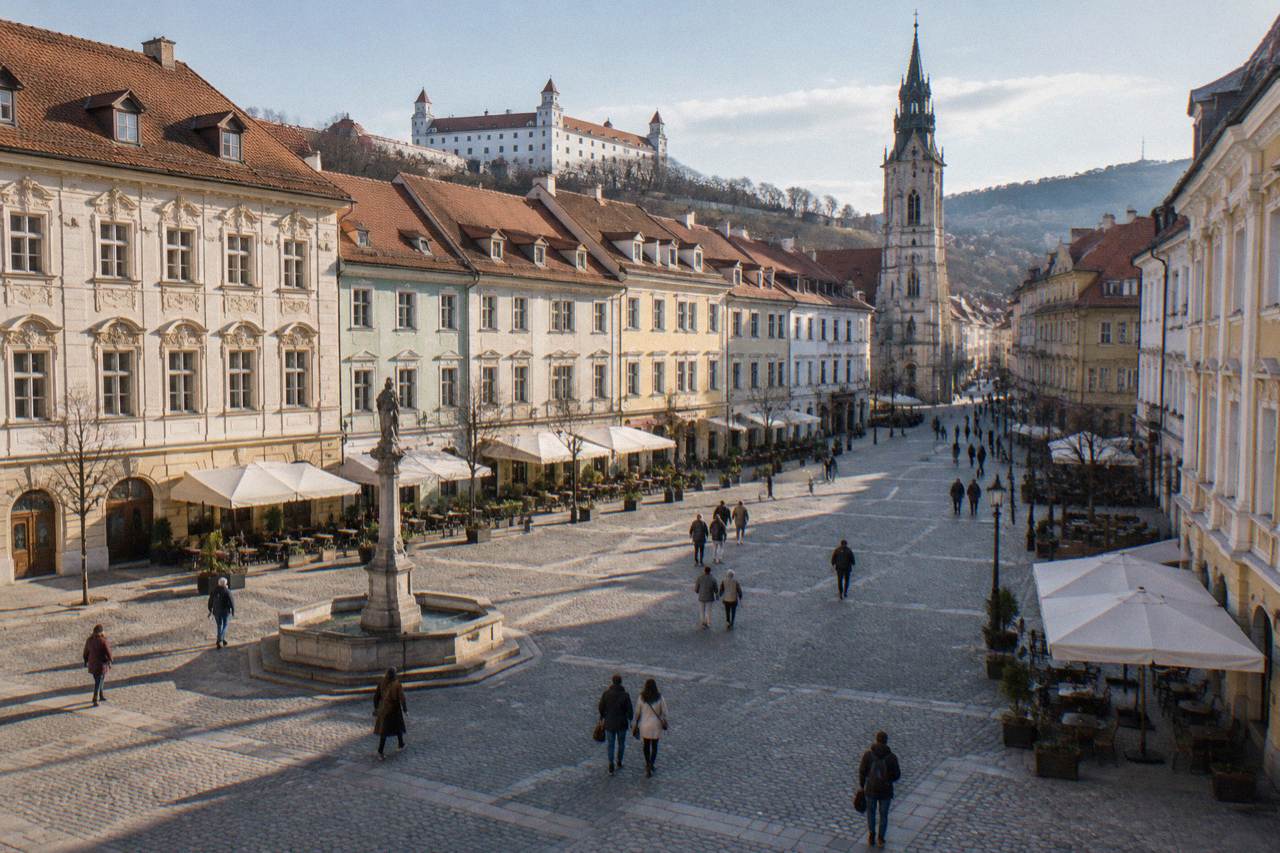
Restaurants in the pedestrian centre post menus with English translations as standard practice, and the staff who serve Hlavné námestie and Hviezdoslavovo námestie work international tables every shift. Outside the core, in Petržalka or the station area, expect more Slovak-only menus and slower conversations, which is a fair trade for the lower prices in those districts.
How Does Bratislava Compare With Other Capitals For English?
Bratislava behaves like a compact Central European capital whose tourism demand is overwhelmingly cross-border: its 2024 top five visitor markets were Czechia, Germany, Poland, Austria and the United Kingdom, and Slovak shares enough vocabulary with Czech that the city's service sector is accustomed to switching languages constantly. English sits alongside German as the default second language in visitor-facing jobs, so a monolingual English speaker faces fewer gaps than in genuinely monolingual destinations.
The comparison that matters is with Vienna, an hour away by train, and with Budapest and Prague. Vienna's tourism volume is far larger and its English penetration correspondingly deeper, a contrast explored in which is nicer, Vienna or Bratislava. But the practical difference for a visitor is smaller than the volume gap suggests, because Bratislava's sights are concentrated in a walkable core, covered in is Bratislava a walkable city, where the density of English-signposted services is at its highest.
Do Guided Tours In Bratislava Run In English?
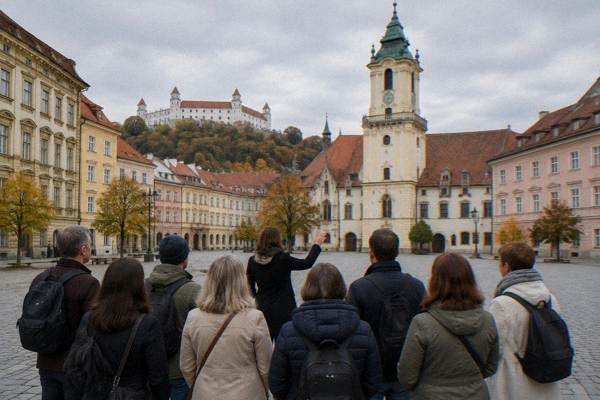
Every bookable product in the city's roster lists English as its operating language, from small-group walking tours of the Old Town and castle to food walks, wine tastings and full-day castle trips, and the operators' listings state the language up front so you can confirm before paying. The free, tip-based walks that run in Bratislava are also delivered in English, with the tip paid at the end.
A guided walk is, in practice, the lowest-friction way to spend a day here without Slovak. The Story of Bratislava city and castle walking tour and its rivals cover the Old Town and castle hill with a live commentary in English, and the private options let a visitor set their own pace and ask questions freely. Food and wine products follow the same pattern: the Old Town food tours and the sommelier-led tastings all operate in English because their customers are overwhelmingly international.
The day-trip layer is the same. Products to the castles of western Slovakia, to the Small Carpathians wine villages and to Bojnice depart from Bratislava with English-speaking guides, which removes the single biggest language barrier a visitor otherwise faces: regional buses and rural castle ticket desks where English coverage is thinner than in the capital.
Where Does English Thin Out In Bratislava?
English coverage thins in three places: residential districts such as Petržalka away from the sights, small shops and markets where trade is local, and bureaucratic or medical settings where Slovak is legally the working language, so carry your European Health Insurance Card and use 112, the universal EU emergency number, which has English-speaking operators. Outside the city, rural areas and some regional bus drivers are the weakest points.
The emergency layer is published and reliable: 112 is the universal EU number, with 155 for ambulance and 158 for police, and these dispatch services handle English calls as a matter of course. For everyday friction, a translation app on a phone covers the corner-shop cases, and patience covers the rest. The city is safe enough that a language gap rarely becomes a safety issue, a picture drawn in what to be careful of in Slovakia.
| Situation | English coverage | What to do |
|---|---|---|
| Old Town hotels and restaurants | Strong, English menus standard | No preparation needed |
| IDS BK ticket machines and app | English interface | Buy in the app before boarding |
| Major sight ticket desks | Strong, English pages online | Check hours online first, note Tuesday closures |
| Regional buses and rural sights | Thin, Slovak dominant | Take a guided day trip instead |
| Emergency calls | 112 handles English | Save 112, 155, 158 before arrival |
One planning note: the castle museum and Michael's Tower close on Tuesdays, the Old Town Hall closes on Mondays, and Devin Castle stays open all winter, Tuesday to Sunday 10:00 to 16:00 from November to February. All of these hours are published in English on the museums' own pages, so the burden of checking falls on reading, not on asking.
Do You Need Slovak For Day Trips From Bratislava?
You do not need Slovak for the bookable day trips, because the operators run them with English-speaking guides, but you benefit from a few words if you travel independently by regional bus or train, where drivers, station staff and village ticket desks work in Slovak. The trade-off is simple: independence is cheaper, guided trips remove the language question entirely.
The Beckov, Trenčín and Bojnice castles day trip is the clearest example. It covers three castle sites across a full day in western Slovakia, several of them in small towns where an independent visitor would face Slovak-only ticket counters and bus connections, and it does so with a guide who explains the history in English throughout. For visitors weighing the format, the castles day trip from Bratislava page carries the itinerary details, and Check availability shows live dates before you commit.
Independent travel is still viable. The REX8 train to Vienna runs hourly and takes 56 minutes with a fixed fare of 12.70 EUR, and tickets can be bought from machines without a conversation. Within Slovakia, regional trains and buses are the thinner zone, so a translation app and written destination names are the practical toolkit.
| Way to travel | Language needed | Notes |
|---|---|---|
| Guided day trip | English only | Guide handles tickets and timings |
| Vienna by REX8 train | English only | Machine purchase, hourly, 56 minutes |
| Slovak regional bus | Basic Slovak helps | Written destination names work |
| City walking and dining | English only | Old Town is fully covered |
Common Questions About Speaking English In Bratislava
Can I Speak English In Bratislava?
Yes. The Old Town, the major sights, public transport ticketing and every bookable guided tour work in English, and 67 percent of the city's 1,188,915 overnight visitors in 2024 were foreign, with Germany, Poland, Austria and the UK among the top markets.
Is English On Museum Signs In Bratislava?
The major museums publish their hours and admission pages in English online, and the main sights serve an international audience daily across their ticket desks. Smaller municipal museums carry less translated material.
Can I Buy Public Transport Tickets Without Slovak?
Yes. The IDS BK app has an English interface, ticket machines sell standard tickets, and SMS purchase is also available. Singles for zones 100 and 101 cost 1.20 EUR for 30 minutes or 1.80 EUR for 60 minutes on paper, less in the app.
Do Taxis And Rideshafts Need Slovak?
App-based rides remove the conversation entirely, since destination and payment are handled in the app. Street-hailed taxis are the one transport mode where Slovak helps.
What If I Need Emergency Help And Speak No Slovak?
Call 112, the universal EU emergency number, which handles English calls. The dedicated lines are 155 for ambulance and 158 for police.
Do Tours Outside Bratislava Run In English?
Yes, the bookable day trips from the city's roster, including castle routes and wine-region trips, list English as their operating language, and the free tip-based city walks are also delivered in English.
Whether the city rewards the effort is a separate question, and the answer sits in is Bratislava worth visiting and what not to miss in Bratislava. The language itself will not be the thing that slows you down. For everything else, Bratislava Travel Guide keeps the practical layer, hours, tickets and transport, in one place.