Is Slovakia Friendly To Americans?
Is Slovakia friendly to Americans? A sourced answer for Bratislava visitors: entry, language, money, safety figures and what the official pages actually say.
Bratislava, the capital of Slovakia, sits on the Danube about an hour by train from Vienna, and it receives American travellers under the same rules as any other Schengen destination. The city has about 468,290 residents (city statistics, 24 June 2026), prices in euros, and a tourism sector built around a pedestrian Old Town, Bratislava Castle and St Martin's Cathedral. Whether a country is "friendly" is a judgement; what can be reported is the paperwork, the language situation, the costs and the safety record, all of which come from official pages rather than impressions.
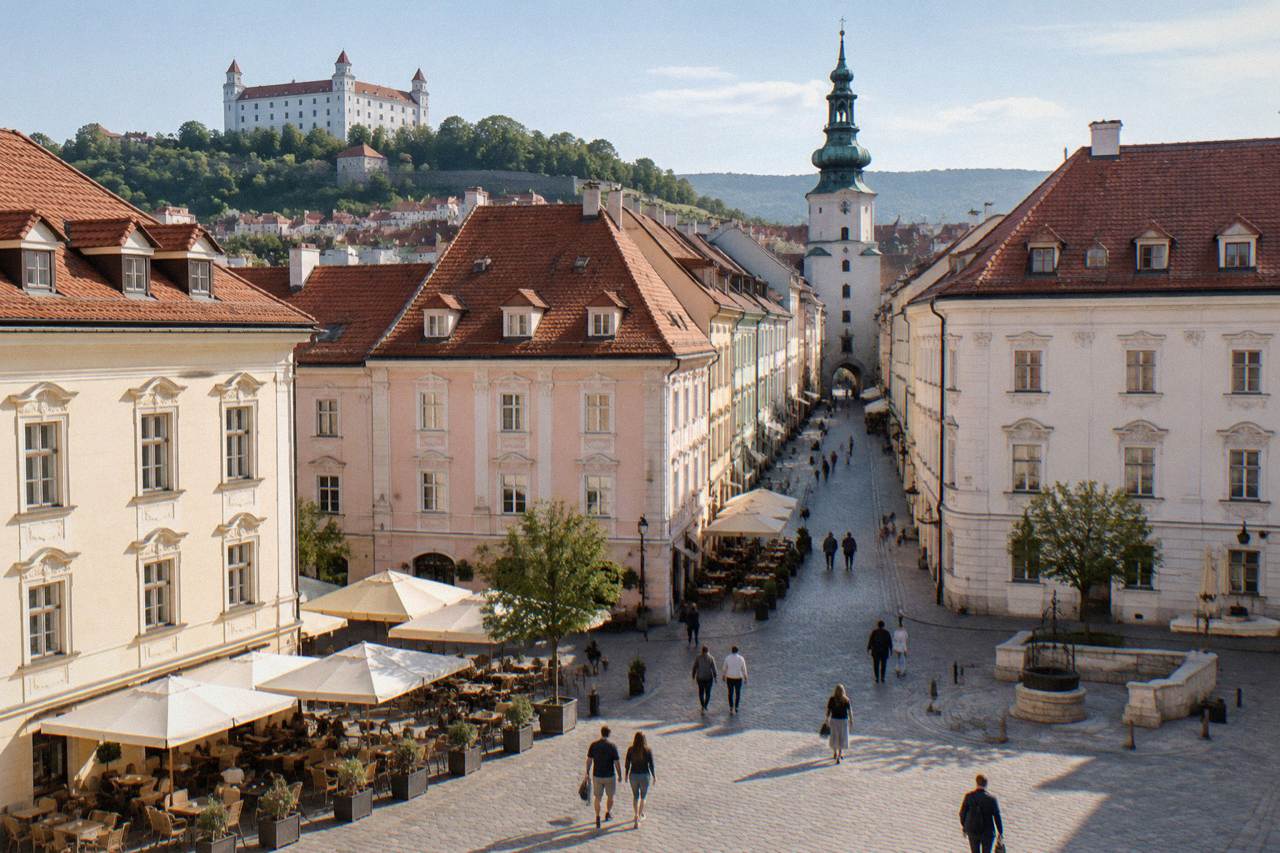
Slovakia places no specific barrier in the way of American visitors, and Bratislava's own tourism record points the other way: 1,188,915 overnight visitors in 2024, up 3.2 percent on 2023, with 67 percent arriving from abroad and the United States listed among the strongly growing source markets alongside China. The country is in the Schengen Area, reported since 21 December 2007, and it has used the euro since 1 January 2009. Nothing in the entry system, the currency or the city's visitor infrastructure targets Americans differently from anyone else.
"Friendly" in practice comes down to three things an American can check before flying: whether the paperwork is simple, whether English works, and whether the city is safe and easy to move around in. On all three, Bratislava's official record is straightforward, and the figures the sources give bear it out. For a broader verdict on the city itself, the companion page is Bratislava worth visiting covers the sightseeing case.
What Do Americans Need To Enter Slovakia?
Slovakia is part of the Schengen Area, reported as a member since 21 December 2007, so American visitors enter under Schengen rules rather than a separate Slovak regime, and the euro has been the currency since 1 January 2009, which removes money-changing friction entirely. Specific passport and visa requirements for United States citizens are not stated on this page; the rules sit with official government sources, and the dedicated page can Americans travel to Slovakia without a visa goes through the entry question in detail. Once inside, everything runs on euros.
Emergency numbers are the standard European set: 112 for the EU-wide service, 150 fire, 155 ambulance, 158 police and 159 municipal police. Tap water in Bratislava is reported safe to drink. The city's tourist tax is EUR 3.50 per person per night in the Old Town and EUR 3.00 elsewhere, charged at accommodation and capped at 60 nights per taxpayer per year.
| Practical basic | What the sources say |
|---|---|
| Currency | Euro, since 1 January 2009 |
| Travel zone | Schengen Area, reported since 21 December 2007 |
| Tourist tax | EUR 3.50 per person per night in the Old Town, EUR 3.00 elsewhere, max 60 nights |
| Emergency numbers | 112 (EU), 150 fire, 155 ambulance, 158 police, 159 municipal police |
| Population | 468,290 as of 24 June 2026 |
One practical note worth flagging: arriving from Vienna is unusually easy. The REX8 train runs hourly from Vienna Hauptbahnhof to Bratislava hlavná stanica in 56 minutes for a 12.70 EUR one-way fare, which makes Bratislava one of the simplest capital-city add-ons in central Europe for anyone already in Austria.
Can You Get By In Bratislava With Only English?
Bratislava's tourism layer, ticket pages, museum sites, the Bratislava CARD programme and tour listings, operates in English as standard, so an American visitor who speaks no Slovak can buy castle tickets, ride public transport and book guided walks without a phrasebook. The deeper question of how widely English is spoken in daily life is covered on can I speak English in Bratislava, but the parts of the city a visitor actually touches are built for foreign arrivals, and 67 percent of 2024's overnight visitors came from abroad.
The clearest evidence is the ticketing itself. Bratislava Castle's museum page publishes its hours and prices in English, Devin Castle's site does the same, and the Bratislava CARD, at 30 EUR for 24 hours with transport, includes a daily 14:00 English-language walking tour of the historic centre with a minimum of two participants. A visitor holding the card is handed an organised English tour as part of the price.
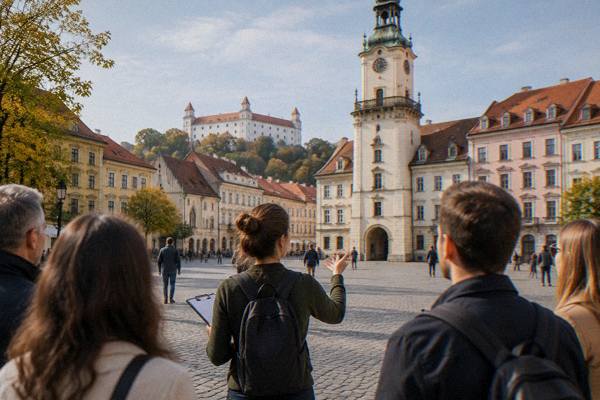
A guided walk is also the fastest way around the language gap, because a guide can translate the questions a menu or a ticket counter cannot. The private two-hour walking tour this site features covers the city with a guide to ask directly, and it suits a first day in particular:
The tour's own page carries the current price, ratings and availability, and the operator's listing handles booking directly. For visitors who want to compare it against castle-country day trips before deciding, the selection below gathers the options side by side.
Is Bratislava Safe And Easy For American Tourists?
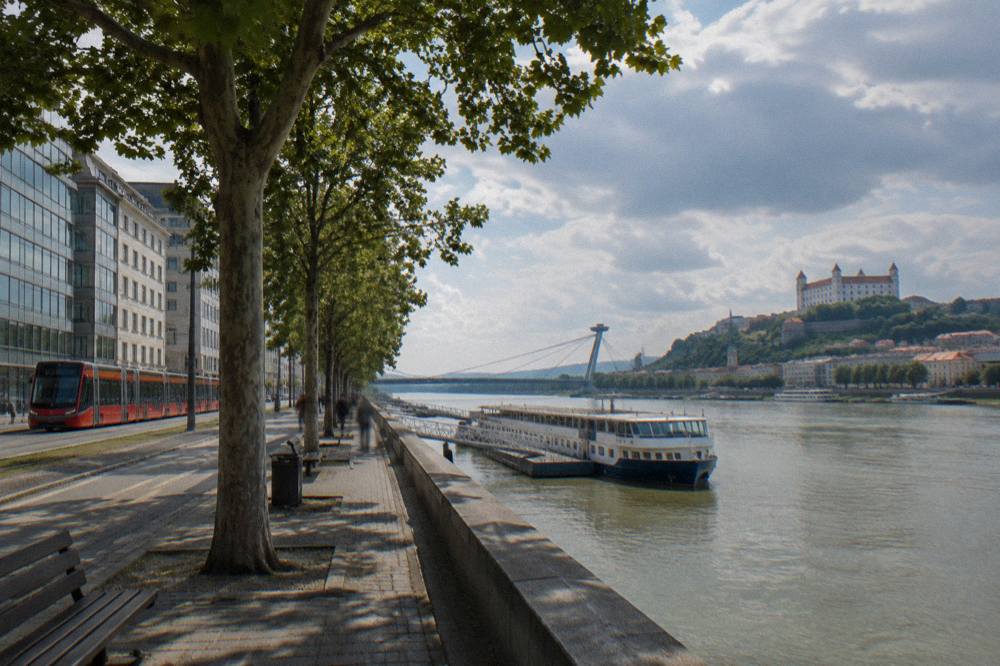
Bratislava reports no travel warnings or alerts aimed at foreign visitors, its emergency system uses the standard European numbers, and its visitor economy, 1,188,915 overnight guests in 2024, runs on a compact pedestrian Old Town where the main sights are walked rather than driven. Tap water is reported safe, the city is inland on the Danube with no coastal exposure, and the question of evening safety is handled separately on is Bratislava safe at night.
Getting around is cheap in euro terms. Standard IDS BK paper singles cost 1.20 EUR for 30 minutes or 1.80 EUR for 60 minutes in zones 100 and 101, with app tickets slightly cheaper at 1.09 and 1.60 EUR.
The main trap for an American visitor is not safety but opening days, because Bratislava's museums close on different weekdays and a wrong assumption wastes a morning. The castle museum and Michael's Tower close on Tuesdays; the Old Town Hall closes on Mondays; Devin Castle stays open all winter, Tuesday to Sunday 10:00 to 16:00 from November to February.
| Sight | Closed day | Standing adult price |
|---|---|---|
| Bratislava Castle, Museum of History | Tuesday | EUR 14 |
| Michael's Tower | Tuesday | EUR 6 |
| Old Town Hall and Apponyi Palace | Monday | EUR 8 |
| Devin Castle | Monday | EUR 8 summer, EUR 6 winter |
| UFO observation deck | None, open daily | EUR 11.50 or 12.50 |
What Should Americans Know About Money And Tipping?
Slovakia has used the euro since 1 January 2009, so American visitors face one conversion, from dollars to euros, and no local currency to learn; the tourist tax of EUR 3.50 per night in the Old Town appears on the hotel bill rather than at a border. Reported tipping practice is a round-up or 5 to 10 percent for good restaurant table service, which is lower than the American norm, so a US visitor tipping 20 percent is simply leaving more than local custom asks for.
Costs at the sights are published and modest in euro terms. St Martin's Cathedral's tourist zone, covering the treasury, crypts and gallery, is 5 EUR. Primate's Palace is 5 EUR standard. The Blue Church charges no entrance fee at all. The UFO observation deck over the Danube costs 11.50 EUR on weekday mornings or 12.50 EUR at other times, and children under 111 cm ride up free.
The cost-of-living comparison against Vienna is covered in full on is Bratislava cheap or expensive, and the honest summary for an American is that the euro prices above are the published figures, while restaurant and hotel pricing is not stated on this page.
What Kind Of Welcome Does The City Itself Give?
Bratislava's visitor programme is built for short foreign stays: a Bratislava CARD at 30 to 39 EUR bundles unlimited transport with free entry to 23 sights and that daily 14:00 walking tour, and the castle grounds are open free of charge from 08:00 to 22:00 every day of the year. The 2024 figures, 1,188,915 overnight visitors with 67 percent from abroad, describe a city that already runs on foreign guests, and the top source markets listed are Czechia, Germany, Poland, Austria and the United Kingdom, with growth reported from the United States and China.
The calendar also leans towards visitors rather than locals-only events. The main Christmas market on Hlavné námestie and Hviezdoslavovo námestie runs from 26 November 2026 to 3 January 2027, and Bratislava Jazz Days follows on 23 to 25 October 2026 at the Incheba Expo Arena. St Martin's young wine is reported to flow from 11 November each year.
Climate is the one thing to plan around. The ERA5 reanalysis for Bratislava, modelled over 1991 to 2020, gives July a mean daily high of 26.3 C and January a mean daily low of -3.1 C, with July carrying 75.8 mm of rain and February 33.4 mm. Those are modelled normals, not a station record, and the month-by-month detail sits on the best-time pages.
How Many Days Should An American Allow?
Two or three days covers Bratislava's core, the Old Town, Bratislava Castle, the UFO deck and a Devin Castle half-day, and the schedule depends on whether a Vienna or Budapest side trip is added, since the REX8 connection puts Vienna just 56 minutes away by train. Many American visitors pair the two capitals in one trip and treat Bratislava as the smaller, walkable half, arriving on the hourly Vienna service and leaving with a clear picture of the city centre. The schedule question is worked through on how many days do you need in Bratislava, where the answer is broken down by trip length and side-trip appetite.
Beyond the city, Slovakia's castle country is reachable on organised day trips, which removes the need to rent a car or read Slovak road signs. Two such trips from this site's roster, both bookable with English-language guiding, are below:
For a fuller picture of the city's headline sights, what not to miss in Bratislava lists the essentials, and why is Bratislava famous covers the history that made them that way. As this Bratislava Travel Guide records it, the desk's read of the official pages is simple: nothing about Bratislava is organised in a way that singles Americans out for anything except a longer flight.
Common Questions About Slovakia For Americans
Is Slovakia Friendly To Americans?
The official record shows no barrier aimed at American visitors: Slovakia is in the Schengen Area, prices are in euros, Bratislava's tourism infrastructure runs in English, and 2024 brought 1,188,915 overnight visitors, 67 percent of them from abroad, with the United States among the growing source markets.
Do Americans need a visa for Slovakia?
Visa and passport rules for United States citizens are not stated on this page; Slovakia applies Schengen entry rules, and the question is covered in detail on this site's dedicated entry page.
Is English spoken in Bratislava?
The tourism layer, ticket pages, museum sites, the Bratislava CARD programme and guided tours, operates in English as standard. Daily-life English outside that layer is discussed on this site's language page.
Is Bratislava safe for tourists?
No alerts aimed at foreign visitors are reported, emergency services run on the standard European numbers (112, 150, 155, 158, 159), and tap water is reported safe to drink.
What money does Slovakia use?
The euro, since 1 January 2009. The tourist tax of EUR 3.50 per person per night in the Old Town, EUR 3.00 elsewhere, is charged at accommodation.