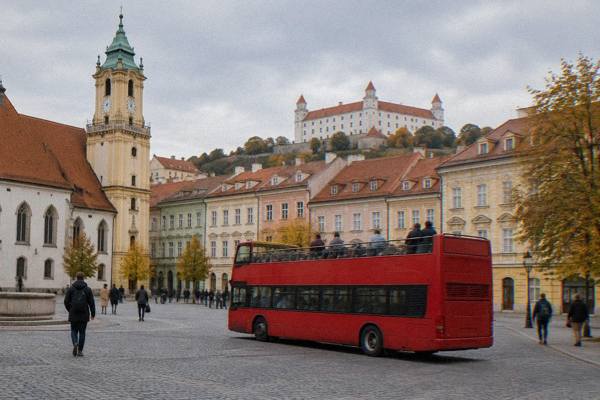
Where Is Bratislava Located?
Bratislava is Slovakia's capital, an inland city on the Danube close to the Austrian and Hungarian borders, about an hour from Vienna by train. Here is where it sits and how to reach it.
Bratislava is Slovakia's capital, and it sits inland on the Danube in the far west of the country, close to both the Austrian and Hungarian borders. The city counted 468,290 residents on 24 June 2026, according to the city's own published statistics. It has no coastline: the water that defines it is a river, not a sea, and the next capital upstream, Vienna, is about an hour away by train. This page sets out exactly where the city sits, what surrounds it, and how the map translates into travel times.
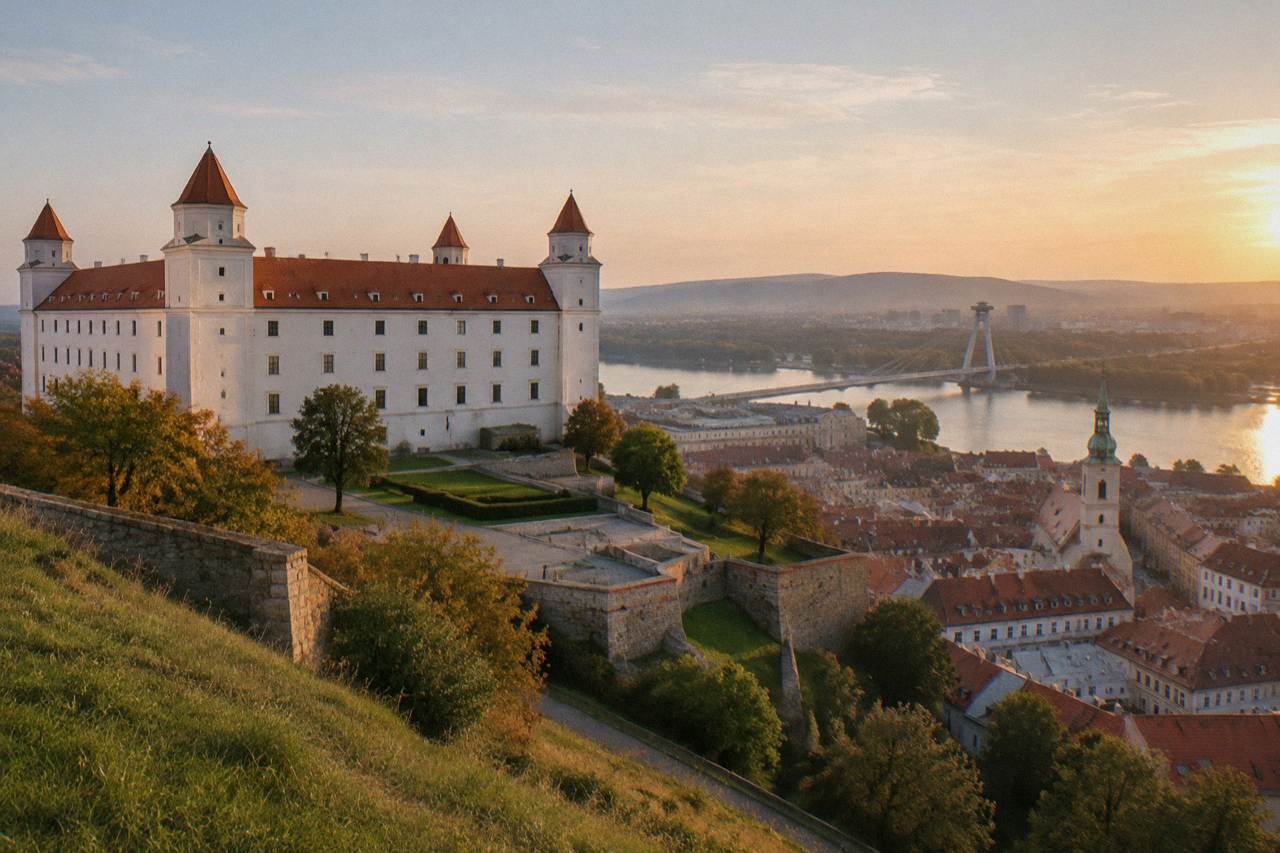
Bratislava is located in western Slovakia, on the Danube river, a short distance from the borders with Austria and Hungary, which makes it one of the few capitals that sits practically on the edge of its own country. It is an inland city, not a coastal one, and the border with Austria is so close that Vienna is reachable in 56 minutes on the direct REX8 train, per the rail information compiled at Seat 61.
That position shapes almost everything about visiting. Because the city hugs the western edge of Slovakia, day trips run in three directions: west into Austria, south into Hungary, and east into the rest of Slovakia itself. The Small Carpathians wine villages sit on the city's doorstep, and Devin Castle stands where the Danube meets the Morava. Within the city, the layout is compact: a pedestrian Old Town, the castle above it, and the river running between the historic core and the Petržalka district. The Bratislava Travel Guide covers all of it, but location is the place to start, because it explains why so many visitors arrive from Vienna rather than from inside Slovakia.
The border position also has a historical logic to it, though this page keeps to geography. When a capital sits this close to two neighbours, the question "where is it" stops being trivial: the answer determines which airport you fly into, which currency questions even arise, and whether the city works as a base or as a stop. For most readers the honest summary is that Bratislava works as both, and the short Vienna link is the reason a two-city trip is the most common shape a first visit takes. Readers weighing that trade-off directly will find the comparison page on which city is nicer, Vienna or Bratislava built exactly for that decision.
How Far Is Bratislava From Vienna And Other Cities?
Vienna is the nearest capital: the direct REX8 train runs hourly from Vienna Hbf to Bratislava hlavná stanica in 56 minutes for a fixed 12.70 EUR one way, with no reservation needed, and the REX6 reaches Bratislava-Petržalka in about 59 minutes. By boat, the Twin City Liner covers the same river stretch in about 75 minutes in high season, reported at roughly 34 to 39 EUR one way in economy.
The Vienna link is the one that matters for most trip plans, and it is unusually dense: two rail routes, a seasonal fast ferry, and direct coaches all connect the two capitals. Prague and Brno are also connected by rail, so check the operators before booking. If the plan is to treat Bratislava as a stop on a Central European run, read how many days you need in Bratislava and whether Bratislava is worth a day trip from Vienna before fixing an itinerary.
Two practical notes attach to those headline figures. First, the REX8's 56-minute timing has held only since the route was electrified in October 2025, so older guides quoting slower times are simply out of date. Second, the trains arrive at two different stations depending on the line: the REX8 reaches Bratislava hlavná stanica north of the river, while the REX6 terminates at Bratislava-Petržalka on the south bank, which matters when booking a hotel near one bank or the other. Travellers connecting through Vienna's airport should also know that Slovak Lines runs a direct coach from Vienna to Bratislava Airport, which avoids the city-pair transfer question altogether for some arrivals.
What River Runs Through Bratislava?
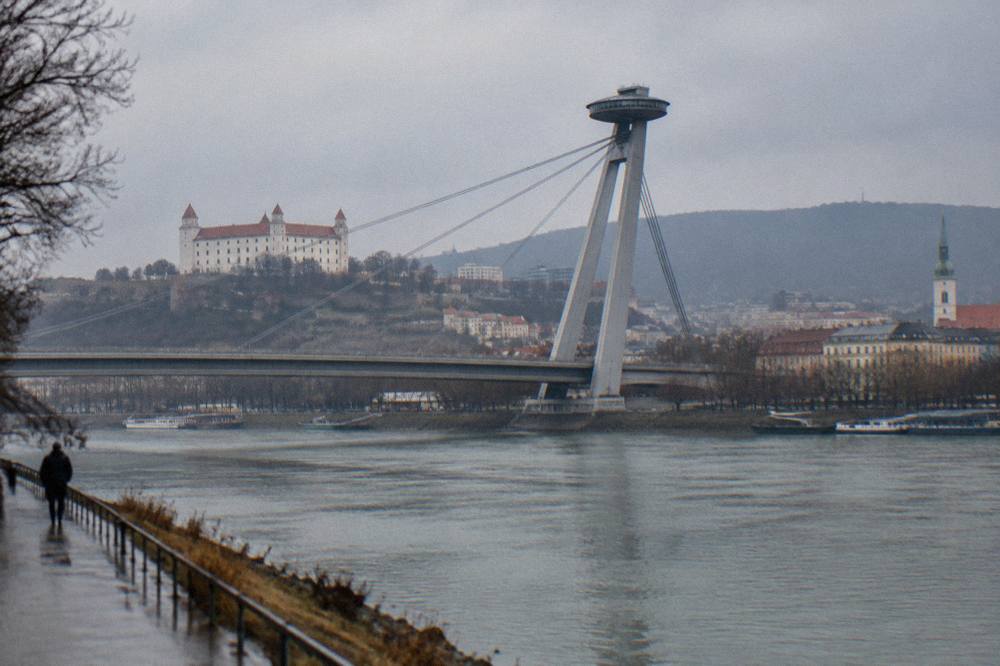
The Danube runs through Bratislava, dividing the historic core and the castle hill on the north bank from the Petržalka district on the south bank, and the bridges across it are among the city's landmarks, including the UFO observation deck on Most SNP. At Devin, on the western edge of the city, the Danube meets the Morava at the site of Devin Castle, which stays open all winter, Tuesday to Sunday 10:00 to 16:00 from November to February.
The river is not scenery only. It is a working transport corridor and a sightseeing one: river cruises run from the city centre, including a round-trip cruise to Devin Castle, and the Twin City Liner connects the city to Vienna by water in season. On land, the riverfront around Eurovea is where the modern city faces the water. For orientation on foot, the Old Town sits on the north bank, the castle climb starts from its western edge, and everything a first-time visitor needs is within a compact area; is Bratislava a walkable city covers that in detail.
The Danube also explains the city's place in the wider region better than any road map does. Following the water upstream leads to Vienna; following it downstream leads toward Budapest; and standing on the deck of the UFO bridge tower puts the whole arrangement in one view, which is a fair part of why that observation deck draws the questions it does, including the one answered at is the UFO in Bratislava worth it. Even the climate table further down this page reflects the river valley's influence on the low-lying city.
Where Exactly Is Slovakia, And Is Bratislava In The EU?
Slovakia lies in Central Europe, and Bratislava sits at its western end; the country is in the eurozone, having adopted the euro on 1 January 2009, and is reported to have joined the Schengen Area on 21 December 2007, so there are no routine border checks on the train from Vienna. Slovakia is a member of the European Union.
Within the region, the practical effect of Slovakia's memberships is simple: the same currency as Austria, open internal borders with neighbours, and the EU-wide emergency number 112 alongside the local numbers 150 for fire, 155 for ambulance and 158 for police. A related question many readers ask at this point is whether Bratislava is cheap or expensive, since the euro makes price comparisons with Vienna immediate.
It is worth being precise about one point that trips up plenty of first-time visitors: because the borders are open, the train from Vienna crosses into Slovakia without any visible checkpoint, and some passengers wonder whether they missed a control. They did not. The reported Schengen membership since December 2007 means identity checks at the land border are not part of the journey, though carrying a valid travel document is still the legal expectation, and the separate question of whether a passport is needed for the Vienna to Bratislava trip is answered on its own page.
What Is The Weather Like In Bratislava Through The Year?
Bratislava has a temperate inland climate with modelled ERA5 reanalysis normals for 1991 to 2020 showing July mean daily highs of 26.3 C and January mean daily lows of -3.1 C, with July carrying the highest monthly rainfall total at 75.8 mm and February the lowest at 33.4 mm; the year sums to about 641.5 mm of rain. These are modelled grid-cell figures, not station records.
Because the city is inland, there is no maritime buffer: winters bite and summers hold their heat. The table below gives the modelled monthly normals, which are the right tool for choosing a month, not for packing for a specific week. For timing a visit around crowds and events rather than temperature, the page on the best month to visit Bratislava goes deeper, and winter-specific questions, including the Christmas market that runs from 26 November 2026 to 3 January 2027, belong to the winter pages rather than a location primer.
Read the table for what it actually says rather than for superlatives. The shoulder months of April, May and October combine middling rainfall with daytime highs between 15 and 20 C, which is why so many itineraries land there.
| Month | Mean High C | Mean Low C | Rain mm |
|---|---|---|---|
| Jan | 3.0 | -3.1 | 34.9 |
| Feb | 5.5 | -2.3 | 33.4 |
| Mar | 10.3 | 1.1 | 42.0 |
| Apr | 16.0 | 5.7 | 44.0 |
| May | 20.4 | 10.6 | 69.1 |
| Jun | 24.1 | 14.5 | 73.6 |
| Jul | 26.3 | 16.6 | 75.8 |
| Aug | 26.2 | 16.4 | 66.8 |
| Sep | 20.8 | 12.0 | 67.1 |
| Oct | 15.0 | 7.3 | 48.5 |
| Nov | 8.9 | 3.0 | 46.3 |
| Dec | 3.7 | -1.7 | 40.0 |
How Do You Get To Bratislava And Around Once There?
The main gateway is Vienna: REX8 trains take 56 minutes from Vienna Hbf, Slovak Lines coaches run from Vienna to Bratislava Airport, and the airport itself connects to the main station by bus 61 in about 25 to 30 minutes. Inside the city, IDS BK paper singles cost 1.20 EUR for 30 minutes or 1.80 EUR for 60 minutes, with cheaper eTicket versions at 1.09 and 1.60 EUR.
The city's transport covers trams, trolleybuses and buses across all zones, and the Bratislava CARD bundles unlimited transport with free entry to 23 sights. For a first visit built around the Old Town and castle rather than the transport network, a guided walk with a castle entry ticket included removes the ticketing decisions entirely, and the northern-Slovakia day tour below shows the other half of the country's geography. You can compare both through Check availability.
Arriving by air deserves one clarifying paragraph, because the region has two airports and the names confuse people. Bratislava's own airport, BTS, is small and sits within the city's transport zones, reachable by bus 61. Vienna's airport, VIE, is far larger and lies about 45 to 90 minutes from Bratislava depending on the coach, with fares in a wide band depending on operator and booking time. Many visitors fly into Vienna and never use BTS at all, and either choice works; the deciding factors are flight price and schedule, not geography, since both airports end at the same Old Town.
| Route | Mode | Time | Fare |
|---|---|---|---|
| Vienna Hbf to Bratislava hl. st. | REX8 train | 56 min | 12.70 EUR one way |
| Vienna Hbf to Bratislava-Petržalka | REX6 train | about 59 min | fixed, no reservation |
| Vienna to Bratislava | Twin City Liner boat | about 75 min | about 34 to 39 EUR (reported) |
| Bratislava Airport to main station | Bus 61 | about 25 to 30 min | IDS BK single |
Location also decides what sits within reach beyond the city. Because Bratislava presses against the western border, the classic day trips split into two kinds: the short ones into Austria and the wine villages, and the long ones east across Slovakia to Bojnice, Orava and the High Tatras. The latter are full-day undertakings, and the tour above is one way to take in that distance without a rental car. Within the nearer ring, Devin Castle and the Small Carpathians villages need only half a day each, and Trnava is a straightforward regional rail run. That asymmetry, short hops west and long hauls east, is the single most useful thing to understand about the city's position on the map.
Common Questions About Where Bratislava Is Located
Where Is Bratislava Located?
Bratislava is located in western Slovakia, on the Danube river, close to the borders with Austria and Hungary. It is the capital of Slovakia and an inland city, roughly an hour from Vienna by train.
Is Bratislava On The Sea?
No. Bratislava is an inland city. The water that defines it is the Danube, which flows through it and onward past Vienna upstream and Budapest downstream.
Is Bratislava Close To Vienna?
Yes. The direct REX8 train covers Vienna Hbf to Bratislava main station in 56 minutes with a fixed 12.70 EUR fare, and the Twin City Liner boat takes about 75 minutes in season.
What Country Is Bratislava The Capital Of?
Bratislava is Slovakia's capital, a Central European country in the EU and the eurozone. Slovakia adopted the euro on 1 January 2009.
How Many People Live In Bratislava?
The city's own statistics put the population at 468,290 as of 24 June 2026, published ahead of the municipal elections.
Do You Need A Different Currency In Bratislava Than In Austria?
No. Both countries use the euro; Slovakia adopted it on 1 January 2009, so crossing from Vienna involves no currency exchange.