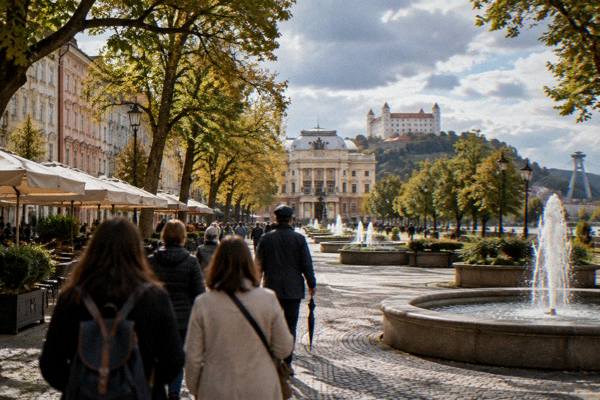
Bratislava Time Zone And Practical Facts
Bratislava runs on Central European Time and on the euro, and most of the practical numbers a visitor needs are small and stable: 1.20 EUR tram tickets, a 3.50 EUR nightly tourist tax in the Old Town, and one emergency number, 112.
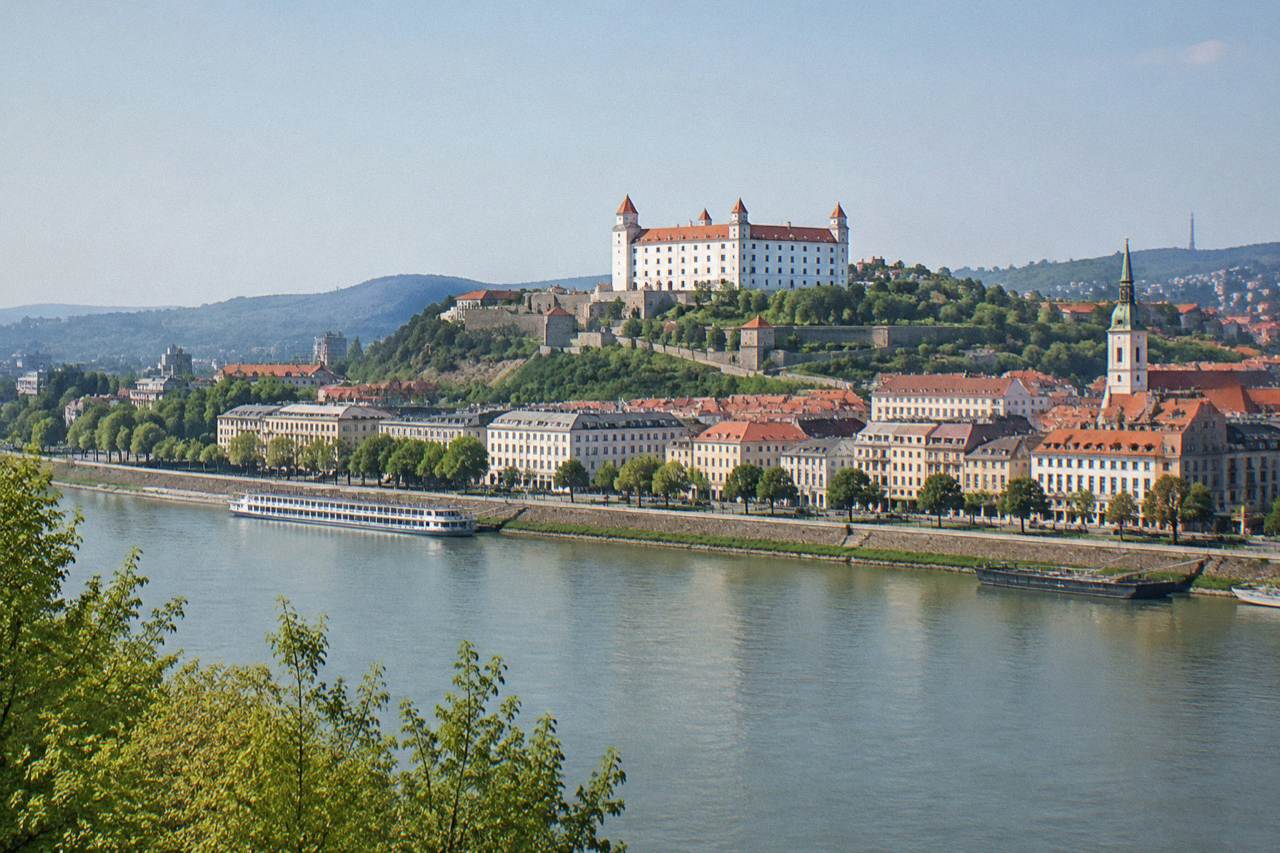
Short answer
Bratislava is on Central European Time (UTC+1, UTC+2 in summer) and uses the euro. A 30-minute public transport single costs 1.20 EUR on paper, the tourist tax is 3.50 EUR per person per night in the Old Town, and 112 reaches all emergency services.
Bratislava, the capital of Slovakia, keeps Central European Time and prices everything in euros, and those two facts settle most of the small planning questions a visitor has before arrival. The rest of this page gathers the numbers that actually matter on the ground: what a tram ticket costs, which night the clocks change, how much tourist tax a hotel in the Old Town adds, and which single phone number reaches every emergency service. Every figure below comes from the primary source that publishes it, from the IDS BK fare table to the city's own tourist-tax ordinance. For the wider picture of sightseeing, the site's things to do in Bratislava page covers the attractions themselves.
What Time Zone Is Bratislava In?
Bratislava keeps Central European Time, which is UTC+1 from late October to late March and UTC+2 in summer under the European Union's daylight-saving arrangement, so the city sits on the same clock as Vienna, one hour ahead of London and six hours ahead of New York for most of the year. Clocks move forward one hour on the last Sunday of March and back one hour on the last Sunday of October.
That places Bratislava an hour ahead of the British Isles all year, with no period where the gap changes, and it removes any jet-lag arithmetic for anyone arriving from Vienna: the REX8 train covers the route in 56 minutes with no border check, since Slovakia has been in the Schengen Area since 21 December 2007, as reported by the National Bank of Slovakia's eurosystem pages. The practical benefit for day-trippers is that a morning departure from Vienna lands in Bratislava in local terms no different from a cross-town commute.
Daylight saving also shifts the sightseeing clock. The UFO observation deck stays open until 23:00 daily, and in midsummer that means the deck is still lit well before dark. In deep winter the castle grounds close at 22:00 sharp, year-round, which matters more when night falls by 17:00. Anyone booking a timed tour should note that operators list times in local Bratislava time and that the city's own cultural calendar, from the Christmas market's 18:00 tree lighting to the 14:00 daily walking tour bundled with the Bratislava CARD, runs on CET or CEST without exception.
What Money Does Bratislava Use, And How Do You Pay?
Slovakia adopted the euro on 1 January 2009, so Bratislava prices everything in EUR with no local currency to exchange: coins and notes are the same as in Vienna or Berlin, card payment is normal in the Old Town, and the tourist tax, castle tickets and tram fares quoted across this site are all euro figures that never need converting.
The National Bank of Slovakia states the adoption date plainly on its eurosystem page, and it is the anchor fact for budgeting. There is no currency risk for visitors arriving from another euro country, and for everyone else the only planning question is whether their card works abroad, which is between them and their bank. Tap water is another quietly useful local fact: the city's water utility supplies the city from underground sources, disinfected only, and its published water-quality monitoring shows it complies with the Ministry of Health Decree in force.
Tipping is appreciated but not compulsory. Reported Slovak practice is to round up or leave 5 to 10 percent for good table service, with small rounding for taxis and hotels; no official tourism source sets a rule, so treat it as a courtesy rather than an obligation. For a fuller picture of prices on the ground, the guide to Bratislava on a budget works through the cheap end of the city, and the guide to eating in Bratislava covers the food side.
What Does Public Transport Cost In Bratislava?
A paper 30-minute single in the city zones 100 and 101 costs 1.20 EUR, or 0.60 EUR reduced, and a 60-minute paper single costs 1.80 EUR, per the IDS BK fare table in force since 1 June 2025; the app and eTicket versions are cheaper at 1.09 EUR and 1.60 EUR, and a 24-hour paper day ticket is 5.40 EUR.
Those zones cover essentially everything a visitor does inside the city, including the bus 61 link from the airport to Hlavná stanica, the main station, which takes about 25 to 30 minutes and runs every few minutes at peak, with the N61 night bus covering the route overnight. Tickets come from the IDS BK app, ticket machines, stops, DPB sales points, newsagents or validators on vehicles. The app gives a further 10 percent discount on singles.
| IDS BK ticket (zones 100+101) | Paper EUR | eTicket/app EUR |
|---|---|---|
| Single, 30 minutes | 1.20 (0.60 reduced) | 1.09 |
| Single, 60 minutes | 1.80 (0.90 reduced) | 1.60 |
| Single, 3 zones, 90 minutes | 2.40 | - |
| Day ticket, 24 hours | 5.40 (2.70 reduced) | 4.85 |
| Day ticket, 72 hours | 10.70 (5.35 reduced) | 9.68 |
| Day ticket, 168 hours | - | 16.20 (8.10 reduced) |
Two autumn 2026 changes matter if you are travelling before mid-December. From 3 October 2026, trolleybus line 32 links Dlhe diely directly to Trnavské mýto, replacing bus 64, with increased frequency. And on the rails, reconstruction around Hlavná stanica means that from 1 September to 12 December 2026 the S50 starts and ends at Bratislava-Nove Mesto hourly and the R55 to Trnava is cancelled; the main station itself stays open. The public transport guide and the train station guide carry the detail.
How Much Is The Tourist Tax In Bratislava?
The city charges a tourist tax of 3.50 EUR per person per night for accommodation in the Old Town district of Staré Mesto and 3.00 EUR per person per night everywhere else in Bratislava, capped at 60 nights per taxpayer per year, under the rate the city has applied since 1 July 2023 with no 2026 change noted on bratislava.sk.
Hotels collect it, usually at check-out rather than inside the quoted room rate, so a two-night stay for two people in the Old Town adds 14 EUR to the bill. The district boundary is the practical detail: the same chain property can fall on either side of the Staré Mesto line, and the 0.50 EUR difference compounds over a week. Budget accommodation is not exempt, and short-term rentals collect it too. The choice of where to sleep is covered in the guide to where to stay in Bratislava.
What Are The Emergency Numbers And Health Basics?
Dial 112 for any emergency in Bratislava; it is the universal EU number and reaches fire, ambulance and police through one dispatch. The direct numbers are 150 for fire, 155 for ambulance and 158 for police, with 159 for the municipal police, and tap water across the city is safe to drink, supplied from underground sources and monitored by the local water company.
The infocislo.sk registry, which compiles the Slovak emergency numbering, lists all five. Pharmacies and the general healthcare system sit outside this page's scope, but the water question recurs for every visitor: the city's water utility publishes its quality indicators online, and its supply is groundwater disinfected with sodium hypochlorite or chlorine dioxide, compliant with Ministry of Health Decree 91/2023. There is no reason to buy bottled water for safety in Bratislava.
For non-emergency help in English, the Visit Bratislava tourist line answers on +421 918 573 172 on weekdays from 9:00 to 16:00, a number published in the footer of the official visitor site.
Which Entry Rules And Practicalities Apply From Abroad?
Slovakia has been in the Schengen Area since 21 December 2007, so travellers arriving from other Schengen states, including Austria and Hungary, cross into Bratislava with no routine border check, while the country uses the euro and keeps Central European Time, three EU frameworks that together make it one of the simplest arrival cities in the region for European visitors.
The euro question is settled by the National Bank of Slovakia's own eurosystem page, which dates adoption to 1 January 2009. Arrival logistics are covered in depth elsewhere on the site: the guides to how to get to Bratislava, Bratislava airport and the Vienna airport to Bratislava route handle the rest. The REX8 from Vienna Hauptbahnhof is the headline link for most visitors: 56 minutes, hourly, at a fixed 12.70 EUR one-way per the route's published fare.
Which Public Holidays Affect A Bratislava Visit?
Slovakia's 2026 public holidays include 1 January, Good Friday on 3 April, Easter Sunday on 5 April, 1 May, 5 July, 29 August, 1 November and 24 to 26 December, with shops closing fully only on a short list of those dates and open until midday on 24 December; several former holidays, such as 6 January and 8 May, are now ordinary working days, and Sunday trading is generally unrestricted.
The 2026 pattern, as reported in holiday summaries citing the Labour Code, thins out the old calendar considerably. Museums run their own closure lists on top: the Old Town Hall shuts on 1 January, Good Friday and 24 December among others, Michael's Tower adds Easter Sunday and Monday, All Saints and 31 December, and the castle museum's standing weekly closure is Tuesday, not Monday. Planning a Monday or Tuesday arrival around museum days is one of the small moves that saves a wasted walk.
| 2026 date | Status in Slovakia |
|---|---|
| 1 January | Public holiday, shops closed |
| 3 April, Good Friday | Public holiday, shops closed |
| 5 April, Easter Sunday | Public holiday, shops closed |
| 1 May, 5 July, 29 August, 1 November | Public holidays |
| 24 December | Shops open until 12:00, then closed |
| 25 and 26 December | Public holidays, shops closed |
When Do Key Sights Open And Close Each Week?
The pattern to remember is that Bratislava's big museums close on different days: the castle's Museum of History is closed Tuesdays and open 10:00 to 18:00 Wednesday to Monday, the Old Town Hall is closed Mondays, Michael's Tower is closed Tuesdays but open Mondays, and Devin Castle is closed Mondays but stays open all winter, Tuesday to Sunday 10:00 to 16:00 from November to February with only its exposition closed.
The castle grounds are free and open daily 08:00 to 22:00 year-round, which rescues a Tuesday, and the Baroque Garden keeps seasonal hours, 9:00 to 16:00 in January, February, November and December, extending to 9:00 to 21:00 in June and July. Devin Castle's site stays open through the cold months at a reduced 6 EUR admission, with reduced tickets at 3 EUR.
| Sight | Admission EUR | Closed | Open |
|---|---|---|---|
| Bratislava Castle, Museum of History | 14 | Tuesday | Wed to Mon 10:00 to 18:00 |
| Castle grounds | free | never | daily 08:00 to 22:00 |
| Devin Castle (winter, Nov to Mar) | 6 basic, 3 reduced | Monday | Tue to Sun 10:00 to 16:00 |
| Old Town Hall and Apponyi Palace | 8 general, 4 reduced | Monday | Tue to Sun 10:00 to 18:00 |
| Michael's Tower | 6 general, 4 reduced | Tuesday | Mon, Wed to Sun 10:00 to 18:00 |
| Primate's Palace | 5 standard, 2.50 reduced | Monday | 10:00 to 17:00 (posted weekly) |
| St Martin's Cathedral tourist zone | 5 | none listed | Mon to Sat 09:00 to 18:00, break 11:30 to 13:00 |
The Bratislava CARD wraps many of these into one pass: 30 EUR for 24 hours with transport included, 36 EUR for 48 hours and 39 EUR for 72 hours, covering all IDS BK zones, free entry to 23 sights and a daily 14:00 historic-centre walking tour for a minimum of two people, with one child under 18 travelling free with the holder. Its discount brochure runs until 31 March 2027.
What Does The Weather Actually Do, Month By Month?
Modelled ERA5 climate normals for Bratislava, 1991 to 2020, put July's mean daily high at 26.3 C and January's mean daily low at -3.1 C, with monthly rainfall ranging from 33.4 mm in February to 75.8 mm in July and a yearly total of 641.5 mm, figures computed for a grid cell over the city rather than recorded at a weather station.
Those numbers frame the seasons without editorialising. Summer is warm rather than southern-hot; winter sits around freezing at night. September carries 67.1 mm of rain, more than June's 73.6 mm is close but the point is simpler: rain is spread across the year, and no month is dry. The weather guide and the best time to visit guide translate the table into planning advice, and the winter guide covers the cold months in detail.
| Month | Mean high C | Mean low C | Rain mm |
|---|---|---|---|
| January | 3.0 | -3.1 | 34.9 |
| February | 5.5 | -2.3 | 33.4 |
| March | 10.3 | 1.1 | 42.0 |
| April | 16.0 | 5.7 | 44.0 |
| May | 20.4 | 10.6 | 69.1 |
| June | 24.1 | 14.5 | 73.6 |
| July | 26.3 | 16.6 | 75.8 |
| August | 26.2 | 16.4 | 66.8 |
| September | 20.8 | 12.0 | 67.1 |
| October | 15.0 | 7.3 | 48.5 |
| November | 8.9 | 3.0 | 46.3 |
| December | 3.7 | -1.7 | 40.0 |
Which Practical Traps Catch Visitors Out In Bratislava?
Five small errors recur: assuming the castle museum closes on Monday when it closes on Tuesday, writing off Devin Castle in winter when it stays open Tuesday to Sunday.
The bike question deserves one more line. nextbike Bratislava arrived in July 2026 with roughly 500 bikes on more than 200 stations as a commercial competitor, distinct from Slovnaft BAjk, which has operated since 2018 with the city and Slovnaft, and from Rekola; a rider with an account on one system cannot use another. The cycling guide sorts the operators.
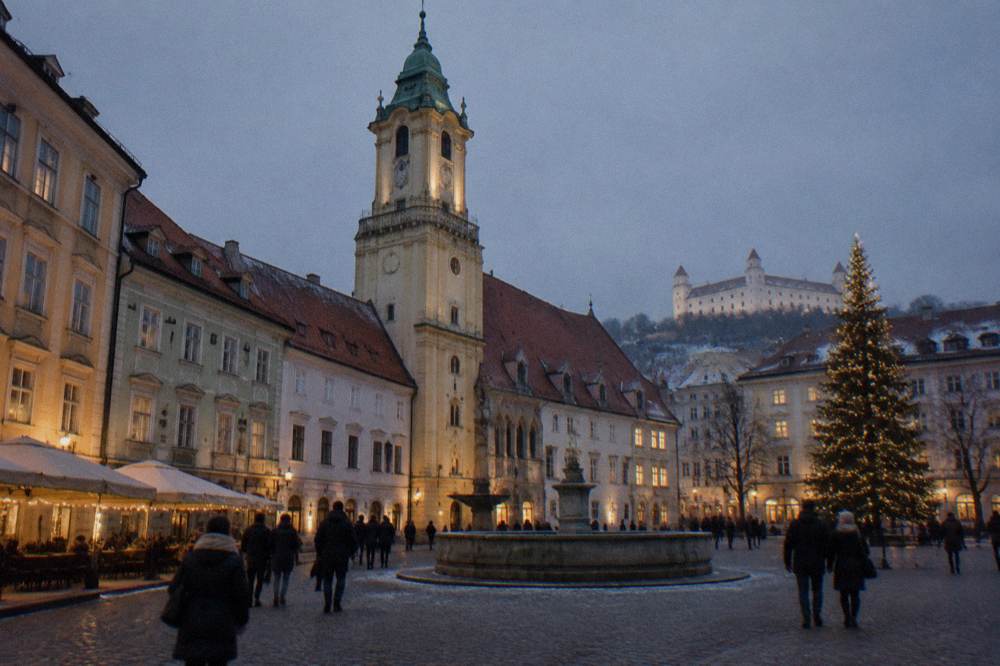
The Christmas market dates are the other seasonal trap. The main market on Hlavné námestie and Hviezdoslavovo námestie runs 26 November 2026 to 3 January 2027, not ending in the days before Christmas Eve as many short summaries claim, and it closes only on 24 and 25 December. The Christmas market guide has the detail.
How Do Day Trips Fit Around A Bratislava Stay?
Bratislava works as a base because its rail and road links are short: Vienna is 56 minutes away on the hourly REX8 at 12.70 EUR one-way, the Small Carpathian wine villages sit on the city's doorstep, and long day tours reach as far as Orava Castle and the Demanovska cave system in northern Slovakia in a single outing booked through an operator.
The Vienna link alone justifies the base strategy, and the Vienna day trip guide covers it. For the northern Slovakia route, an organised day trip handles the distance and the driving: the Demanovska Cave and Orava Castle day trip pairs two of the country's headline sights in one departure, and live pricing and times sit on Check availability. The castle-and-city walks below suit the days spent in Bratislava itself.
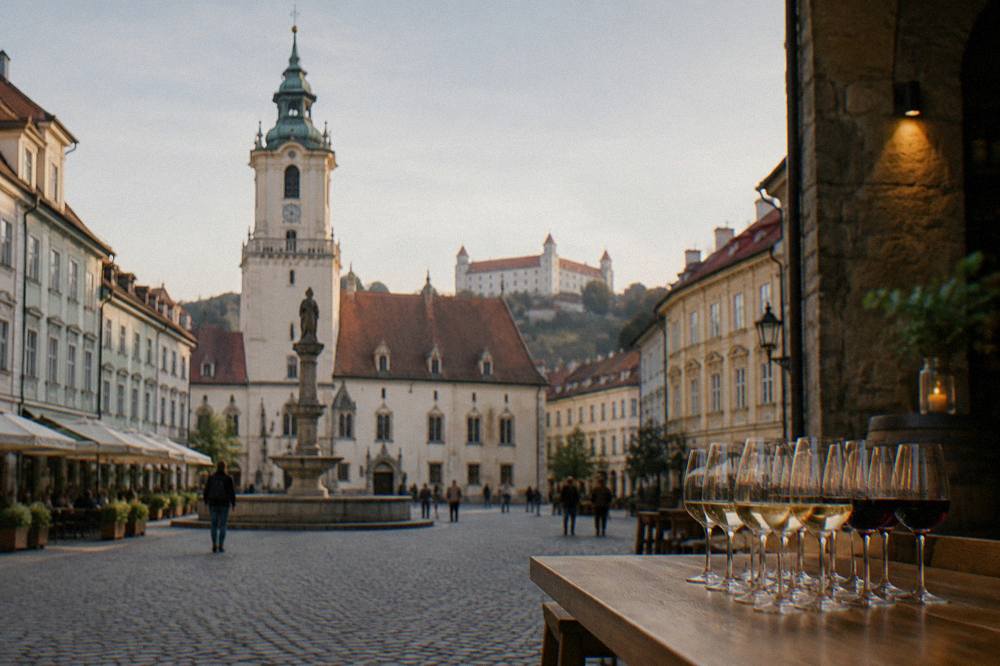
The wine country east of the city is the third classic direction, and St Martin's young wine traditionally appears from 11 November each year, served in venues across the region, as reported by local wine calendars. In late November the Small Carpathian wine route's open-cellars weekend normally follows, though the 2026 edition's dates are unconfirmed on the route's own site, so check before booking around it. The Slovak wine guide and the Small Carpathians wine route guide carry the region in depth.
Common Questions About Bratislava Practical Facts
Is Bratislava on Central European Time?
Yes. Bratislava keeps UTC+1 from late October to late March and UTC+2 in summer, changing clocks on the last Sunday of March and the last Sunday of October, the standard European Union arrangement.
Do I need Slovak crowns or euros in Bratislava?
Euros only. Slovakia adopted the euro on 1 January 2009, and every local price quoted on this site, from the 1.20 EUR tram single to the 3.50 EUR Old Town tourist tax, is a euro figure.
Is Bratislava tap water safe to drink?
Yes. The city's water company supplies groundwater that is only disinfected, and its published monitoring shows compliance with the Ministry of Health Decree in force.
What is the emergency number in Bratislava?
Dial 112 for any emergency. The direct lines are 150 for fire, 155 for ambulance, 158 for police and 159 for municipal police.
How much is the tourist tax in Bratislava?
3.50 EUR per person per night in the Old Town district of Staré Mesto and 3.00 EUR elsewhere, capped at 60 nights per taxpayer per year, a rate in force since 1 July 2023.
Is Bratislava expensive for transport?
No. A 30-minute paper single in the city zones costs 1.20 EUR, the eTicket version 1.09 EUR, and a 24-hour paper day ticket 5.40 EUR, per the IDS BK fare table in force since 1 June 2025.
The numbers on this page are the ones that survive year to year with only small revisions, and the Bratislava Travel Guide carries the rest of the destination, sight by sight.